

Crafting a Gateway to the Future —The Beauty of Solid Wood and Wajima’s Path Forward
四十沢 宏治
Koji Aizawa

Wajima [Ishikawa]
Koji Aizawa
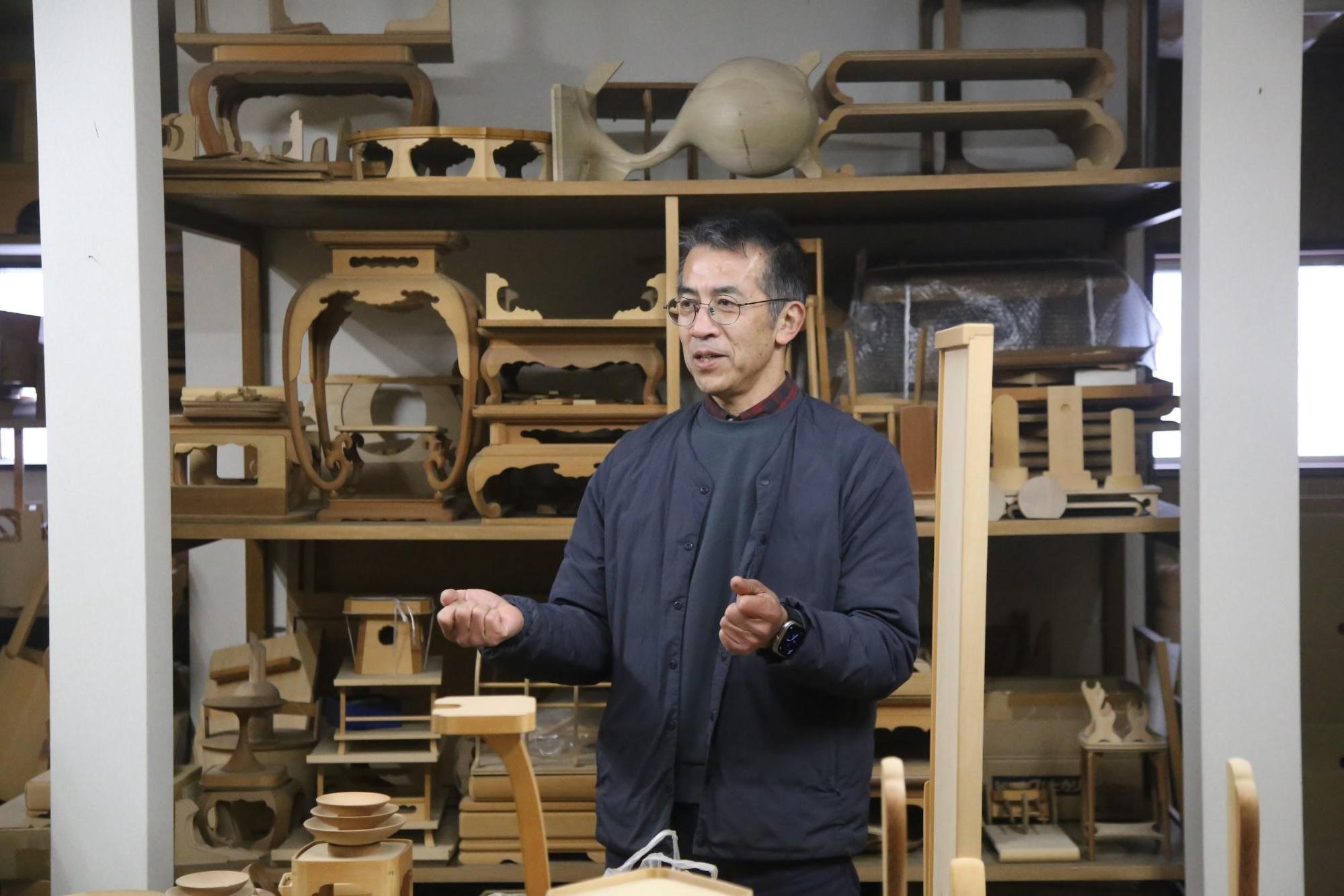
Second-generation head of Aizawa Mokuzai Kogei, a woodworking studio in Wajima. Founded in 1947 shortly after World War II, the studio has long supported Wajima lacquerware by producing kiji—the wooden bases that form the foundation of the craft. After graduating from university, Aizawa worked for an electronics manufacturer before returning to the family business in his second year. Centering on highly precise machining and meticulous hand-finishing, he began developing and selling original products that highlight the natural appeal of solid wood. In 2019, branding director Masanori Oji joined the team, marking the start of full-scale brand development. In 2023, Aizawa opened Factory’s Gallery, an on-site gallery and shop attached to the workshop, as a new hub to draw people in.
Wajima lacquerware is a craft sustained by many artisans working in division of labor. The very first—and essential—step is kiji: creating the wooden form that becomes the vessel.
Founded soon after the war, Aizawa Mokuzai Kogei has supported Wajima’s kiji-making for decades. Today, however, the studio is moving beyond “work before the lacquer,” creating products that convey the inherent beauty of wood itself, as well as small “drops” that reconnect post-earthquake Wajima with people near and far. We spoke at length with second-generation craftsman Koji Aizawa about the studio’s origins, the idea of the “beauty of solid wood,” and the future of Wajima.
The Path of Aizawa Mokuzai Kogei: Supporting Wajima as a Kijishi
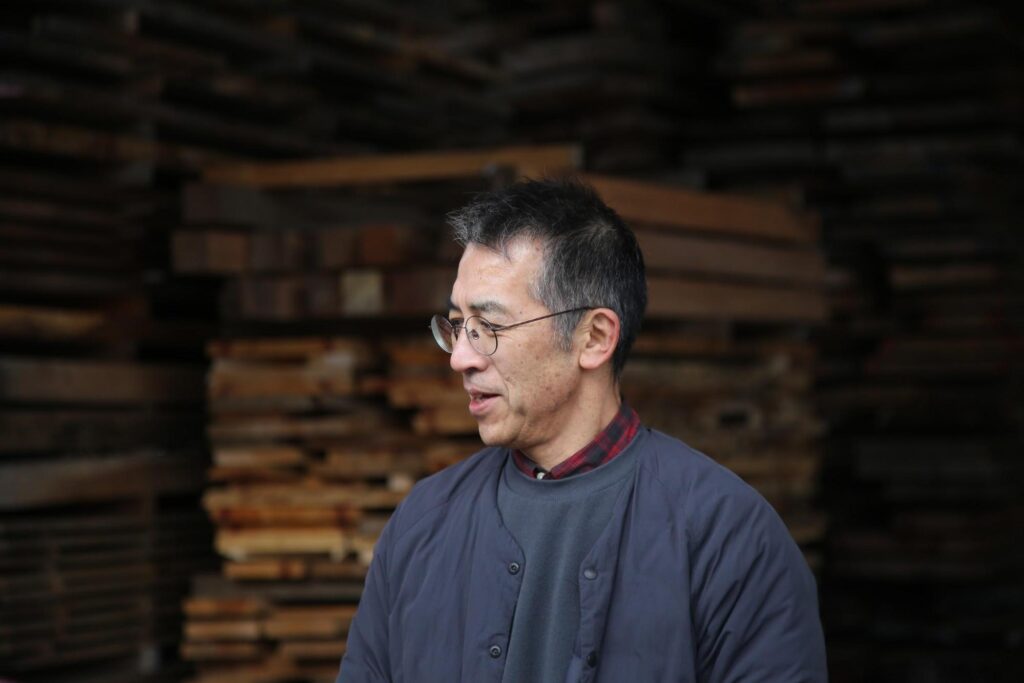
“I’m the second generation,” Aizawa begins, carefully explaining his relationship with the family trade.
As the eldest son—and the only boy—he grew up playing in the workshop, touching wood, and mingling with craftsmen during factory gatherings. The family business was not something “special,” but simply an extension of everyday life.
After university, Aizawa joined an electronics manufacturer. He chose it, he says, because it was “a company that makes things.” His interest in manufacturing had naturally stayed with him.
The turning point came when he asked his father what he intended for the future. The reply: “You can do whatever you want for two or three years.” In that moment, Aizawa realized—perhaps for the first time—that his father hoped he would eventually take over. In his second year as a company employee, he was told, “It’s about time you came back.”
“I had always assumed I would,” Aizawa recalls. “I’d helped out since I was little and had been around wood all my life. I liked making things.” And so he chose to return home.
Aizawa Mokuzai Kogei was founded in 1947. The first generation entered the woodworking world young, but rather than stay long under others, he struck out on his own—perhaps, Aizawa says, because he resisted working for someone else. The starting point was sashimono, traditional Wajima joinery.
Notably, his father was among the first in Wajima to introduce motorized machinery. In an era dominated by handwork, this mechanization was so advanced that other kijishi would bring their own pieces and ask him to shape them. Aizawa calls this spirit “forward-looking”—a mindset of rationalization and adopting new tools that continues in the studio today.
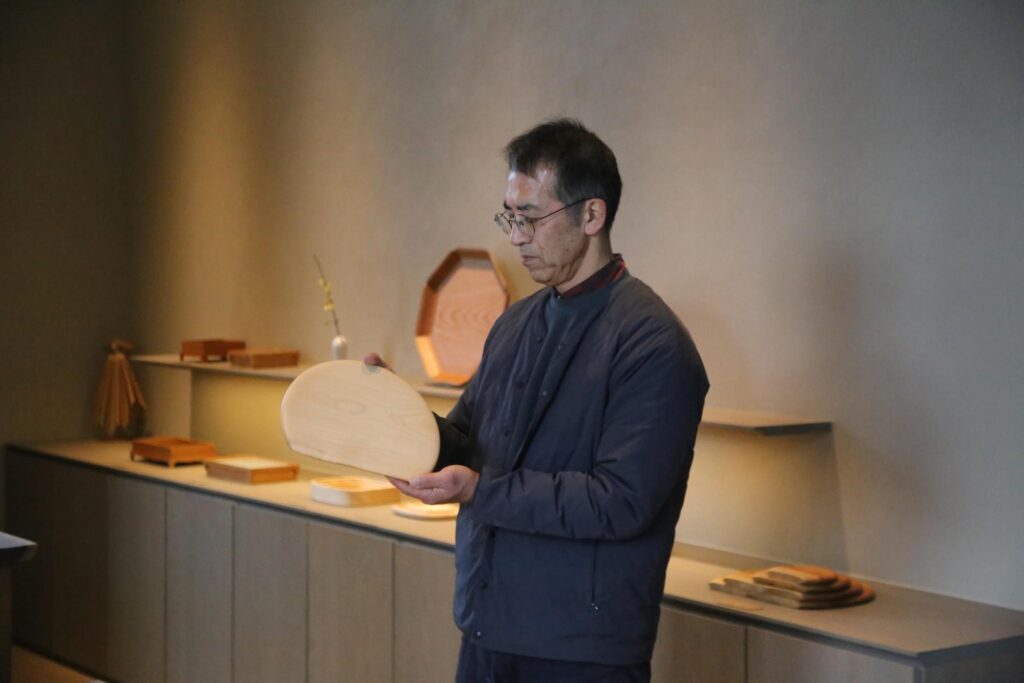
From this history as a kijishi, Aizawa next turned to a new question: the beauty of wood itself.
He is careful to unpack a common misconception—that he simply “makes uncoated products.” Wajima lacquerware is produced through specialized processes: repeated lacquering, decoration, and finishing. Kiji, while fundamental, has long existed as an independent step, separate from manufacturing and sales of the final lacquerware. Aizawa Mokuzai Kogei had, for many years, continued doing “the work up to the point of lacquering.”
Around twenty years ago, however, Aizawa began to feel a growing doubt.
“Wood is already beautiful as it is.” Yet once it becomes Wajima lacquerware, the grain disappears entirely. He wanted more people to know the beauty of bare wood.
His first attempt was fuki-urushi, wiping lacquer into the surface—a local technique. But the result was brownish, and while the grain was visible, it felt “too Japanese” for everyday life.
The real shift came a little over a decade ago, when his wife tried applying natural oils such as walnut oil to the kiji.
“This is cute,” he remembers thinking. That intuition set the direction. A shop in nearby Nanao began carrying the pieces, and little by little they spread. It was the moment when changes in how people live aligned with the maker’s own sense of “what I want to use.”
“The Beauty of Solid Wood,” Born from Wajima
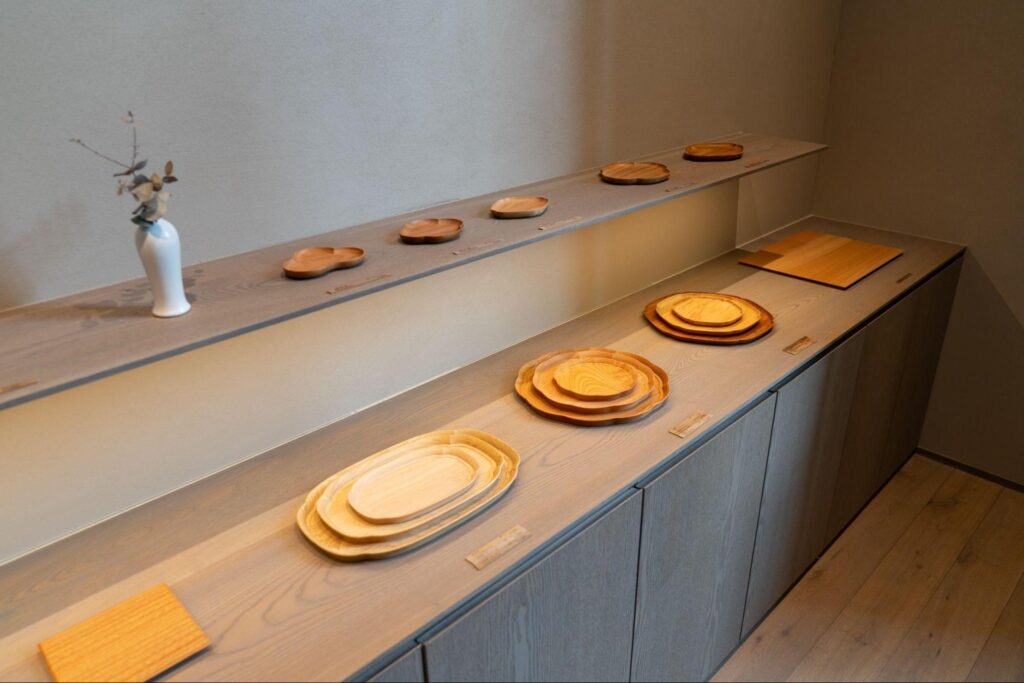
The phrase Aizawa champions is “the beauty of solid wood.”
Because he loves wood and has spent so much time with it, he wants his lineup to fully draw out the appeal of solid timber. Some pieces are carved from a single block; others are laminated to create volume. What they share is a desire for users to feel not just the form, but the amount of material—the value of the tree behind it.
To make a tray 30 centimeters in diameter, for example, requires a very large tree. The beauty of the shape carries with it the accumulated time embodied in the material itself.
Material choices are also clear: his original brand uses hardwoods—dense, beautifully grained, and durable. At the same time, Aizawa acknowledges a hard truth: systems for sustainably growing hardwoods are still insufficient. “In a sense, we’re taking wealth from the mountains,” he says. “I don’t want to waste it.” This awareness leads directly to ideas about using every part of the material to its fullest.
That way of thinking extends beyond wood to Wajima itself.
After the earthquake, many reconstruction workers and volunteers came to Wajima, sometimes stopping by the workshop. A comment he heard repeatedly was, “I want to buy something to take home from Wajima, but there’s nothing I can buy.”
“They end up buying something in Kanazawa.” Aizawa found that deeply frustrating.
He wanted something that could embody a connection to Wajima—something people could take home.
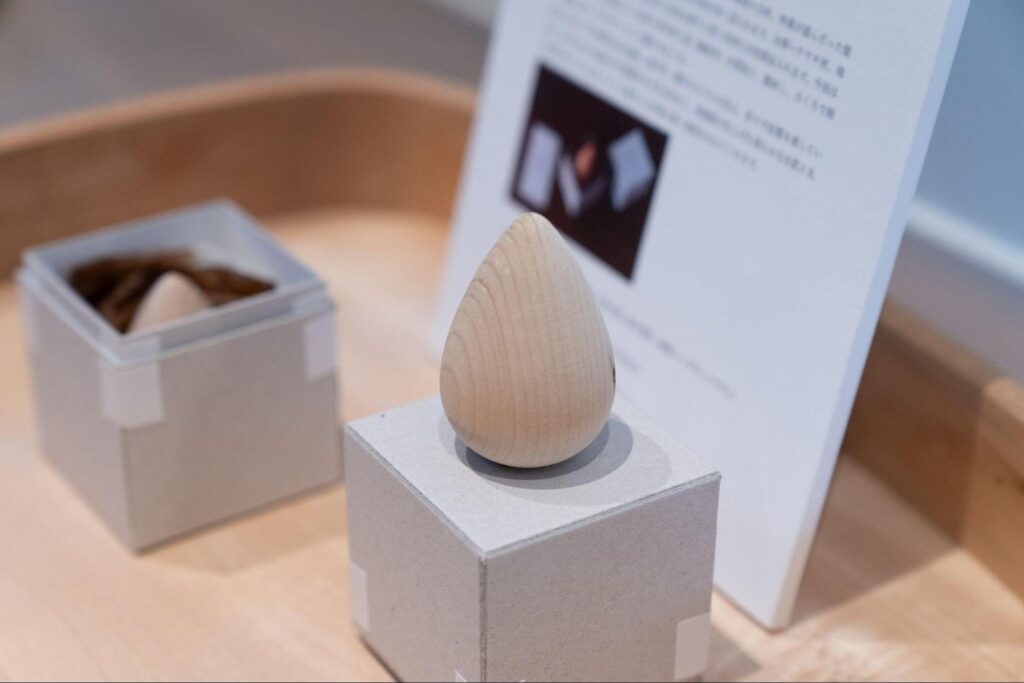
Thus was born “Drops of Wajima.” Designer Masanori Oji conceived the droplet-shaped object, while designers in his network helped refine the packaging and inserts.
A key feature is the small bookmark included with each piece. On it, Aizawa writes things like “places I want you to visit,” “recommended workshops,” or notes about the land and nature—almost like a fortune slip. He hopes buyers will think, “Someday, I’ll go,” and return to Wajima.
Objects that connect people and share memories—that wish is embedded in each drop. In fact, there have been cases where people who had left Wajima found the piece, bought it, and reconnected. “That’s the power of a product,” Aizawa says quietly.
Technique as a Tool, Values as the Core
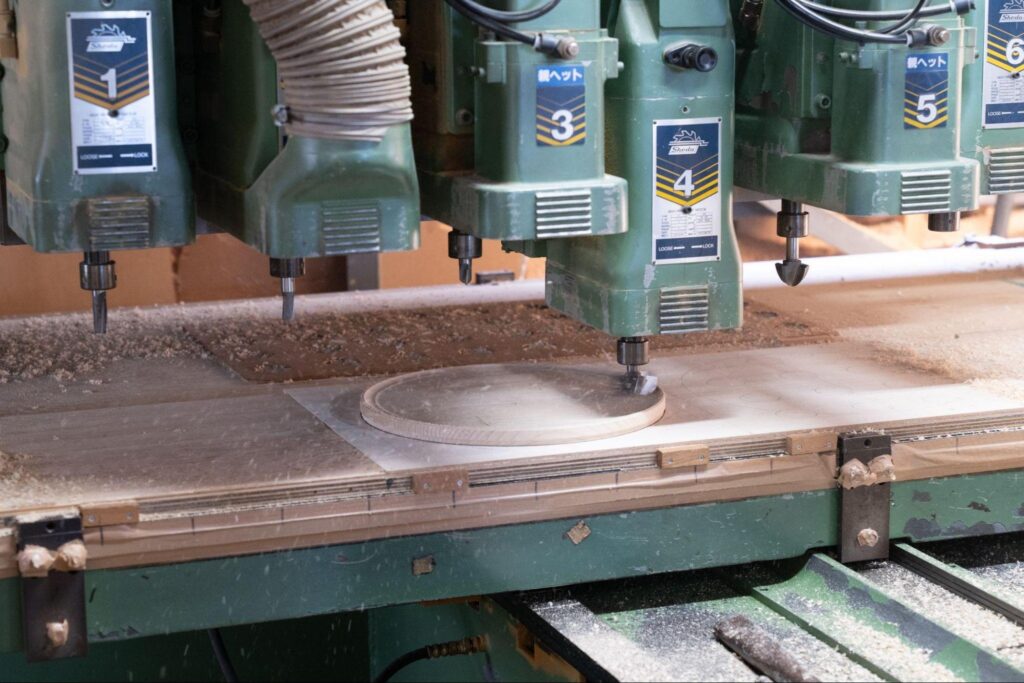
The finish of Aizawa Mokuzai Kogei is supported by a balance of machine processing and handwork. But Aizawa speaks not in terms of technical bravado, but of values.
“Machines are just tools. It’s about how you use them.” Depending on the order, machines can be more efficient—or less. Wajima work is often small-lot and multi-variety, requiring the process to be reconfigured each time.
Above all, he emphasizes polishing.
“Anyone can make the shape. But the final polish depends on the image of completion the person holds.” Care shows—or doesn’t—based on values. The workshop is, by his own admission, strict about this final step. It is what makes the beauty of solid wood possible.
The children’s tableware series “ara!” also reflects this thinking. Young children have weak grips, so handles are helpful—but as they grow, those handles become obstacles, and the pieces stop being used. Letting a memory lose its role feels wasteful.
So the handles can later be shaved off, transforming the piece into a form usable for years.
“You can’t do this with ceramics or plastic. You can because it’s wood.” It’s a product that turns material properties into extended lifespan.
This mindset is gradually expanding beyond the workshop.
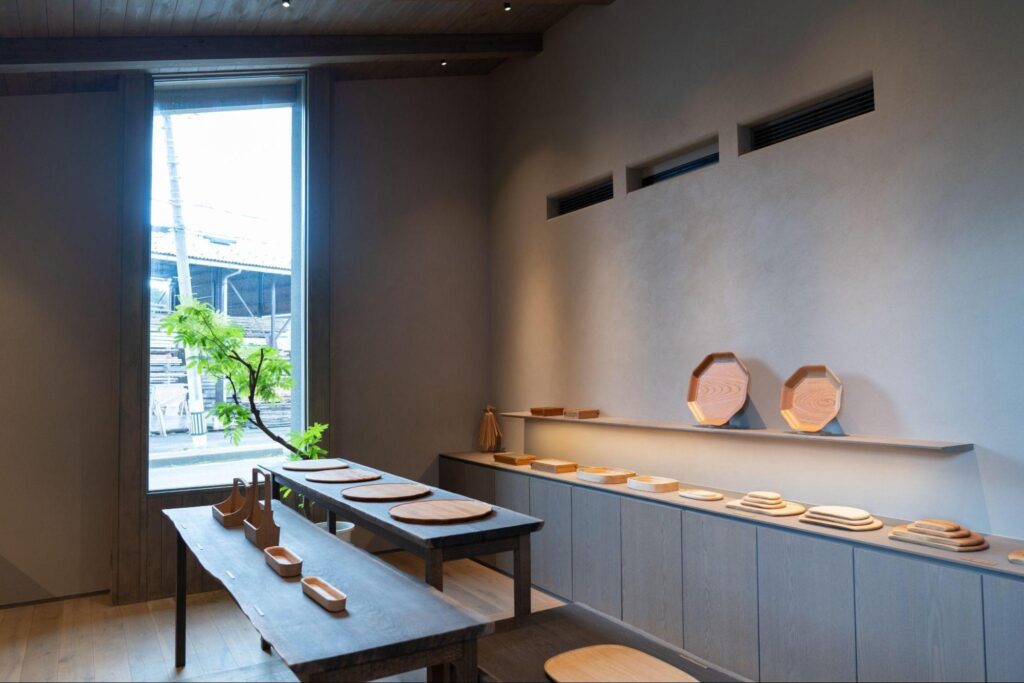
In 2023, Aizawa opened Factory’s Gallery, combining a shop with a multipurpose salon. The original plan was to host workshops and events to draw people in. About two months after opening, however, the earthquake struck, and workshops have yet to begin.
Still, events continue: tea gatherings, craft beer and food events, sessions to blend and create one’s own scent. Linked with new shops and people emerging in Wajima, the workshop is beginning to function as a community space.
Recently, Aizawa has also stepped tentatively into tourism, asking, “How do we bring people to Wajima?” Partnering with LIVE DESIGN SCHOOL, he helped test a tour program set in Wajima. It went beyond sightseeing, incorporating daily reflections, proposals, and final presentations.
“What comes next? Do we turn it into tours, or build lodging?” he asks. Collaboration across fields will be necessary. The discussion continues.
After the earthquake, many craftsmen temporarily left Wajima. A LINE group was created to coordinate their return for work, and many did come back—but over time, some left for good. The shortage of artisans continues, and sometimes people leave before there’s time to teach them properly.
“You can’t learn without work,” Aizawa says. “You learn by working.”
He has been searching for a successor for over ten years. Because he’s open to candidates beyond family, he won’t decide lightly. At the same time, connections with design schools and others are creating new possibilities. From that widening circle, he hopes to meet the right person.
What Does He Want to Pass on to the Future?
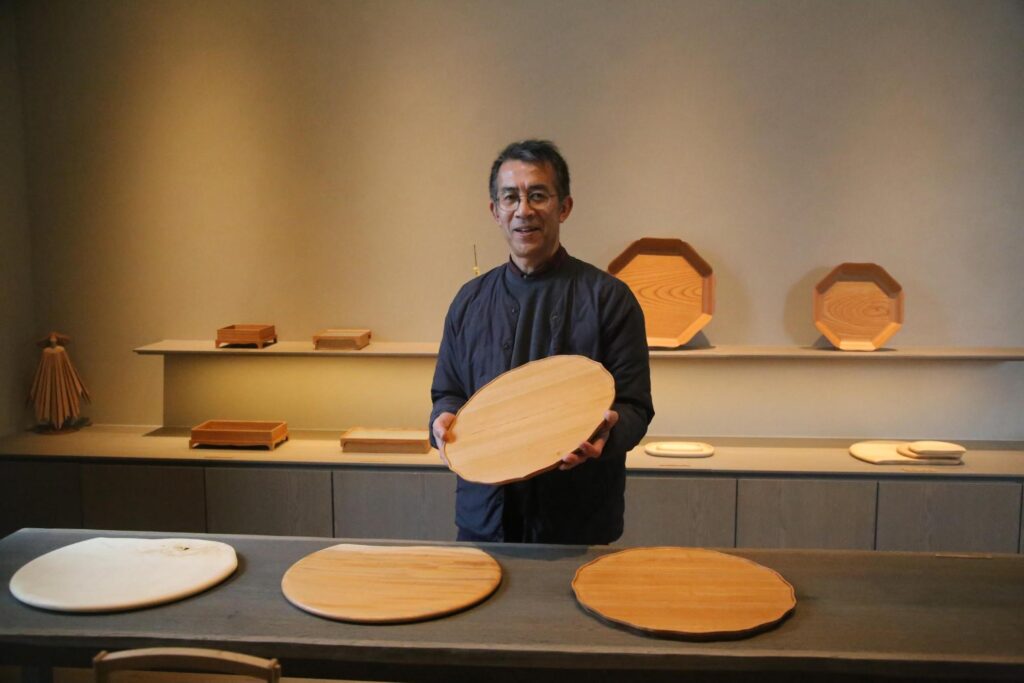
“Looking at it calms you. Touching it feels good. It relaxes you. There’s even a scent.”
In a stressful age, bringing such things into daily life can loosen the heart, make meals more enjoyable, and enrich living.
What Aizawa Mokuzai Kogei hopes to carry forward is not only the techniques of a kijishi, but the comfort that comes from touching and using wood over time—and a way of life that allows people to feel its value.
To experience the beauty of solid wood in everyday life. To let vessels become a starting point for connections between people, and between Wajima and the wider world.
Aizawa believes that this accumulation of small connections is the shape of the future he wants to hand to the next generation.