Carrying 400+ Years of Culture Forward in a Hot-Spring Town:The World of the Maehata Family—Artisans and Tea Practitioners
前端春斉
Shunsai Maehata

Ishikawa []
Shunsai Maehata
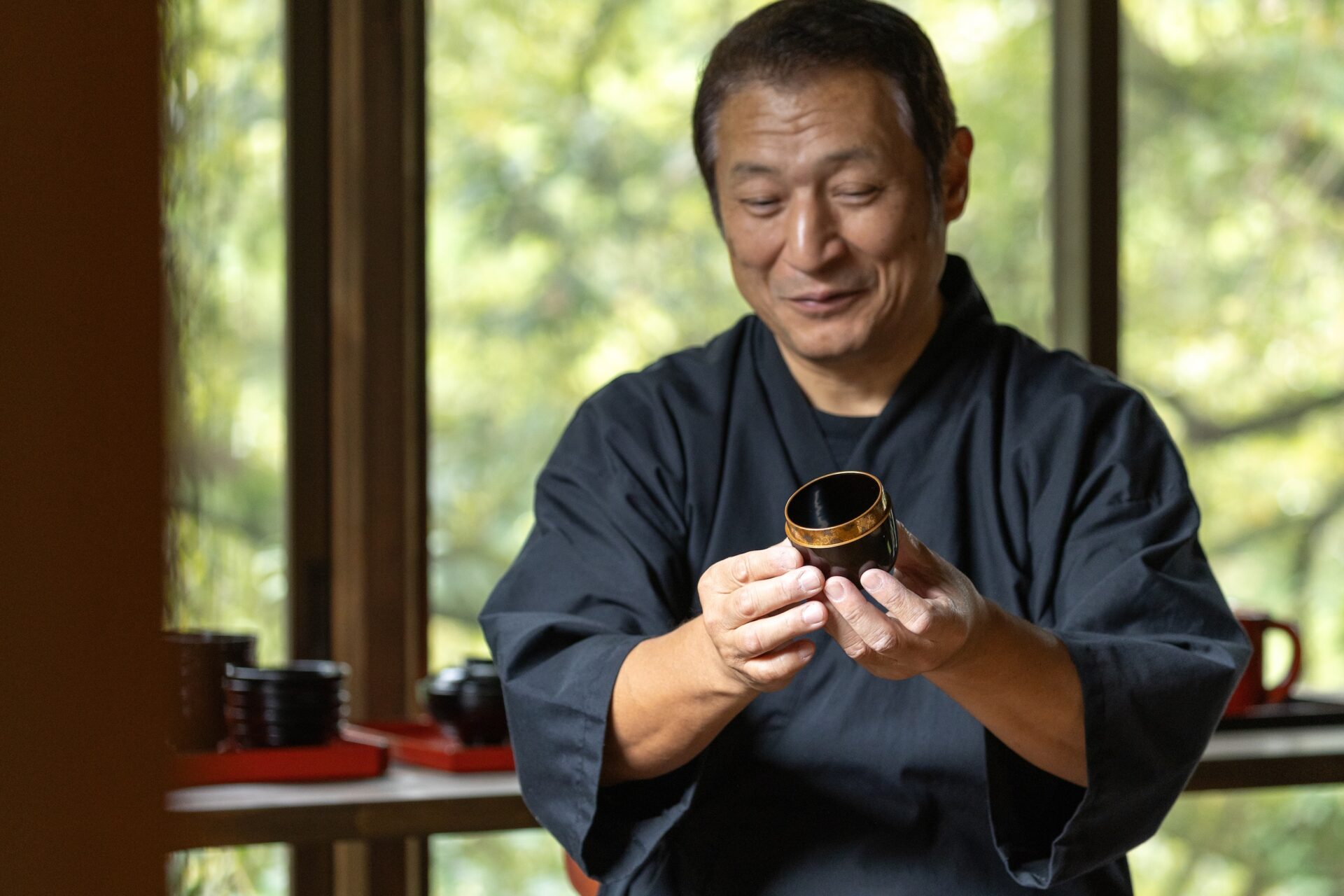
Born in 1964 in Yamanaka Onsen, Kaga City, Ishikawa Prefecture. He is an eighth-generation successor of the Maehata family, renowned for traditional lacquer artistry. In 1985, he assumed the name of the third-generation Shunsai Maehata, and trained under his father as well as Yasushiro Yoshinari, studying lacquer art and Kaga maki-e techniques.
His works are known for their luxurious yet fresh expressions incorporating refined designs. He also developed “Toshitsu,” a new technique that combines ceramics and lacquer. Centering his practice on tea utensils, he is highly regarded as a contemporary tea-ceremony utensil artist, while also teaching maki-e techniques to others.
Yamanaka Onsen in Kaga City, Ishikawa Prefecture. With a history of more than 400 years, Yamanaka lacquerware stands as one of Japan’s emblematic traditional crafts. Nurtured by the climate and culture of this hot-spring town, the lacquerware tradition still thrives today through the hands of local artisans.
We spoke with Shunsai Maehata—an artisan certified in lacquer craftsmanship—about his thoughts on making lacquerware, his new challenges, and his deep ties to the community.
A Lineage Rooted in the Feudal Era—History and the Family Trade
Located in Kaga City, Ishikawa Prefecture, Yamanaka Onsen is known as one of Hokuriku’s leading hot-spring destinations. Its history reaches back to the Nara period, with more than 1,300 years since its founding. Visitors are drawn to the town’s scenery shaped by the changing seasons, and to the nostalgic atmosphere that lingers throughout the streets.
Yamanaka is also a region where traditional crafts have taken deep root. Yamanaka lacquerware and Kutani ware—both representative of Japanese craftsmanship—were born and fostered here.
“The workshop was incorporated during my father’s generation, but our family history goes back to the era of the Daishoji Domain,” Maehata says. “Our ancestors supported the region as samurai, and in my great-grandfather’s time, the family ran a diverse range of businesses—mining, forestry, agriculture, and more. My great-grandfather was active in the birthplace of Kutani ware, and there are even records connected to a memorial for Saijiro Goto.
“But the Great Depression caused the mining business to decline, and our family trade reached a turning point. After that, my grandfather focused on wood-base turning and lacquerware production here in Yamanaka Onsen. In my father’s time, business expanded with clients in Kyoto and Tokyo, and the workshop grew into one that trained many apprentices. I’ve been inheriting that flow little by little.”
In the history Maehata describes, the deep ties between his family and the region are unmistakable. Behind the continuity of craft and culture—carried forward through shifting eras—lies a great deal of trial, error, and effort.
Lacquerware Making Through Changing Times
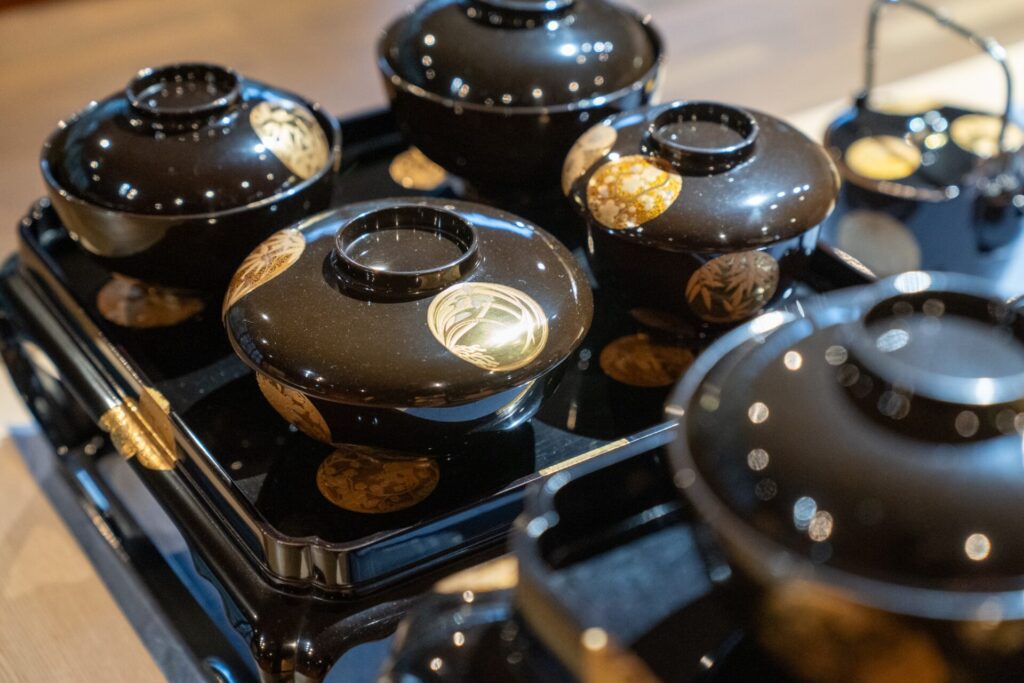
“During Japan’s postwar high-growth period, demand for lacquerware increased dramatically. Tea utensils in particular were in high demand, and my father produced many works. The workshop was always lively, with artisans and apprentices constantly coming and going,” Maehata recalls.
At the same time, changes in society steadily affected the lacquerware industry.
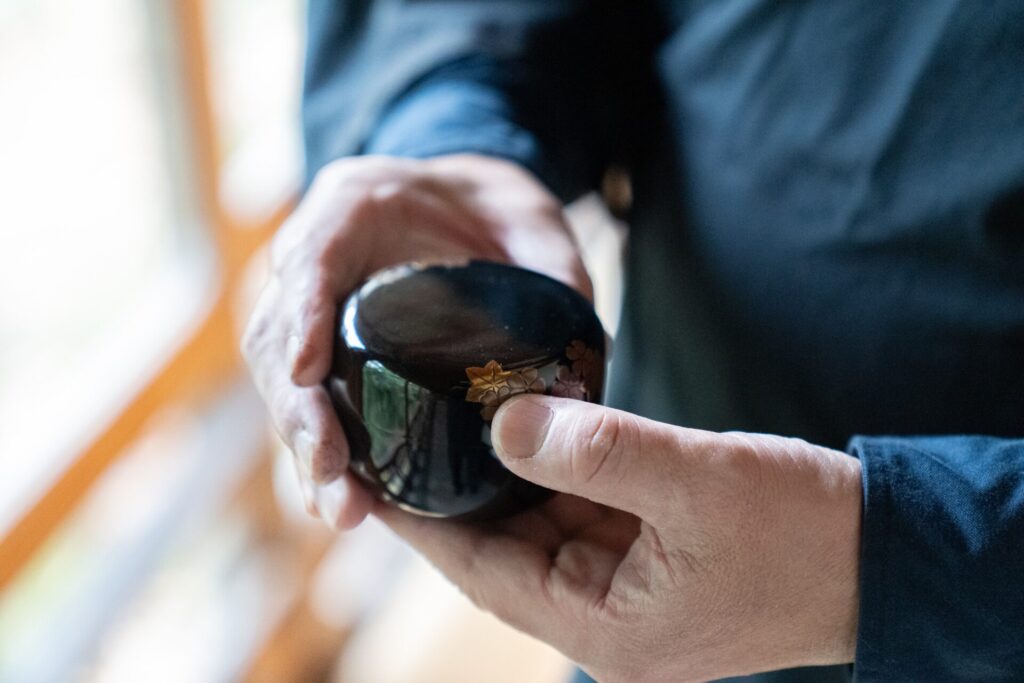
“After the bubble economy burst, the economy stagnated. With declining birthrates and an aging population, the market shrank. We managed somehow, but the COVID-19 pandemic brought an even harsher reality. The amount of work dropped sharply, and fewer apprentices and artisans came to the workshop,” he says, speaking candidly about the struggle.
Still, Maehata does not dwell only on the difficult side.
“Our work isn’t simply about making products. The biggest issue for us now is how to connect traditional techniques and culture to the next generation,” he says.
From postwar prosperity to today’s challenges, the history of lacquerware has moved through large waves. Yet in Maehata’s words, one senses a forward-looking stance: while inheriting what his father built, he continues to explore new designs for the future.
The Spirit of Lacquer Art Reflected in Presentation Works
Maehata’s lacquer works have been created as presentation pieces for both the Pope and the Emperor of Japan—testimony to their high level of technique and artistry. Such works not only symbolize Japanese traditional craftsmanship, but also serve as meaningful vehicles for cultural exchange and the use of regional resources.
The piece presented to the Pope was commissioned through the Mushakoji Senke school of tea. It was a tea utensil created based on an older craft object.
“I used white lacquer to evoke the look of ivory, and applied gold and silver maki-e featuring grapes—an important Christian symbol—along with the ‘IHS’ motif,” Maehata recalls. The utensil is still carefully preserved in the Vatican today, standing as a work that conveyed the cultural value of Japanese lacquer art to the world.
The piece presented to the Emperor was made using pine wood from the dead pine trees of the Numazu Imperial Villa.
“With the intention of making use of local nature, we dried the pine, finished it in a way that brought out the grain, and then added maki-e depicting pine waves and Aka-Fuji (the ‘red Mount Fuji’),” Maehata explains. “Aka-Fuji has long been a symbol of celebration, so it became a piece that wove local nature and culture into one.”
The work was received directly by the Emperor, and later displayed at the Numazu Imperial Villa Memorial Museum.
“Being entrusted with such important work together with my father is something I truly take pride in as a lacquer artist. It made me realize that lacquerware is not merely a craft object—it connects culture, history, and people’s feelings,” Maehata says. Those experiences deepened his sense of what lacquer art can carry into the future.
Childhood Memories—The Starting Point as an Artisan
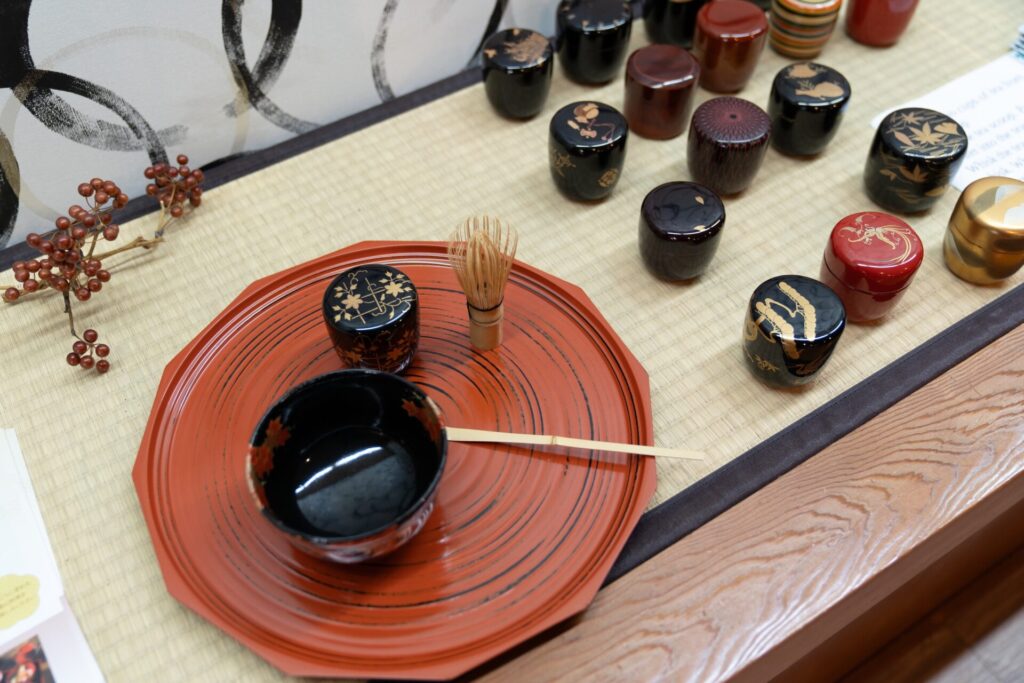
“Our workshop and our home were the same place, so my father’s workspace was part of everyday life,” Maehata says. “The distinctive scent of lacquer, the sound of wood being carved, and the artisans at work—those were always around. As a child, I would imitate their movements or play with tools.”
One story from around age three remains vivid.
“I accidentally stepped into a lacquer bucket with one foot, and my father panicked and used oil to remove it. Lacquer often causes skin irritation, so he was worried—but I had no reaction at all. Maybe that made me feel, in a way, that I was meant to be connected to lacquer,” he says with a smile.
As he grew older, he became involved more seriously in lacquerware making while still in high school.
“I learned the basics from my father and the craftsmen at the workshop, and I also studied under a teacher in Kanazawa. He was strict, and kept telling me: ‘Maki-e isn’t just drawing. You must observe real nature carefully and understand its structure accurately.’”
The lesson went beyond simply copying shapes—it cultivated a craftsman’s stance of knowing the real thing and putting soul into the work.
“For example, unless you truly understand how a leaf’s stem emerges or how the veins run, it becomes nothing more than imitation. He trained me thoroughly in those details.”
By observing nature, maki-e gains realism and vitality. That rigorous foundation continues to underpin Maehata’s work today.
“Maki-e isn’t mere decoration. It feels like you’re capturing nature itself inside the surface. What I learned from my teacher lives on in my work.”
Childhood play in the workshop, and the strict training that followed—those experiences formed the origin of Maehata’s sensibility. Each memory seems to have become part of the delicacy and expressive richness present in his works.
Passing Lacquerware Culture to the Next Generation Through Hands-On Experiences
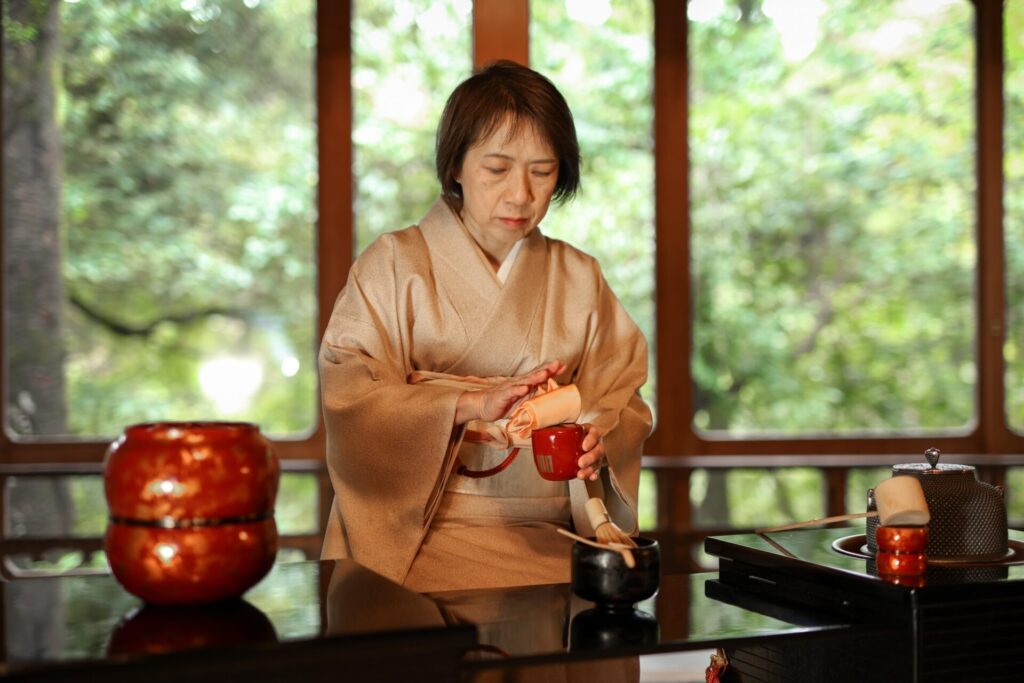
“Mugen-an was established by relocating a residence originally built in 1912 by Yokoyama Akira, from a branch line of the Yokoyama family—retainers of the Maeda family of the Kaga Domain,” Maehata explains. The building originally stood in Kanazawa, and was moved to Yamanaka Onsen to be preserved and used as a base for sharing local culture.
“My father founded Mugen-an as a public foundation about 40 years ago. He strongly felt the need to protect and pass on traditional crafts, so he opened it as a facility for sharing regional culture,” Maehata says.
The samurai-style shoin residence maintains its historical value while serving as a place to communicate Yamanaka Onsen’s culture and traditional crafts.
Mugen-an consists of three main facilities. Among them is the newer “Uruhashi-kan,” which Maehata’s father renovated during the Heisei era.
“We named it after the word ‘uruhashi’—‘beautiful’—which is also said to be connected to the origin of the word ‘urushi’ (lacquer). The first floor is open as a café, where visitors can enjoy coffee or matcha served in Yamanaka lacquerware. The second floor is used as an exhibition space and private dining rooms, and it’s also used for meetings and special exhibitions.”
Mugen-an offers a place where visitors can directly encounter lacquerware culture and deepen their understanding.
“For many overseas visitors, it’s their first time touching lacquerware. We design the experience so they can learn its beauty and value through hands-on encounters. I’d be happy if they feel that lacquerware represents a part of Japanese culture.”
He also emphasizes collaboration with other local resources.
“By combining hot-spring culture, local food culture, and lacquerware, we can communicate the broader appeal of Yamanaka Onsen. For example, at Mugen-an we serve kaiseki cuisine using lacquerware that we produce. The seasonal presentation and the vessels together create a beautiful staging. It becomes a chance for people to feel lacquerware’s charm as tableware—and enjoying the harmony between food and vessels is something unique to lacquerware.”
After the pandemic, Maehata says, he once again felt the importance of protecting local culture.
“Tourism declined, and the whole region was deeply affected. That made me realize how vital it is to keep communicating the region’s appeal. By connecting Yamanaka Onsen’s hot springs, nature, and food culture with lacquerware, I want people to rediscover the value of this place.”
Centered on lacquerware, Maehata’s efforts to draw out the region’s broader appeal—and connect it to the future—extend beyond the boundaries of traditional craft.
What Do You Wish to Pass On to the Future?
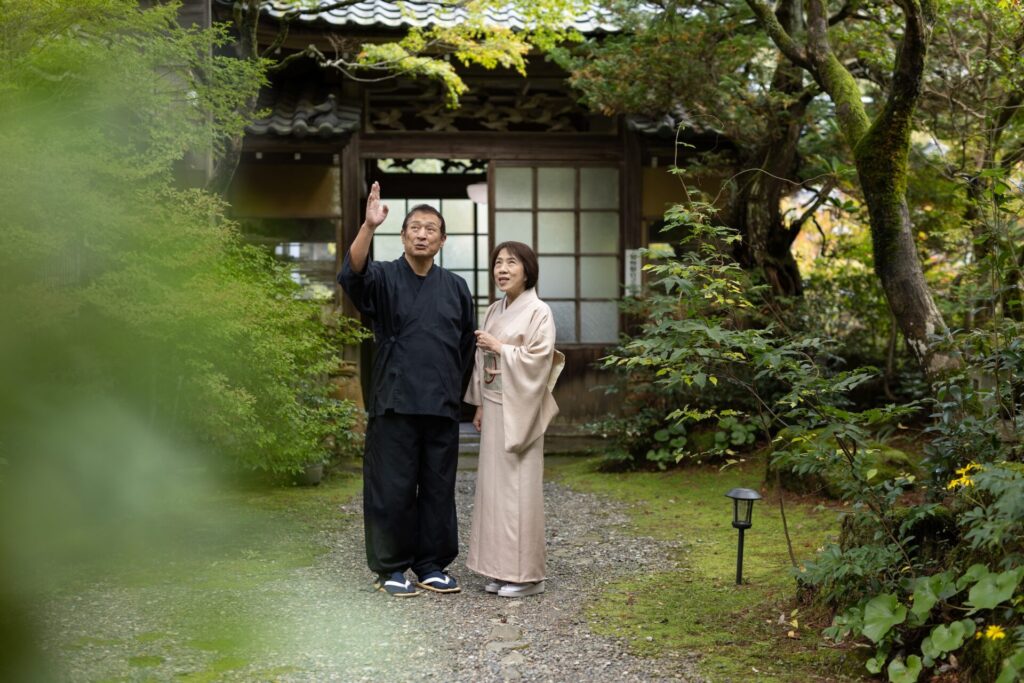
“Ishikawa has traditional crafts such as Yamanaka lacquerware, hot-spring culture, and rich nature,” Maehata says. “With the opening of the Shinkansen, access has improved, so I hope many people will visit. If they can experience the depth of Japan’s traditional culture here, I’d be very happy.”
His words carry not only a message about tourism, but also deep affection for the region’s history and culture. Yamanaka lacquerware is both a representative craft of Yamanaka Onsen and a symbol of the area’s climate and culture itself. His wish for people to experience its appeal comes through strongly.
What Maehata hopes to pass on is not only Yamanaka lacquerware as an object. It is the depth of culture that can only be felt by visiting, touching, using, and experiencing it—along with the background of making itself—handed to the next generation.
In Ishikawa, traditional craft, nature, and hot-spring culture exist in remarkable harmony. In Maehata’s words, one senses both pride in the region and genuine warmth toward those who visit. A trip to Yamanaka Onsen offers a special experience—one that lets people feel the richness of Japanese culture firsthand.