

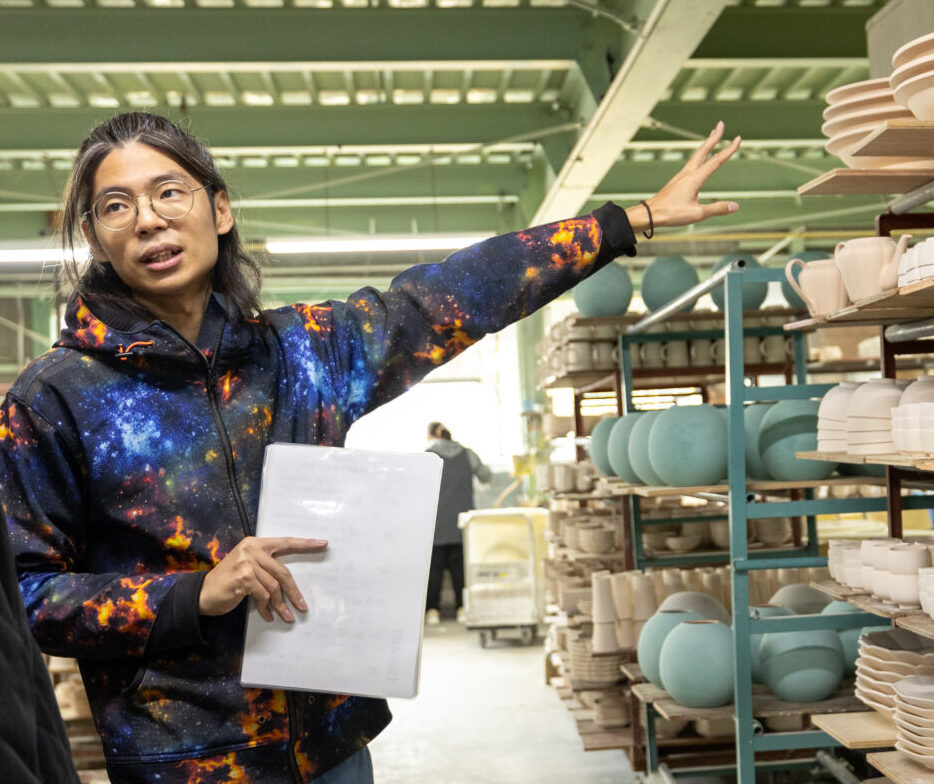
The Japanese Spirit Embodied in White Kutani: tocowa
陳宮吉緯
Miyayoshi Wei Chen

Komatsu [Ishikawa]
Miyayoshi Wei Chen
Born in Taipei, Taiwan. After studying Japanese at a university in Taiwan, he studied abroad at Reitaku University in Chiba Prefecture. Upon graduation, he joined an affiliated public-interest foundation connected to the university, working in the fields of social education and school education. After marriage, he became part of his wife’s family business, Miyayoshi Seitou, where he is now involved in public relations, product development, and tourism initiatives.
Founded in 1972 in Komatsu City, Ishikawa Prefecture, Miyayoshi Seitou is a kiln that specializes in forming the clay bodies used for Kutani ware. Today, the person in charge of guiding visitors through the studio and leading hands-on tours is Miyayoshi Wei Chen, the second generation’s son-in-law.
In a world where the scale of Kutani ware continues to shrink, he has also become a key figure behind tocowa, the company’s own brand—built upon the strengths of a clay-body forming kiln. What does Chen Miyayoshi see as his “role” within a Kutani ware kiln? And what “spirit” lies at the heart of what he does?
What Can We Do—As a Kutani Kiln Today?
Since 1972, Miyayoshi Seitou has been forming clay bodies for Kutani ware in Komatsu City, Ishikawa Prefecture. The kiln is currently led by second-generation owner Katsushige Miyayoshi, supported by the third generation—his son and his son-in-law, Miyayoshi Wei Chen. Though born in Taiwan, Chen Miyayoshi has made his home in Komatsu, working to communicate not only the beauty of Kutani ware, but also the craftsmanship spirit embedded within each piece.
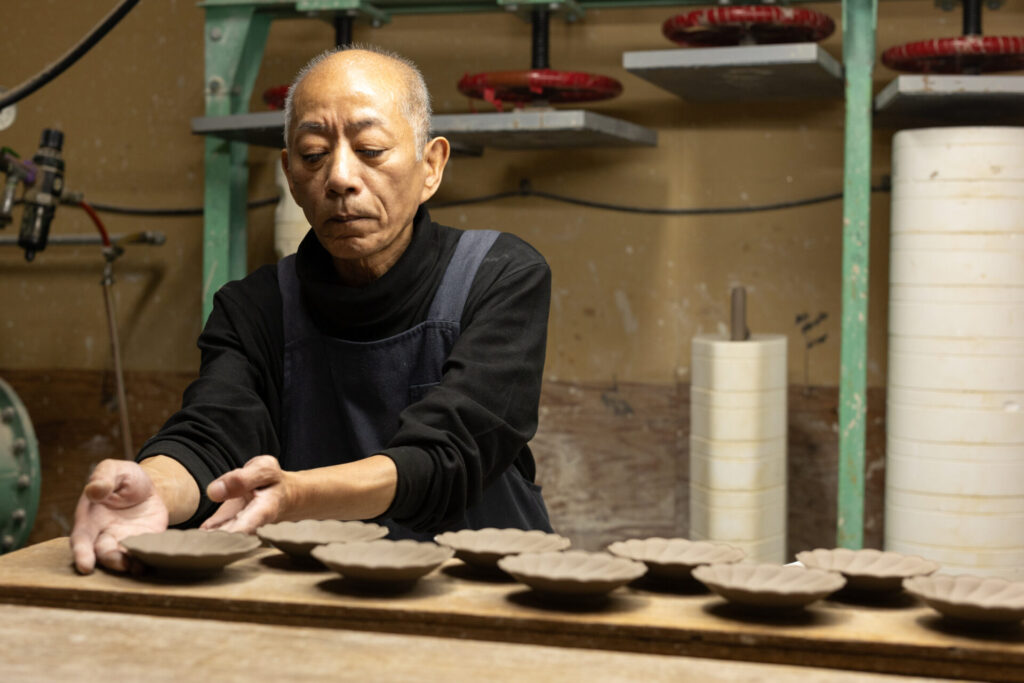
Miyayoshi Seitou is family-run and employs more than 20 staff members. It holds approximately 70% of the share of clay bodies within the Kutani ware production area, making it an indispensable presence for overglaze enamel wholesalers in Komatsu, as well as for Kutani ware artists working across Japan.
In the workshop, clay-body forming is carried out using both machinery—such as roller machines and pressure casting—and handwork tools like wheel throwing and mold pressing. Large-volume orders from major restaurants are produced using machines, while pieces requiring precise specifications from artists are made by hand.
“One distinctive feature of Kutani ware clay bodies is their beautiful, slightly bluish white. That color comes from the raw material known as Hanasaka touseki.”
Just a few minutes’ drive from Miyayoshi Seitou lies Hanasaka Touseki Mountain, where Hanasaka touseki is quarried and processed into clay for forming. Unlike the striking whiteness of Amakusa touseki used for Arita ware, the bluish white tone comes from the higher iron content found in Hanasaka touseki.
It is even said that “without Hanasaka touseki, it cannot be called Kutani ware”—perhaps because that distinctive, bluish white has such a strong appeal.
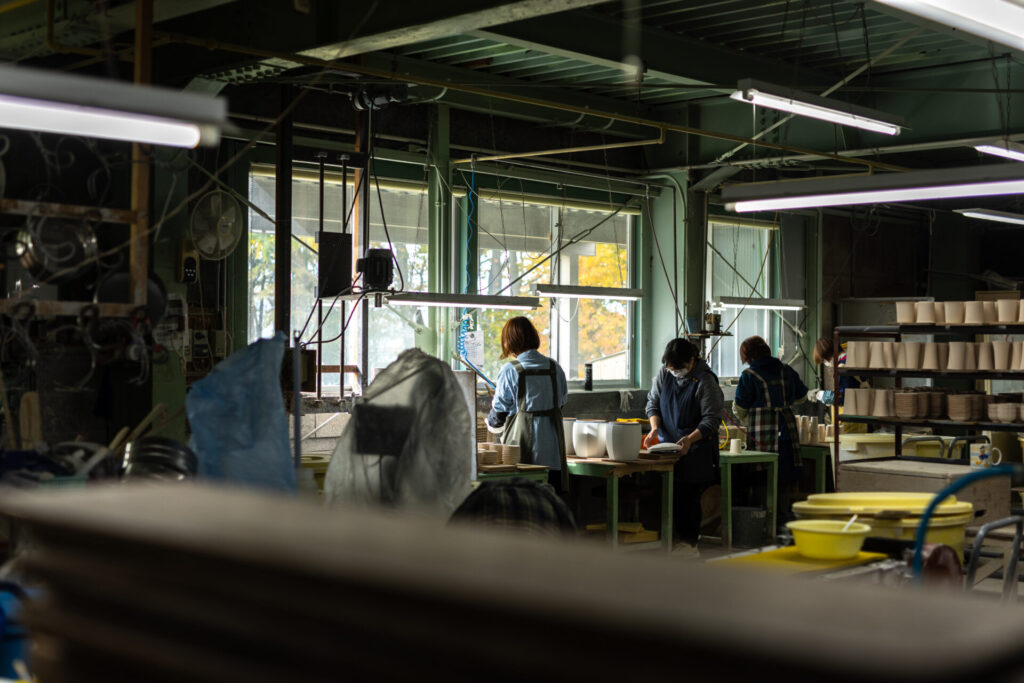
Yet the number of clay-body forming kilns has been steadily declining in recent years.
“There used to be dozens in Komatsu City, but in reality, with a mass-production structure like ours, there are now only two—us and one other. If we were to stop, Kutani ware itself wouldn’t be able to function. As a kiln, we feel the responsibility of continuing to make things every day.”
Chen Miyayoshi says that his father-in-law—the company president—feels this responsibility even more strongly. “We must fulfill our role and contribute to the community,” he says repeatedly, emphasizing the importance of passing Kutani ware on to the next generation.
“When I first joined Miyayoshi Seitou, there was a plan to establish a tourism hub for Kutani ware. The president immediately agreed. At the time, he was also head of the kiln association, so he visited each kiln personally, bowing and asking for their cooperation. But it didn’t go smoothly.”
Many kilns, discouraged by the shrinking industry, were unable to show interest in a new initiative. Still, the president persisted—driven by pride as a kiln owner and a deep commitment to the future of Kutani ware.
“It’s something I could never do,” Chen Miyayoshi says. “It’s truly remarkable.”
Witnessing this determination prompted Chen to reflect on his own role.
A New Challenge for a Kiln: White Kutani, tocowa
Kutani ware has traditionally been produced through a division of labor—clay-body forming at kilns, overglaze enameling at either wholesalers or individual painters, and wholesaling, where the finished painted products are supplied to stores for customers to purchase. Kilns rely on wholesalers for distribution, and pricing authority largely rests with those wholesalers. In extreme cases, a piece purchased from a kiln may be sold at ten or even a hundred times the original price.
Meanwhile, clay-body forming kilns cannot survive unless wholesalers purchase their work. Historically, they had little choice but to accept dictated prices. The powerful wholesalers set the rules, and the kilns follow—the practice has continued for generations. When Chen Miyayoshi first joined Miyayoshi Seitou, the situation was much the same.
“Honestly, it didn’t feel right for our times. I felt that the true value of works created with artisans’ hearts and souls should be communicated properly.”
At the same time, some wholesalers were closing due to a lack of successors—threatening the very means of selling. In response, Chen Miyayoshi, together with his wife and her younger brother, decided to take a new step: delivering their work directly to customers.
“We knew we couldn’t compete through colorful decorations. To make use of what Miyayoshi Seitou does best—clay bodies—we decided to compete with ‘white.’ And we would sell it directly ourselves. That was the beginning of tocowa.”
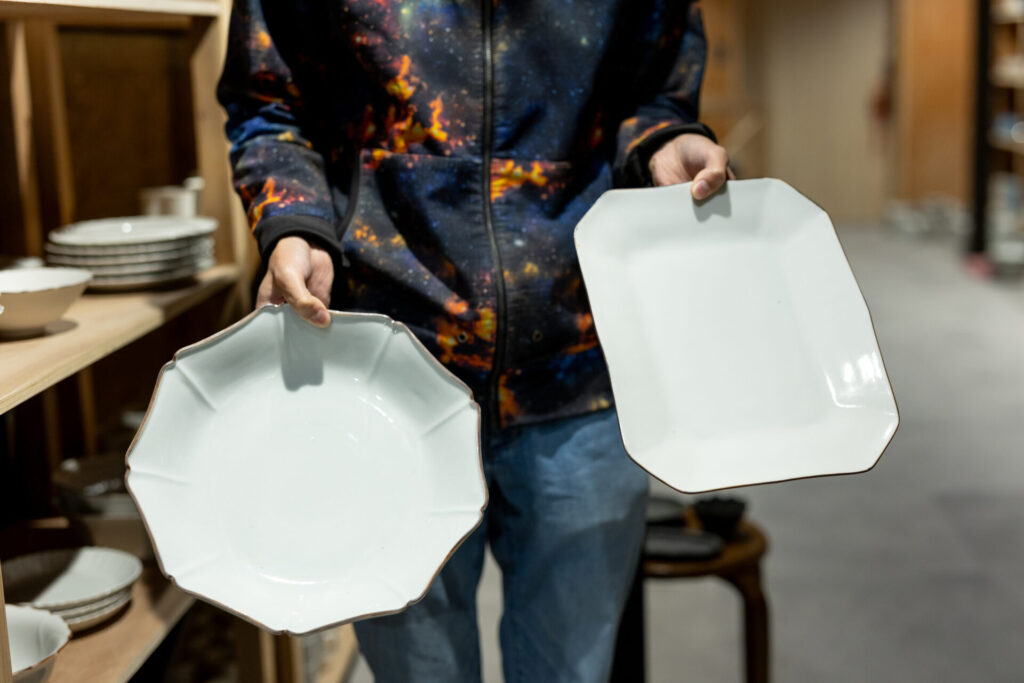
Unified in a bluish white tone, tocowa offers a stark contrast to the ornate, colorful image often associated with Kutani ware. Yet expressing the natural color of Hanasaka touseki is something only a clay-body forming kiln can do.
Simple yet dignified, tocowa has been embraced by people across generations and has come to be known as “White Kutani.”
“There was never a category called ‘White Kutani.’ It was a name that customers naturally began using.”
Named after the Shinto concept of tokowaka—eternal youth and renewal—tocowa represents a declaration by the younger generation: a commitment to convey the true value of craftsmanship directly to customers, while protecting the pride of those who came before.
Some view White Kutani as unconventional.
“That’s probably true,” Chen Miyayoshi says with a smile.
“But if lifestyles change and people seek white pieces, then it’s our role to make them. And all the tradition and techniques inherited as a Kutani ware kiln are fully reflected in tocowa. Kutani ware exists because of its white clay body. Even if the impression is different, it is still Kutani ware.”
Why I Pour My Passion into Kutani Ware
Born and raised in Taiwan, why does Chen Miyayoshi devote himself so deeply to Kutani ware?
After studying Japanese at university in Taiwan, he studied abroad in Chiba Prefecture, continued to graduate school, and later worked for about ten years in social and moral education. Through this experience, he learned to think independently, find answers, and act—realizing that one must build one’s own life.
“When I entered the world of Kutani ware and saw it shrinking, I asked myself how I should face it, and what I should do.”
His background in education shaped his ability to find value and define his role even in difficult circumstances.
Today, Chen Miyayoshi also serves as a guide for studio tours and hands-on programs at Miyayoshi Seitou. What he always conveys is the presence of the artisans.
“Every artisan works with love and prayer, wishing happiness for those who use their pieces. When visitors hear this, they feel more attached to the vessel they chose. I sometimes joke, ‘But don’t treasure it too much, or we won’t be able to sell any more,’ and everyone laughs.”
Throughout the tours, Chen Miyayoshi acts as a connector—linking visitors with artisans, communicating not only the beauty of the pieces, but also the spirit behind them.
What Do You Wish to Pass On to the Future?
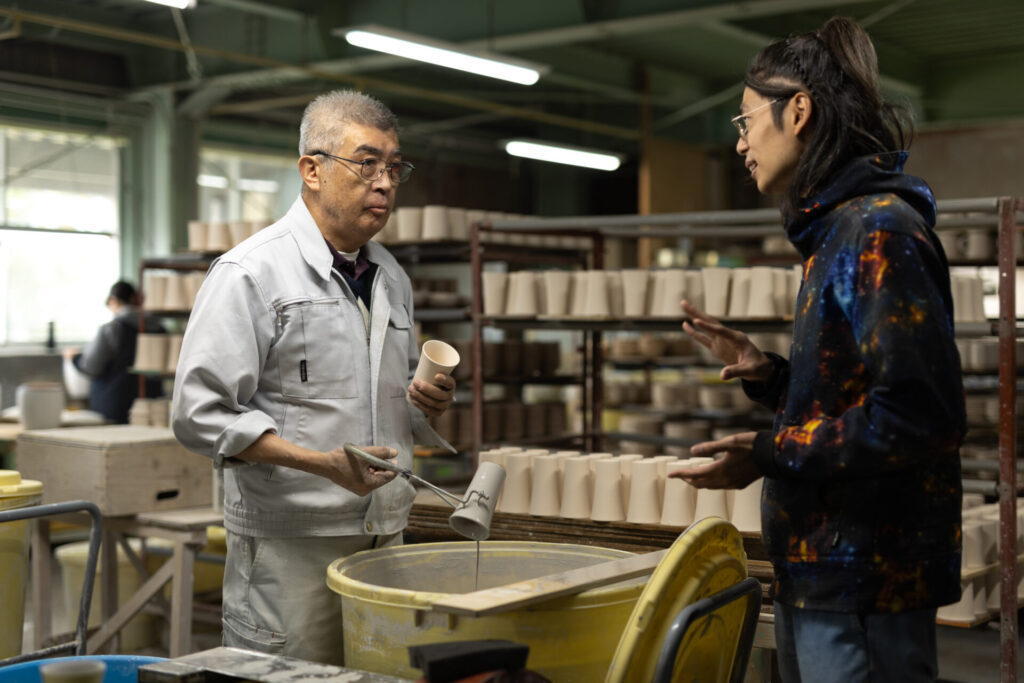
Carrying forward the president’s belief in fulfilling one’s role and contributing to the community, Chen Miyayoshi says he wants to continue sharing Kutani ware with a wider audience. That is why tocowa exists.
“While working in Chiba, I also learned about the Japanese spirit—the way Japanese culture values people and objects. That spirit connects directly to the craftsmanship passed down through Kutani ware.”
Each Kutani ware piece carries the artisans’ prayers and spirit, as well as the hopes of those who bring it into the world.
What Chen Miyayoshi wishes to pass on is not only the vessels themselves, but the craftsmanship spirit—the Japanese spirit of cherishing people, objects, and culture.
Facing one’s role sincerely within the environment one is given—steadily, and sometimes boldly.
Through Chen Miyayoshi’s journey, we are reminded of a spirit that even Japanese people themselves may sometimes forget.