

Blending Lacquerware into Everyday Life—Craftsmanship Rooted in Yamanaka
浅田 明彦
Haruhiko Asada

Kaga [Ishikawa]
Haruhiko Asada
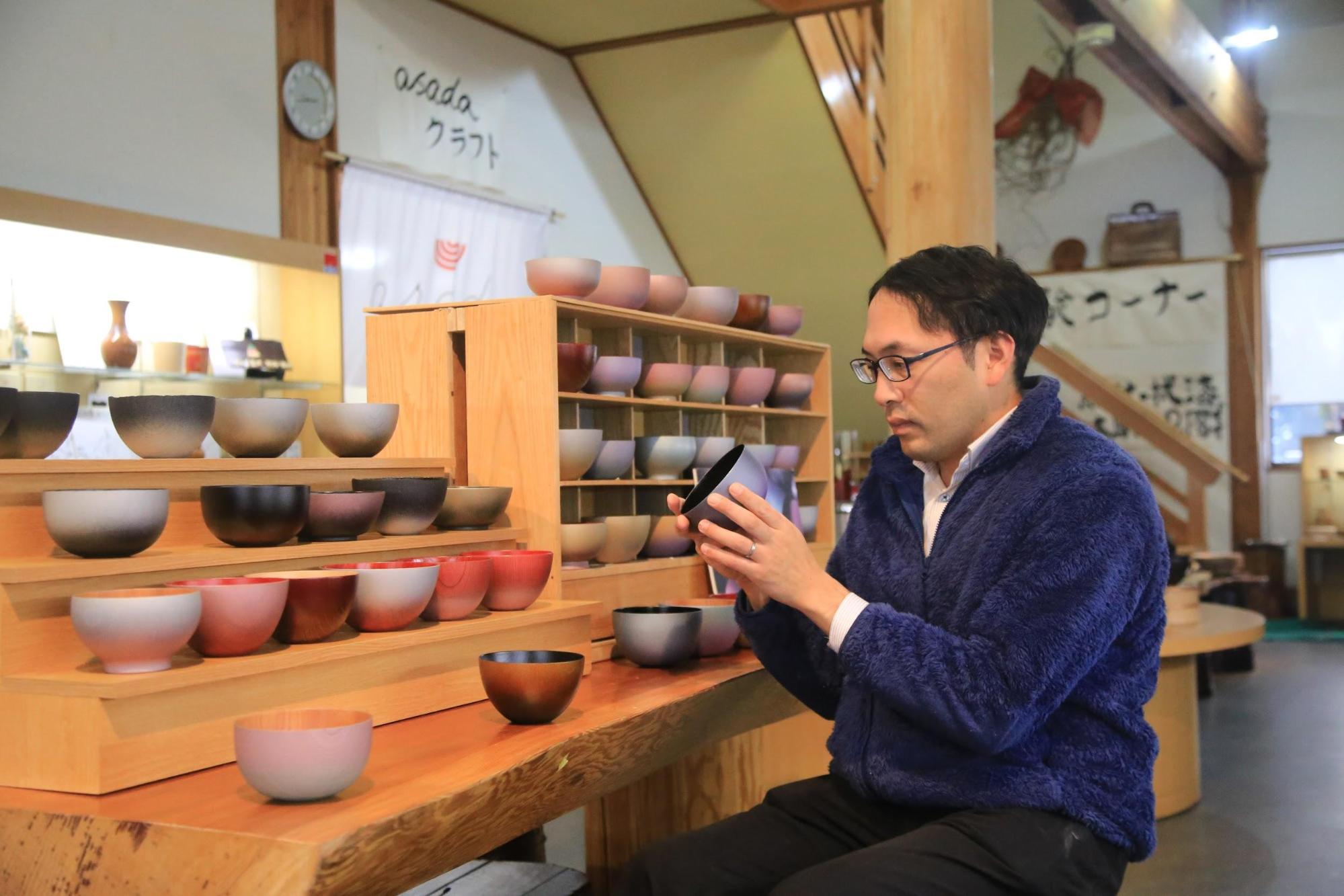
Representative of the lacquerware manufacturer Asada Shikki Kōgei in Yamanaka Onsen, Kaga City, Ishikawa Prefecture. He began to seriously consider taking over the family business after graduating high school, when he followed his father’s advice and enrolled in a vocational school. Centering on product development, sales, and in-store customer interaction, he proposes “Western-style lacquerware for everyday use” as part of modern life.
Lacquerware is often thought of as “something to use on special occasions.” Quietly questioning that assumption is Asada Shikki Kōgei, based in Yamanaka Onsen, Kaga City, Ishikawa Prefecture. Carrying on a family business that began with a kijishi (woodturner) in the Meiji era, Akihiko Asada now oversees everything from product development and sales to customer service and hands-on workshops, connecting Yamanaka lacquerware to contemporary lifestyles. Grounded in the techniques of the production area, his work is shaped by a constant question: who is this for, and how should it be delivered? That commitment defines the craftsmanship of Asada Shikki Kōgei.
Inheriting a Woodturner’s Trade and Delivering Lacquerware as Everyday Tools
The company was founded in the Meiji period, though its beginnings were not in “business” but in the work of a kijishi, a woodturner. It was not a household that had always been devoted solely to lacquerware; rather, from Asada’s grandfather’s generation onward, the family became deeply involved in Yamanaka’s craft.
What Asada heard growing up was that the founding figure trained many people and produced numerous apprentices. Then, during his father’s generation, a major shift occurred.
“My father was from a generation that steered more toward ‘business’ than being purely a craftsman. I think there was a sense that because there were people making the wooden bases, someone needed to develop and expand lacquerware as products.”
Asada’s present position is built on inheriting both the pride of making and the perspective of delivering.
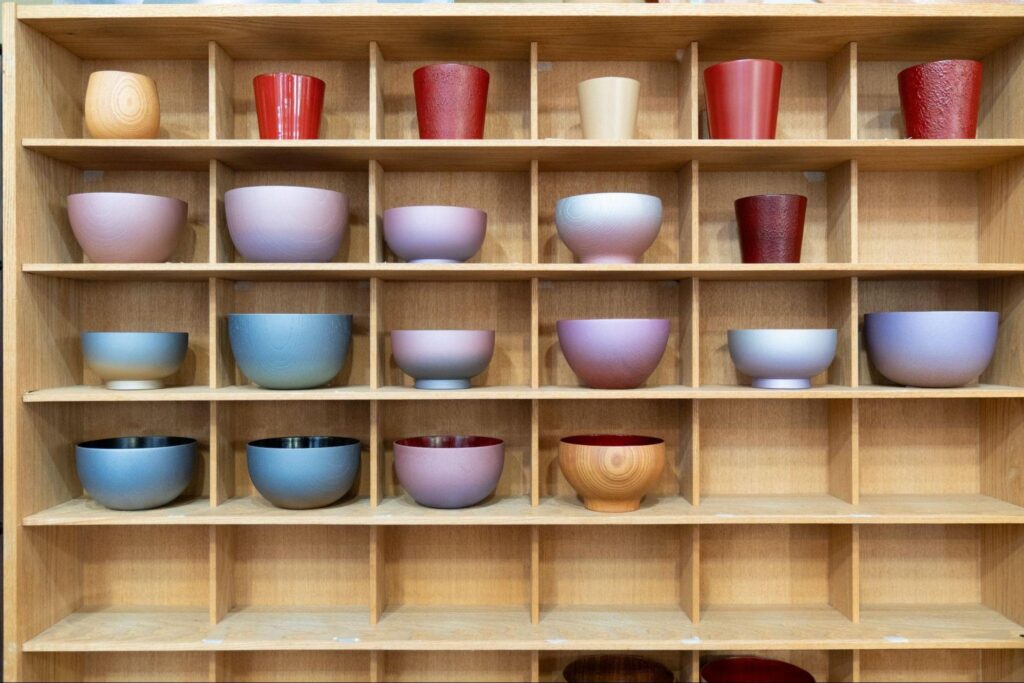
Within that flow, Asada came to take on a role that considers not only “how to make” but also “how to get people to pick it up.” When asked what defines the character of Asada Shikki Kōgei, he immediately points to a history of targeting women. Since his father’s time, they have studied forms and colors, accumulating small innovations to create things people find “cute.”
A sugar pot shaped like an apple, unexpected forms reminiscent of persimmons or chestnuts—these eye-catching designs are not mere novelty, but gateways that invite people to reach out and touch.
“There was also the desire to make lacquerware that would make foreign visitors stop and look—that idea connects directly to what we’re doing now.”
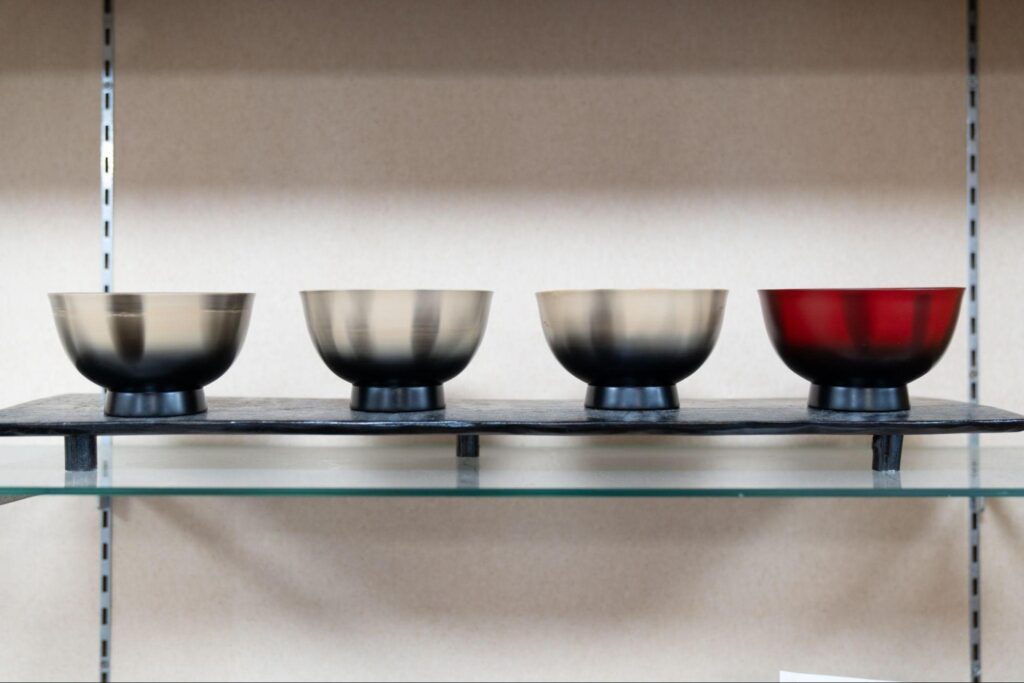
The Utsuroi series introduced metallic light into the color palette of Yamanaka lacquerware, which had traditionally centered on red, black, brown, and natural wood tones. Surprisingly, it began as an experiment.
“Pastel colors are cute, but people would say, ‘The price isn’t cute.’ So I started wondering what colors look luxurious. Metallic finishes really stand out under lighting. It began with, ‘Let’s try silver.’”
Color mixing is delicate; even slight differences in proportion change the depth of color. Dark tones can quickly become tiring. Through trial and error, the series arrived at a subtle lightness that resonates with the sensibility of traditional Japanese colors. Gold shifted from deep hues to a pale, champagne-like tone. The balance of color ultimately defines the expression of the series.
It also coincided with a time when the idea of “looking good on social media” was spreading. The tactile confidence of making and the currents of how things are shared—this challenge captured both.
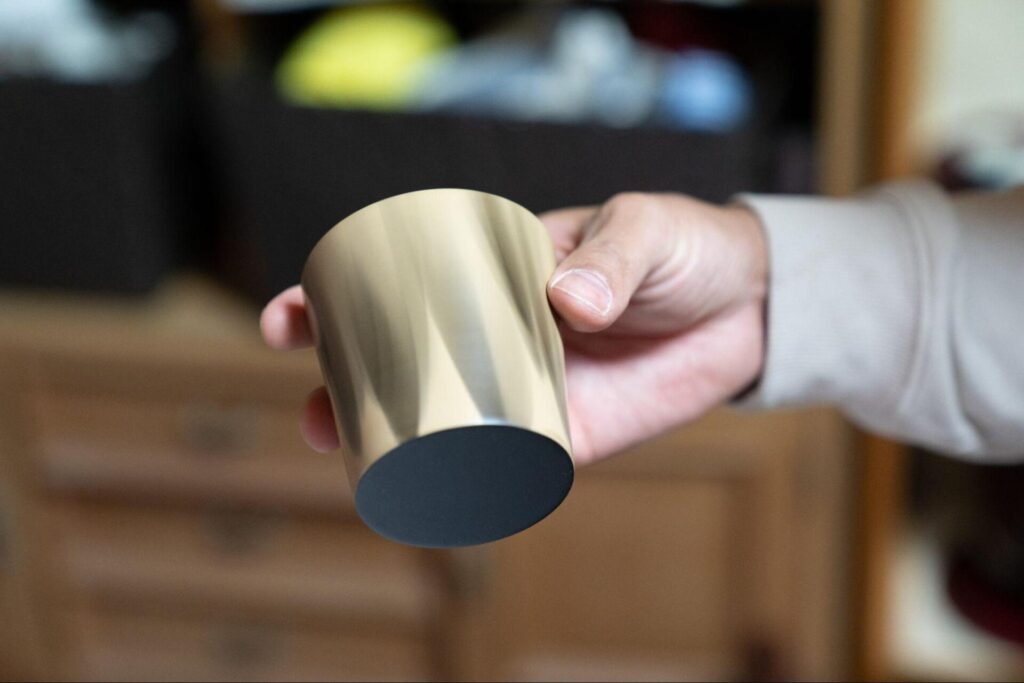
Behind the birth of the Murakumo cup was a candid request from the sales floor. When the Utsuroi cups began to gain traction at pop-ups, a buyer reportedly said, “We can see these sell. Next, we want something ‘really good’ at a higher price point.”
What Asada encountered was murakumo-nuri, a technique he saw at a Yamanaka new works exhibition. By applying soot from Japanese candles to a lacquered surface, patterns emerge—and he felt instantly drawn to its expression.
“I asked if something that had been made as an artwork could be turned into a product. We wondered what would happen if we used the Utsuroi cup as a base, applied a lacquer undercoat, and then added murakumo-nuri. That’s how it progressed.”
The technique is not clearly documented in literature, and its origins remain somewhat mysterious. Even so, through research and refinement, it arrived at a one-of-a-kind landscape.
The Rationality and Strength of Yamanaka Lacquerware—Found in Vertical Grain Cutting and Fuki-urushi
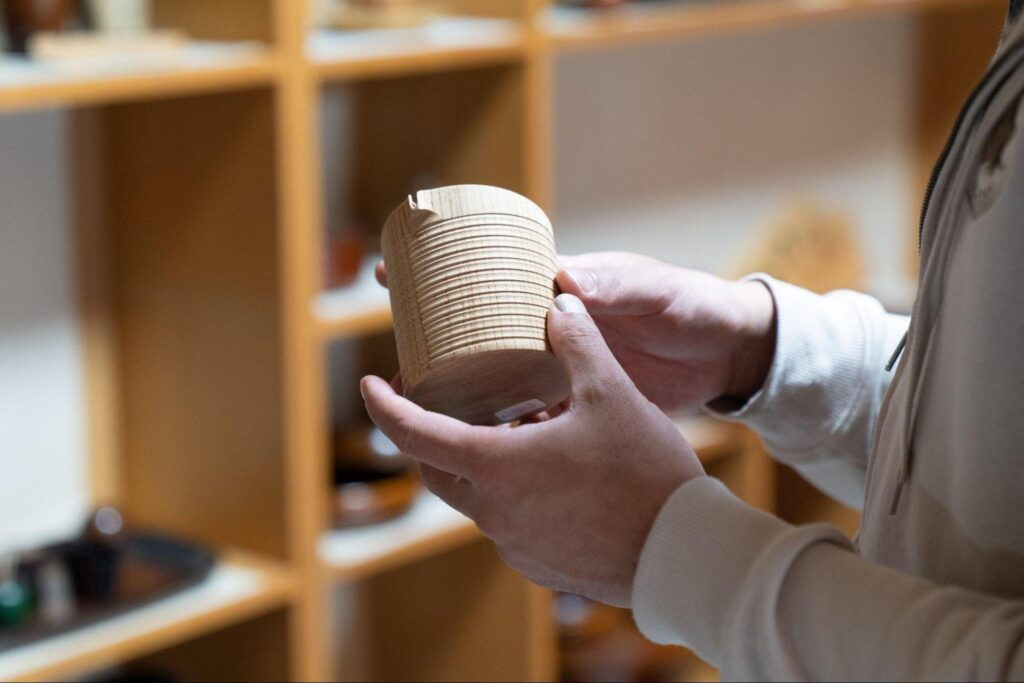
Yamanaka lacquerware is often called “Yamanaka of wooden bases.” Asada explains the idea of tate-kidori—cutting wood like zelkova (keyaki) vertically by splitting logs rather than slicing them into rounds. This method reduces cracking and warping, making it especially strong for lidded vessels.
He also mentions decorative turning techniques unique to Yamanaka, such as sensuji, in which evenly spaced lines are carved into the surface. Beyond visual beauty, these grooves fit comfortably in the hand and prevent slipping—designs created for use.
Accepting natural variations in wood as a given, craftsmen make the most of usable material. Scratches or stains can be made less noticeable through finishing. In the workshop, rationality and care coexist.
When asked what he keeps in mind for lacquerware meant for everyday use, Asada cites fuki-urushi as a defining Yamanaka technique.
“You apply lacquer and wipe it off with cloth or paper before it hardens—that’s why it’s called fuki-urushi. If the wooden base isn’t smoothly turned, unevenness shows easily, so it’s difficult to finish cleanly. But it’s a way of coating that brings out the beauty of the wood itself.”
Unlike works built up through dozens of layers, this approach highlights the character of the wood and makes it suitable as daily tableware. This, too, is Yamanaka’s identity.
With these regional techniques and ways of thinking as a backdrop, and by combining the chance effects of candle soot with a high level of finish for everyday use, Asada Shikki Kōgei’s vessels were highly evaluated and received the Prime Minister’s Award at a national traditional crafts competition.
When asked about the points of evaluation, Asada lists: “thin and light,” “each pattern is unique,” “stackable,” and “simple in shape.”
“Because it’s simple, the technique is really tested. There’s nowhere to hide.”
Having studied wooden bases, undercoating, and finishing, Asada understands the difficulty that resides in the “cleanliness” of form. Rather than overpowering with presence, the pieces compete on precision. Here again, the Yamanaka context is clear.
Beyond Making: Connecting Users and Makers
What Asada values most is not ending with making, but continuing to connect people with one another.
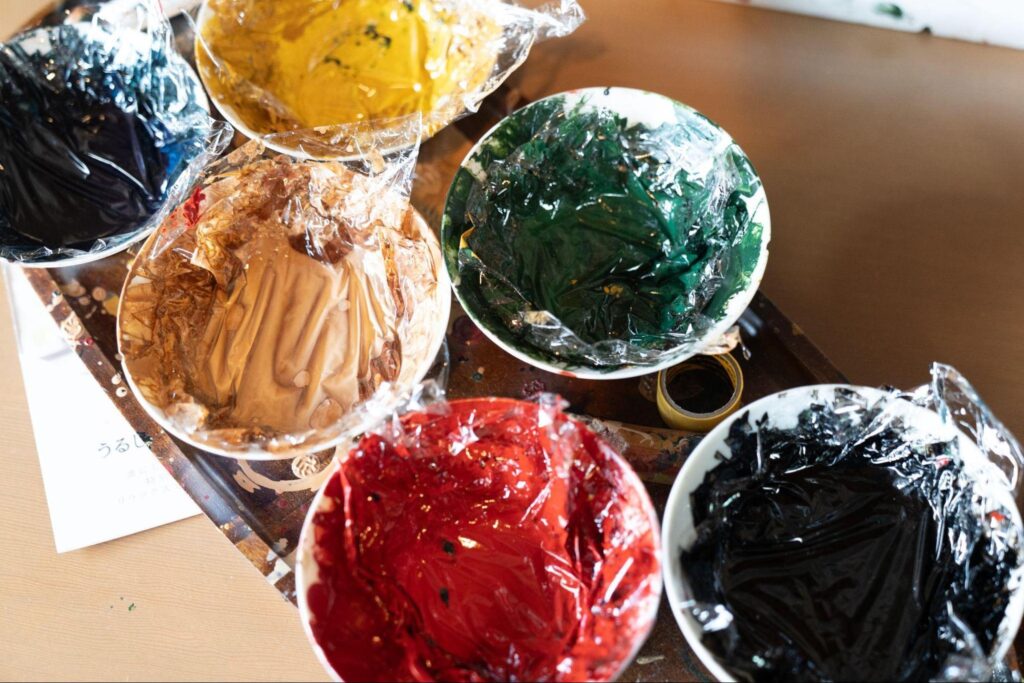
Asada Shikki Kōgei also offers hands-on experiences. The origin of the fuki-urushi workshop dates back to when Asada was around ten years old and accepted a school program introducing traditional crafts. Today’s experiences expanded to fill needs that painting workshops alone could not meet.
“During painting workshops, quite a few people would say, ‘I’m not good at drawing, so I’ll just watch.’ So we introduced a fuki-urushi experience that even people who aren’t confident could enjoy, and it became popular.”
Apply and wipe—the process itself is simple, making it possible even in a short time. If there’s more time, visitors can tour the workshop or try an additional experience of painting designs on the underside of a vessel with lacquer. The design lowers barriers while leaving a tangible sense of having touched the real thing.
As for challenges facing production areas, Asada mentions changing demand and a shortage of successors. The key to overcoming them, he believes, lies in communication.
“Nowadays, it’s a given that things are good. So how do you communicate and get them to reach people? Since we live in an era where you can share through social media, the possibilities really change depending on how you transmit.”
If more people use the products, more people will want to become makers. It’s a chicken-and-egg cycle, but that’s why starting the rotation matters.
What he wants to pass on to younger generations, even before technique, is “liking what you do” and “perseverance.” Aesthetic sense can be developed later; continuity becomes strength. Asada himself has felt this through hands-on product creation and customer interaction.
Asked about the words that made him happiest as a representative, Asada recalls a moment in customer service.
“Someone said, ‘I wasn’t planning to buy anything, but your words convinced me.’ That made me happiest. It wasn’t just that the product was good—it felt like they were praising how I communicated it.”
Being asked to re-lacquer (maintain) vessels that had been thoroughly used also brings deep satisfaction, because it means they are truly being used.
While running a business, he also acts as a bridge, expanding the work of local craftsmen. Aware of the difficulty of that position, Asada chooses to stand on the side of telling people, “There are craftsmen like this.”
What Do You Want to Carry into the Future?
Finally, when asked to imagine the future, Asada’s answer is remarkably quiet.
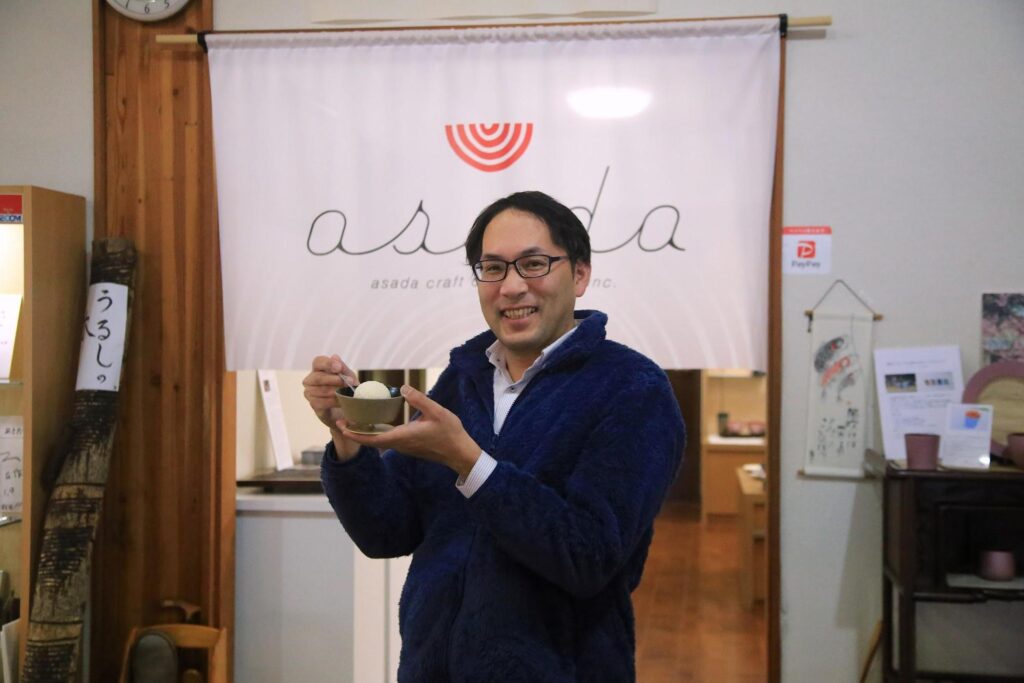
“Rather than standing out too much, my ideal is that they blend in with other tableware. I’d like them to be vessels you realize you’ve been using every day without noticing.”
Not craft objects that appear only on special occasions, but lacquerware as everyday tools that bring comfort and a sense of richness through use. Passing on that value and sensibility to future generations—that is what Asada hopes to carry forward into the future.