

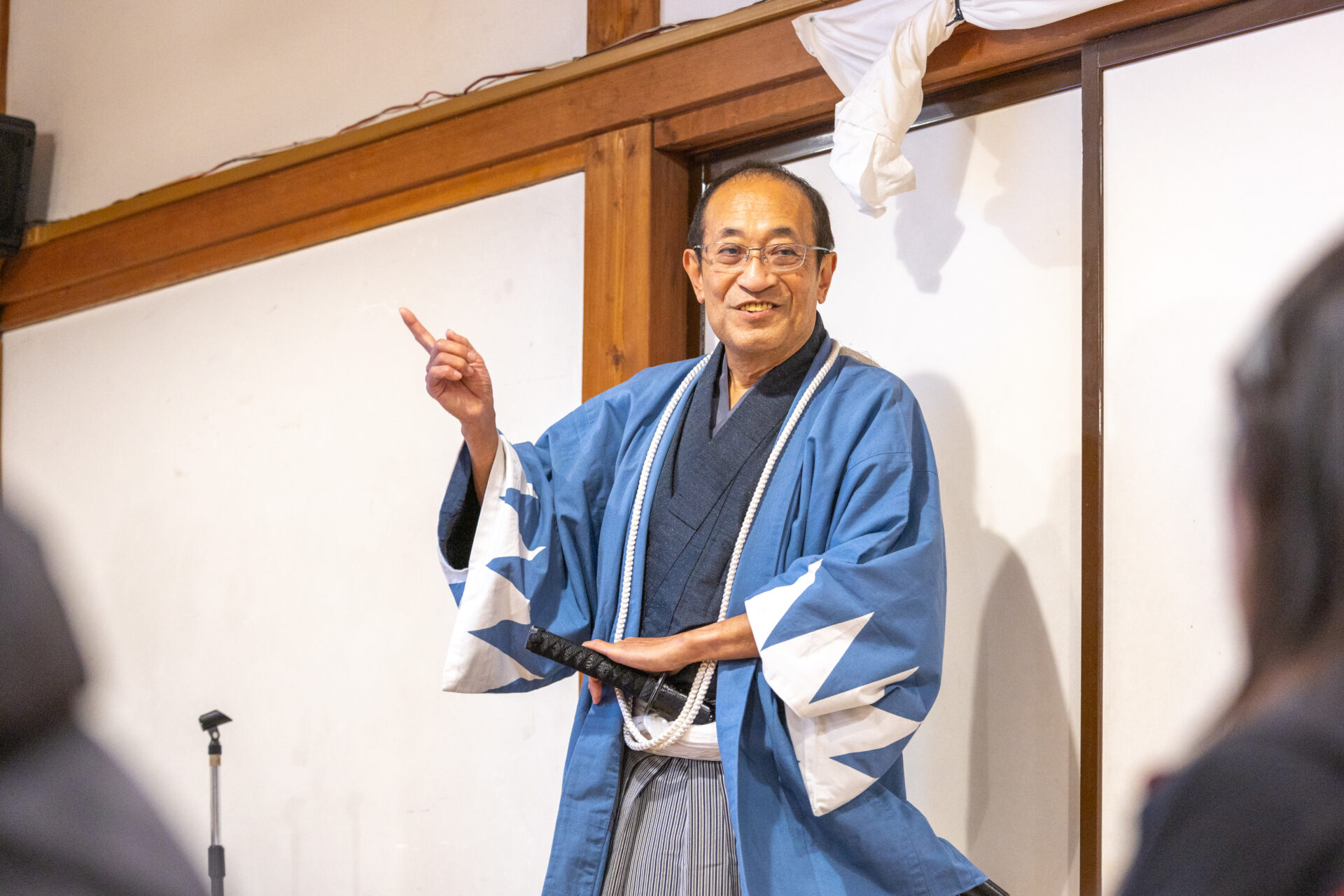
The Spirit of Aizu — “What Must Not Be Done Must Not Be Done” A Moral Code That Connects the Way of Life
佐藤功武
Yoshitake Sato

Aizu [Fukushima]
Yoshitake Sato
Born in Aizu-Wakamatsu City, Fukushima Prefecture. A descendant of Aizu samurai Aizawa Heiemon.
Sato worked at the Aizu-Wakamatsu Tourism and Products Association, where he helped attract school trips and contributed to regional revitalization following the Great East Japan Earthquake. He later worked at the Bandai-Asahi National Park Visitor Center and served as a relocation coordinator for Fukushima Prefecture.
He currently serves as director of the Aizu Shinsengumi Society, working to pass on the history and spirit of Aizu.
At the age of 70, Yoshitake Sato still runs full marathons while continuing his efforts to promote the history and pride of his hometown.
Born in Higashiyama Onsen, a historic hot-spring district of Aizu-Wakamatsu City, Sato grew up as a descendant of samurai of the Aizu domain. Throughout his life, he has faced numerous hardships, including the closure of his family business and the impact of the Great East Japan Earthquake. Yet he has continued to devote himself to the revitalization of his region.
Today, as the director of the Aizu Shinsengumi Society, he works to pass on the history and spirit of the samurai to the next generation.
What exactly is the spirit of Aizu symbolized by the “Jū no Okite”—the code of discipline that teaches “what must not be done must not be done”? And what drives Sato to continue dedicating himself to his community?
This article traces his journey while exploring the values that shape Aizu’s identity.
Returning the Kindness I Received to My Hometown
“I run about 10 kilometers three or four days a week. On weekends, I run around 20 kilometers. I’ve completed full marathons held locally as well as the Tokyo Marathon.”
Even at 71, Yoshitake Sato is remarkably energetic. He began running in his fifties—not simply as a hobby or for health, but out of a desire to encourage his hometown after the devastation of the Great East Japan Earthquake.
“Right after the disaster, all we heard were grim reports. I wanted people to know that here in Fukushima there were still people moving forward and running toward the future.”
Sato was born into a family that ran a traditional inn in Higashiyama Onsen, near the center of Aizu-Wakamatsu City. Raised as a descendant of Aizu samurai, his life, however, was far from smooth.
Although he inherited the family business, the inn soon closed due to financial difficulties. Debts increased, and at one point he even considered moving to another prefecture.
It was the people of Aizu who helped him during that difficult time.
“They told me, ‘We’ll support you—stay here and keep trying.’ They even helped arrange things so I could build a house. I was deeply moved. I wondered if anyone else would go that far for someone.
Later, when I asked how I could repay them, they told me, ‘You don’t have to.’ That’s when I decided that the kindness I received should be returned to the community.”
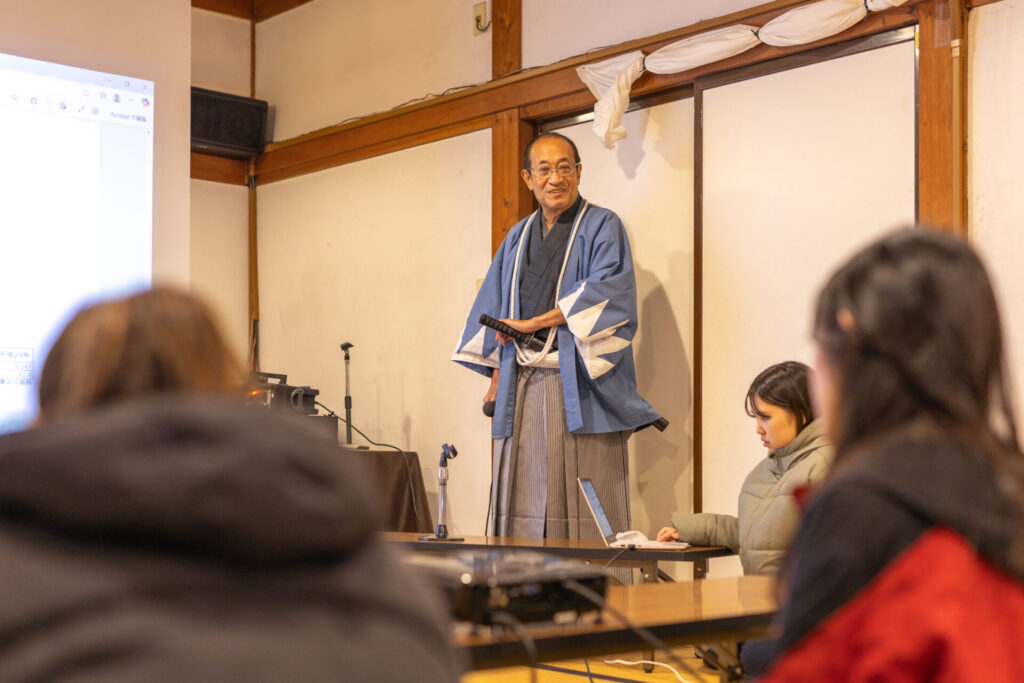
From then on, Sato began devoting himself to activities aimed at revitalizing his hometown.
Calling himself “a salesman for Aizu,” he worked at the Aizu-Wakamatsu Tourism and Products Association, focusing on attracting school trips. His strong vitality and dedication to the region gave him a great sense of purpose.
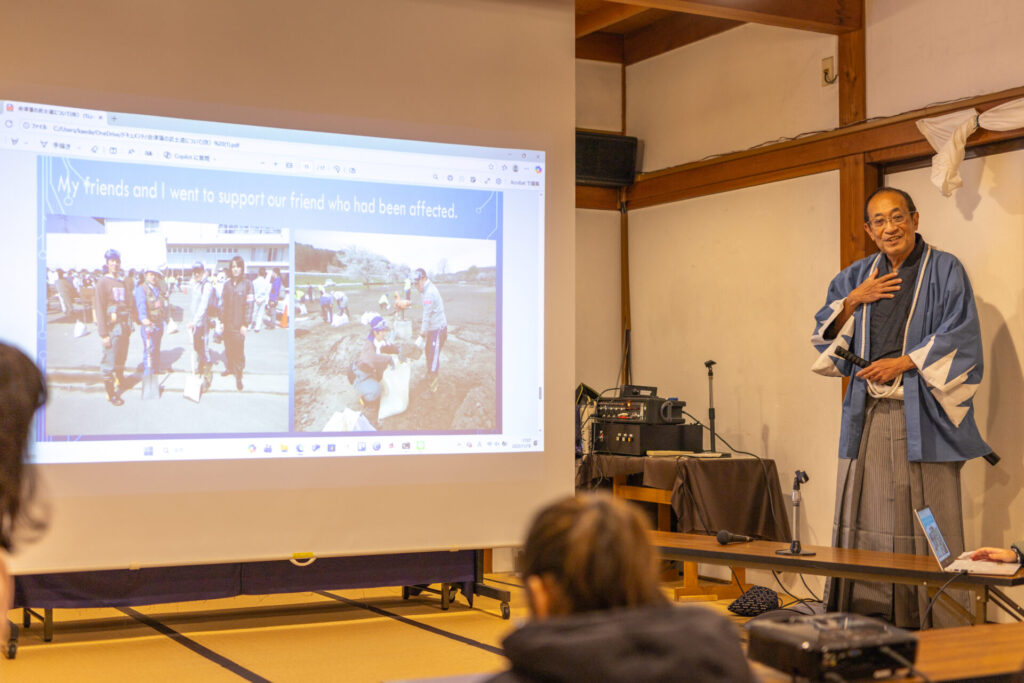
But only a year later, the Great East Japan Earthquake struck. More than 90 percent of the schools that had visited Aizu on school trips stopped coming.
“To be honest, I thought we were in serious trouble. But at the same time, I felt it was my moment. When Aizu was in difficulty, it was my chance to give something back.”
He traveled across Japan, visiting schools and boards of education and asking them to return to Aizu.
Gradually, the number of visiting students recovered to about 80 percent of its peak.
When encouraging schools to visit Aizu, there was one message he always conveyed—the unique value of the region.
“In Aizu we have a teaching called the Jū no Okite. The spirit cultivated through it is one of the defining values of our region.
During the Boshin War at the end of the Edo period, the Aizu domain formed the Byakkotai, a unit of teenage samurai. They were about the same age as the students who come here on school trips. Their willingness to fight for their homeland at such a young age reflects the spirit shaped by that teaching.”
A Way of Life Inherited from His Ancestors
Understanding the spirit of Aizu requires looking at the history of the Aizu domain itself.
Its foundation was shaped by the teachings of Lord Hoshina Masayuki, the domain’s founder. His family code clearly stated that when the Tokugawa shogunate faced difficulty, Aizu must rush to its aid first.
Such unwavering loyalty—never choosing neutrality or self-preservation—became embedded not only in the domain’s ideology but also in the personal values of its people.
As a result, during the turbulent final years of the Edo period, Aizu accepted the role of Kyoto Protector, fully aware that it would face hostility from anti-shogunate forces.
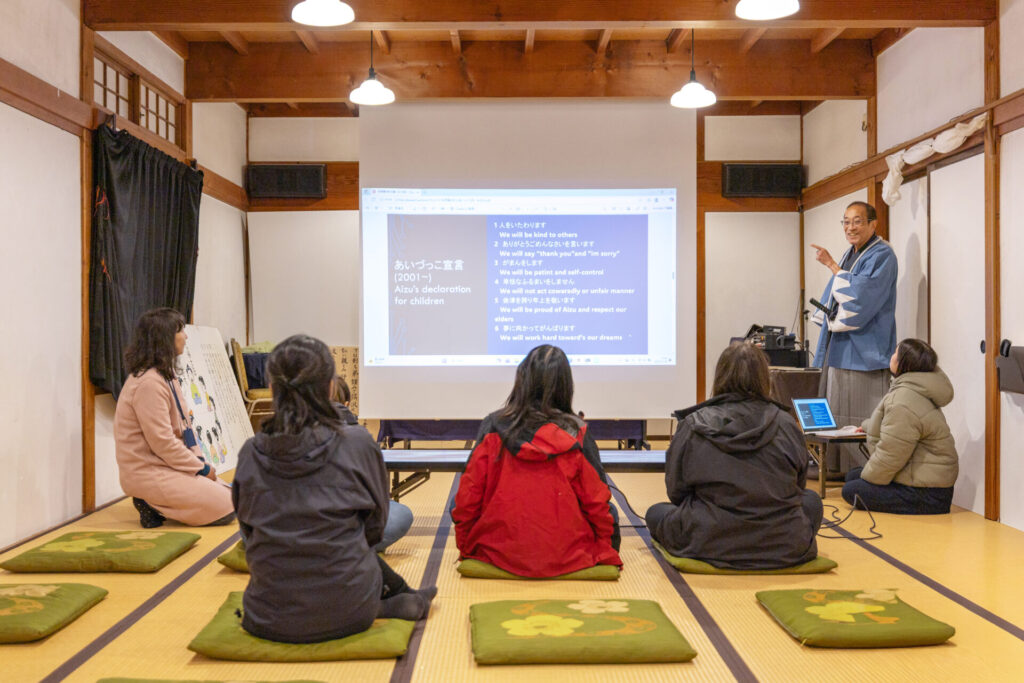
“The Aizu domain remained loyal to the shogunate until the very end of the Boshin War, even after suffering tragedies such as the Byakkotai and the fall of Tsuruga Castle. That was because they upheld the samurai virtue of **‘gi’—righteousness—**cultivated through the Jū no Okite. That spirit is still deeply rooted in the hearts of the people of Aizu today.”
Sato himself lives according to these principles. As a descendant of Aizu samurai Aizawa Heiemon, he continues to discipline himself with the maxim “what must not be done must not be done,” while always offering help to those in need.
Sharing the Pride of Aizu Today
Today, Sato dedicates much of his energy to the Aizu Shinsengumi Society, where he serves as director.
The group has more than 80 members across Japan, conducting research on the Shinsengumi, organizing lectures, and collaborating with regions connected to the group’s history.
One of their main activities is participating in local festivals such as the Aizu Shinsengumi Festival and the Aizu Festival. Wearing Shinsengumi uniforms, they perform sword demonstrations that draw enthusiastic applause from spectators.
“At first we simply shouted victory cries a few times. But seeing the smiles of people along the street made us want to do more—to bring energy and joy to everyone.”
At the same time, Sato does not carry historical conflicts into the present.
During his school-trip promotion work, he once visited a school in Kagoshima—home of the Satsuma domain, Aizu’s opponent in the Boshin War.
After some initial tension, they began discussing “Gōchū education,” the moral training given to samurai boys in the Satsuma domain. Surprisingly, its principles were very similar to the Jū no Okite.
“The only difference was that Gōchū education included the teaching ‘never lose.’ When I jokingly pointed that out, everyone laughed and the atmosphere softened immediately.
In the end, Aizu and Satsuma share the same spirit. As samurai, both valued loyalty to their domain.”
What Do You Wish to Pass On to the Future?
When asked what he most hopes to pass on to future generations, Sato answered without hesitation.
“A spirit that disciplines oneself while showing kindness to others. That is not only the spirit of Aizu, but also a wonderful value cultivated by the Japanese people.”
In Aizu today, a modern version of the Jū no Okite known as the “Aizukko Declaration” is taught to children as a guide for life.
As in the days of the samurai, Aizu continues to teach what it means to live with integrity. Because of this, the spirit passed down through generations will surely continue into the future.
Sato is sometimes called a stubborn man of Aizu, yet his words and actions are filled with warmth and compassion for others. His life—combining unwavering conviction with flexibility—reflects values from which many can learn.