

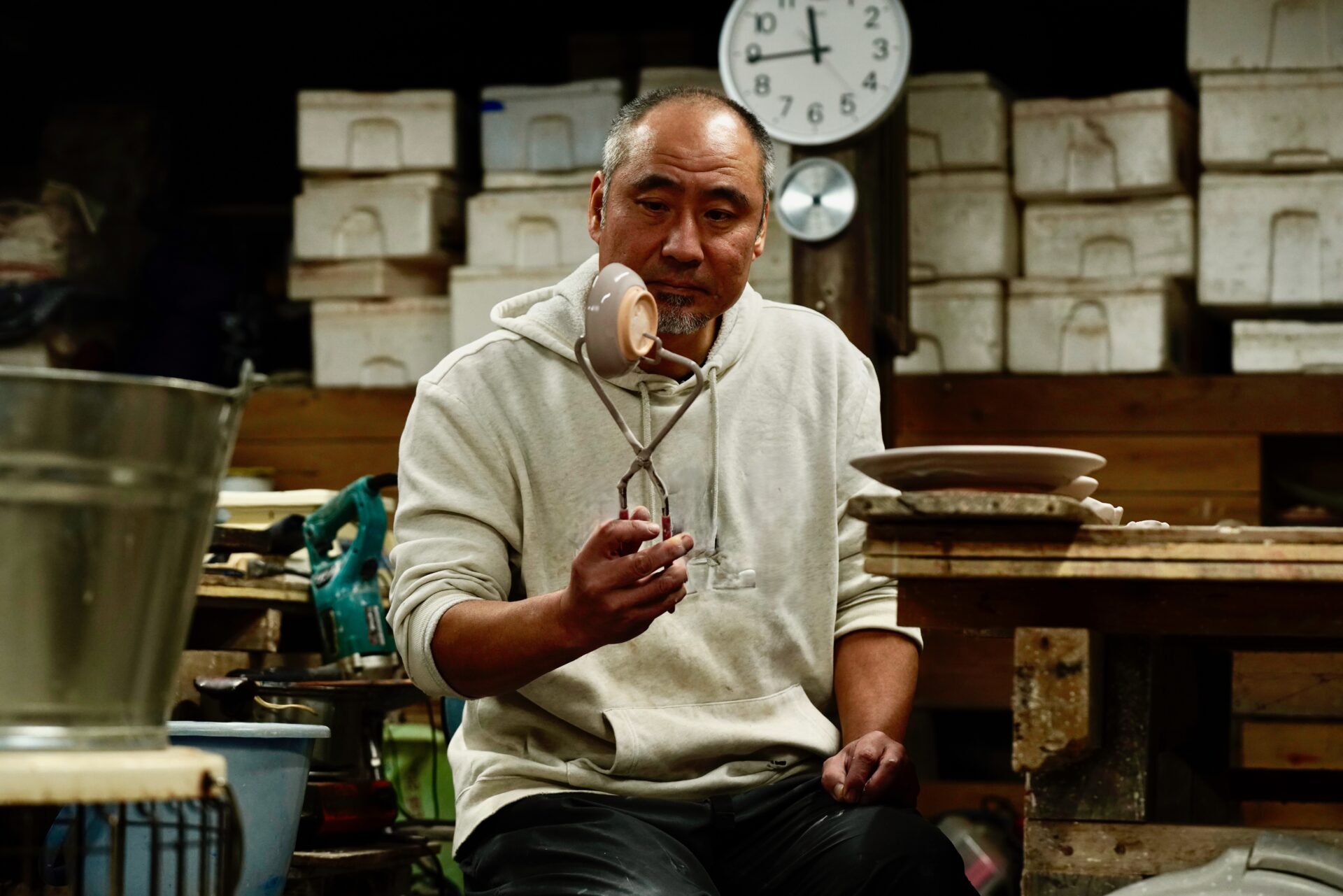
Quietly Enduring — Ever-Changing Vessels and an Unchanging Everyday Life
手代木崇 幸右衛門
Takashi Kōemon Teshirogi

Aizu [Fukushima]
Takashi Kōemon Teshirogi
Born in Aizumisato Town, Fukushima Prefecture. After working as a company employee, he returned to take over his family’s pottery kiln, which has been passed down for generations. He is the 11th-generation Kōemon Teshirogi. A coffee lover, his favorite creation is a coffee dripper designed using the rigid form of shinogi carving. He is so particular about his work that he even learned welding in order to make its metal support.
Hongo in Aizumisato Town is a village of pottery. Tucked away beside its winding lanes, almost literally buried into the ground, stands the workshop of Kanzan-gama. Although its owner says without hesitation that the kiln has “no particular defining feature,” what has allowed it to endure for 300 years? We spoke with its 11th-generation head, Kōemon.
The Sixth Son of a Samurai — and a Potter as a Civil Servant
Walking through the town of Aizu-Hongo, one does not encounter the bustle one might associate with a tourist destination known for pottery. Instead, there is only the clear air of winter and the scent of ordinary life. Beside one of its quiet side streets, there stands a kiln as naturally as though it had always belonged there, with vessels displayed just as naturally beside it.
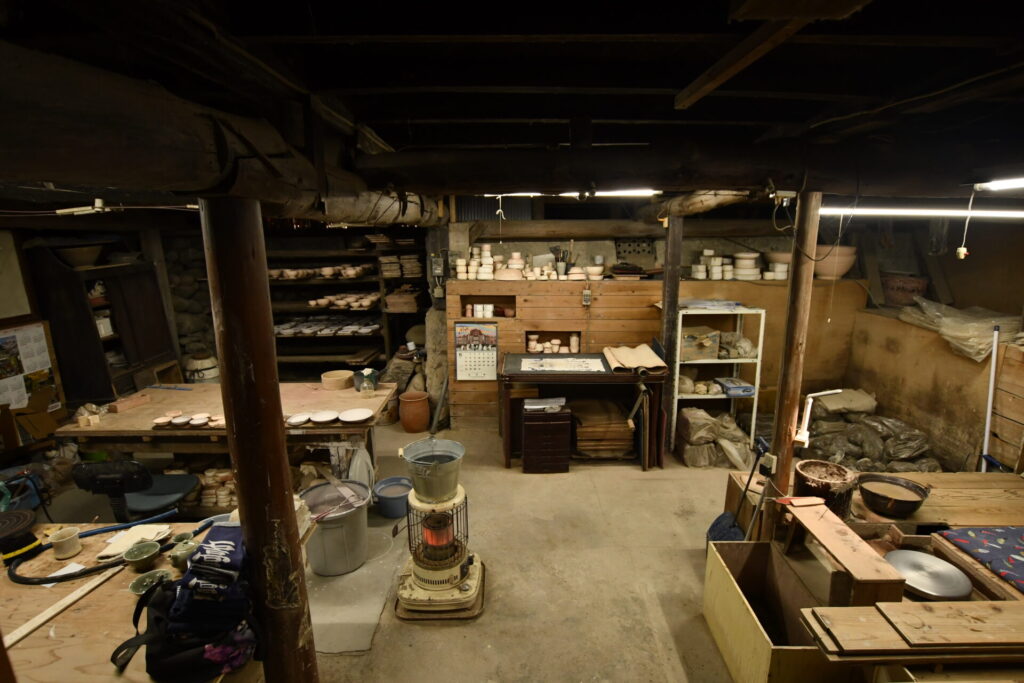
The workshop bears the sign Kanzan-gama. At first glance, it looks like an ordinary private home. But hidden beneath it lies what its owner calls a “secret base,” dug out of the earth with nothing more than a pickaxe.
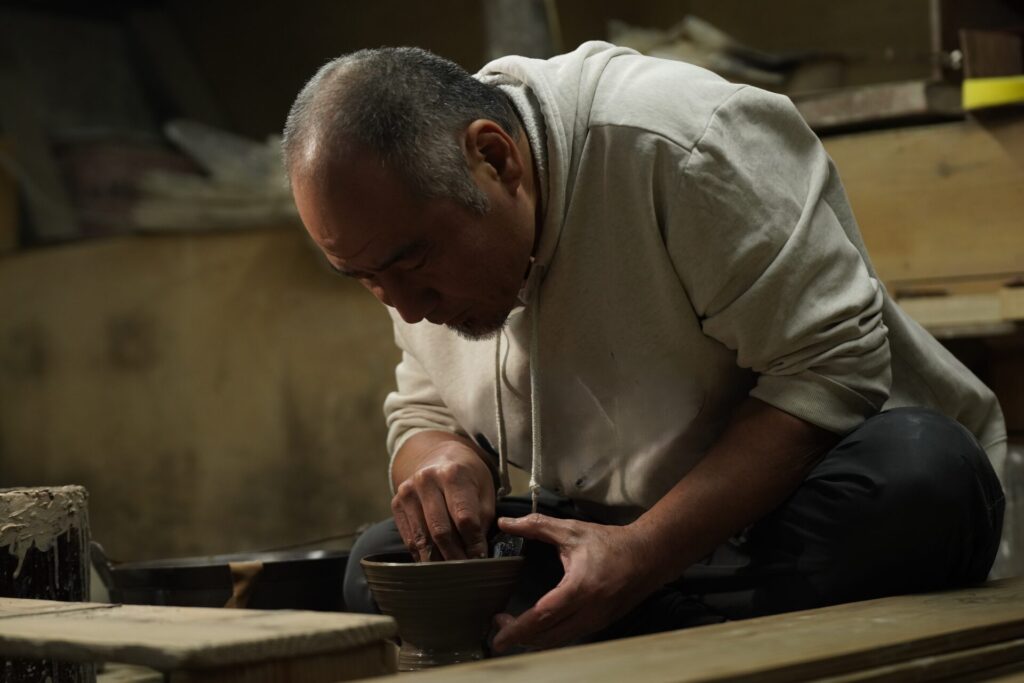
The man who welcomes us is the 11th-generation head, Takashi Teshirogi.
“The kiln’s history? Around 300 years, I’d say. We don’t really know the exact starting year.”
He speaks lightly, almost casually. Even while referring to a history three centuries long, he smiles and says, “Well, roughly speaking.” That lack of pretension, that looseness—perhaps it is precisely this that became Kanzan-gama’s shrewd survival strategy through the turbulent history of Aizu.
The kiln’s origins go back to the Kyōhō era in the mid-Edo period, around 1716 to 1736. But its beginnings remain somewhat obscure.
“It seems the first generation was called Magoroku. He was probably the sixth child.”
Teshirogi recounts these fragments of oral history as though gently drawing on a thread from the past. The founder is said to have been a samurai serving at Tsuruga Castle. Yet because he was not the eldest son, he did not inherit the family position—or perhaps, at his lord’s command, he set aside the sword and began kneading clay in this place instead.
“In those days, it was a ‘domain kiln,’ so I guess it was something like being a civil servant today.”
That one remark reveals much about the character of Kanzan-gama. It did not begin as the work of an artist seeking personal expression. It began as the work of a practical craftsperson making what the domain required, in the quantity it required. That is why even the hereditary name Kōemon, passed down through the generations, was adopted rather loosely—some generations took it on, others did not.
“The second generation was the first to use the name, and the third did too, but my father didn’t. It was all pretty casual—more like, ‘Use it if you want.’”
They did not cling to names. They were not bound by formality. What mattered was simply continuing to make vessels. That pragmatic spirit may well be the inheritance of Magoroku, the first-generation founder who shifted from samurai to potter.
Kanzan-gama has changed its form like a chameleon, adapting to each era. At the time of its founding, it produced earthenware, but when porcelain-making began in Aizu-Hongo around the fourth generation, the kiln followed suit and shifted to porcelain.
Then, in the generations of Teshirogi’s grandfather, during the Meiji and Taisho periods, the kiln’s location changed dramatically.
“It seems there used to be a climbing kiln near what is now the castle park, but at some point they moved here.”
His grandfather chose the present site.
“But there wasn’t enough workspace, so he dug underground.”
Descending the staircase beside the entrance, one suddenly enters another world. The air is cool, and the walls are lined with rough stone—stone everywhere.
“As he was digging, a lot of stone came out, so he just used it as building material for the walls.”
It feels like a secret hideout, or perhaps the ruins of some ancient site. This underground studio, dug out by his grandfather with a pickaxe and shovel, remains cool in summer and stable in temperature through winter. It is an ideal environment for storing clay and working at the wheel.
“We also use this space for pottery workshops for visitors. People are always amazed.”
This underground space is perhaps the true sanctuary of Kanzan-gama, a symbol of its unyielding spirit.
The Richness of “Having No Defining Feature” — Welding, Reclaimed Wood, and a Coffee Dripper
“What makes Kanzan-gama distinctive? Hmm… I don’t think there’s really anything in particular.”
Teshirogi says this with ease. In a world where many kilns describe their own signature glazes or unique techniques, his answer lingers in the ear precisely because of its simplicity.
“Every time we fire the kiln, we try different things. We change the composition of the raw materials, test glazes, and experiment.”
At times, he creates a subdued red glaze modeled on the red roof tiles of Tsuruga Castle, controlling the firing through oxidation and reduction. At other times, he makes jars painted with ayame, the iris, the flower of Aizumisato Town. And then there are softly rounded vessels finished in a gentle celadon glaze.
To say that the kiln has no fixed defining feature is, in another sense, to say that it can become anything. That flexibility is both a legacy of the “civil-servant potter,” once making whatever the domain required, and a strength in the present day, when lifestyles have diversified and tableware must respond to many different ways of living.
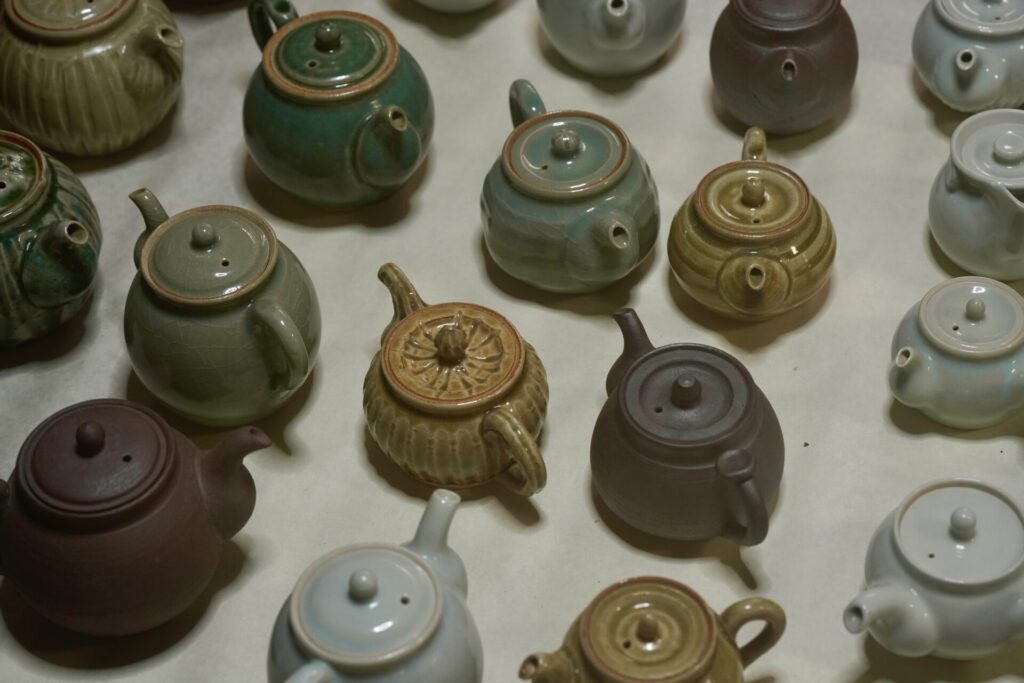
“We call this the debeso type.”
Looking inside the spout, one sees that instead of a metal strainer, the body of the teapot itself bulges inward like a little navel—debeso means “outie belly button”—with holes pierced through it and the spout fitted over that structure. It is an old technique, using no metal strainer at all.
“Now that you mention it, I guess that might count as one of our characteristics. We’ve been making it forever.”
He says it offhandedly, but in that debeso spout one can clearly sense the handiwork of someone who has long pursued ease of use.
Then he points to something else.
“Look at this. I made it myself.”
Set in one corner of the workshop is a coffee dripper—rugged and yet stylish. It stands on an iron frame, mounted on a weathered wooden base.
“During the pandemic, I suddenly wanted to make a coffee dripper. Since I had the time, I learned welding.”
Even the metal frame is of his own making.
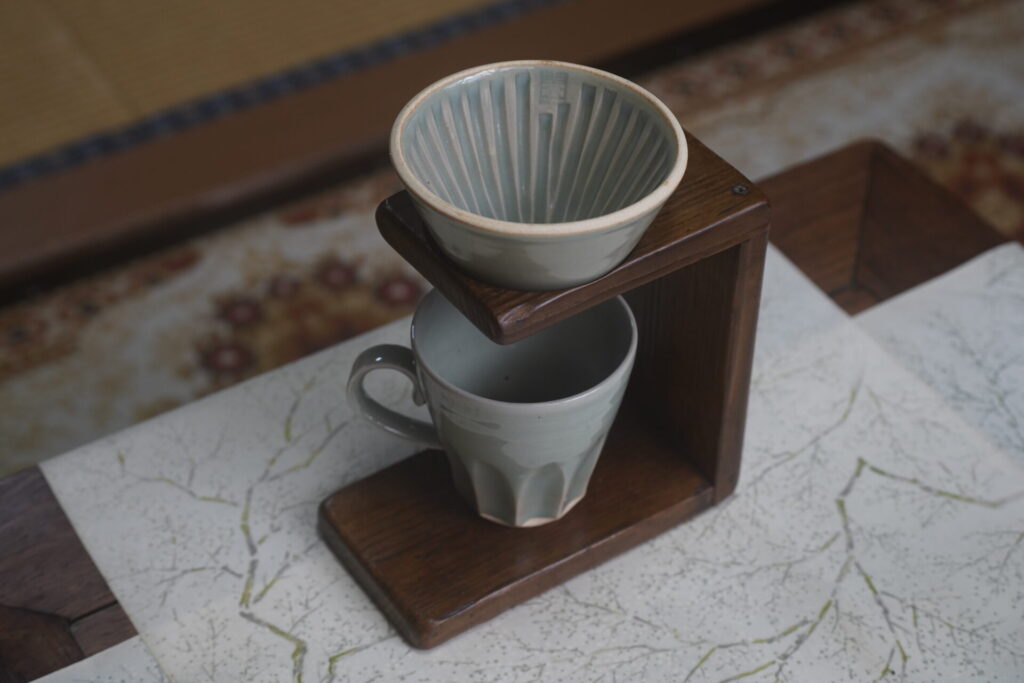
More surprising still is the wood used for the base.
“This was originally an old teita—a board used to place wheel-thrown vessels on. Probably from the early Showa period.”
The old board is worn smooth, warped, and cracked. Where most people would see only scrap wood, Teshirogi saw character.
“It’s better like this than something too clean, don’t you think?”
A coffee dripper made for his own use, by a man who loves coffee. He welded the iron, cut the reclaimed wood, and of course threw the ceramic dripper itself. He adjusted the depth and angle of the grooves repeatedly, all in pursuit of the best flavor extraction.
“The newest one I made has deeper grooves. I don’t like it when the coffee drains too slowly.”
This freedom, this lightness of approach—rather than speaking solemnly of “preserving tradition,” he simply uses every skill available to enrich his own life. That, perhaps, is the way of Kanzan-gama.
Leaving Once — and Returning Again
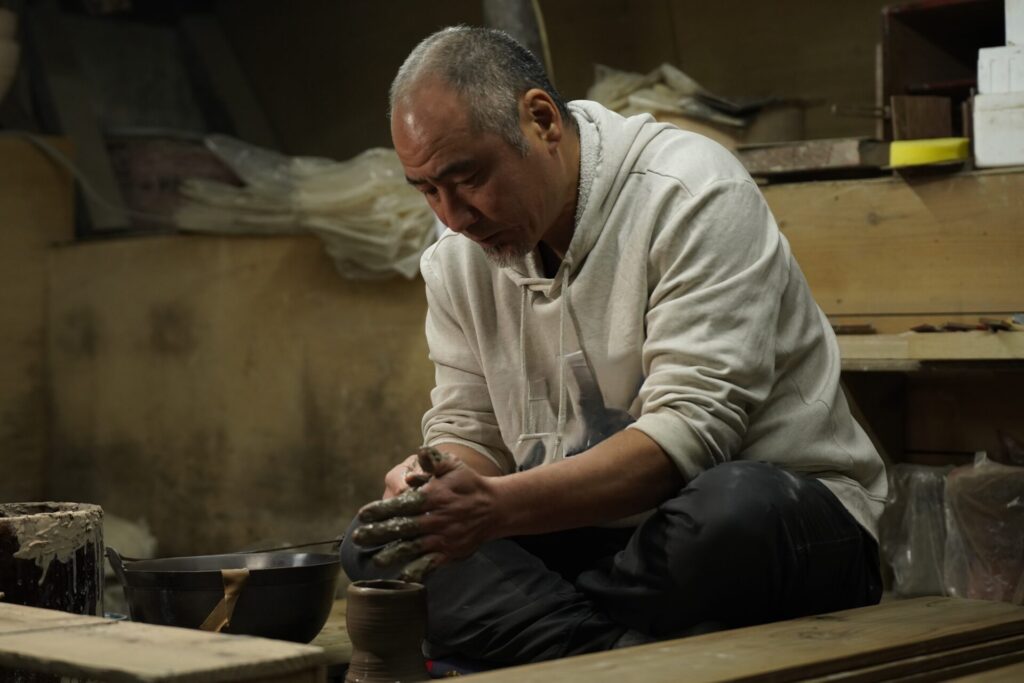
Teshirogi did not initially intend to become a potter.
“I pushed back against it. At first I chose not to do it and worked as a company employee instead.”
Resistance to inheriting the family business is a path many successors in traditional crafts know well. But the turning point came suddenly. The company where he had been working ran into difficulties, and he made the decision to return home.
“There were changes in my life, and I started to think maybe I really had to take up the kiln after all.”
There was no dramatic declaration, no grand turning point in the theatrical sense. He simply returned to the underground workshop as though yielding to the natural flow of things.
“I had been around clay since I was little, so actually making things came back quite naturally. Training? Not really.”
Despite a gap of twenty years, his body had remembered. That quiet familiarity was perhaps proof that, within him, the blood of the potter had been flowing all along—shaped by growing up watching his grandfather and father at work in that underground studio.
What Do You Wish to Pass On to the Future?
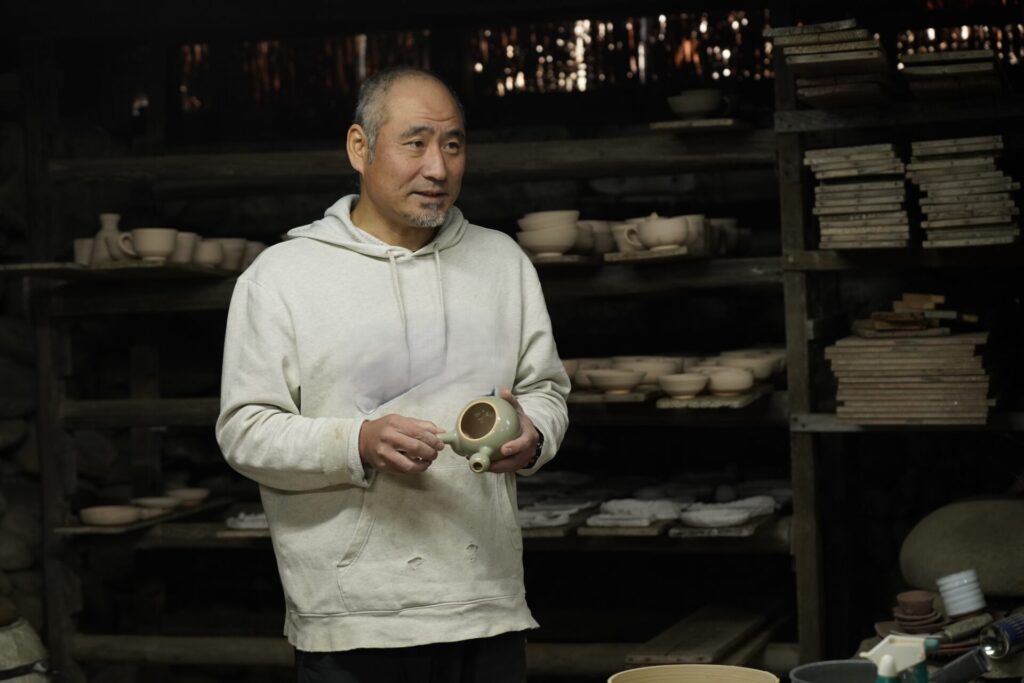
“What kind of moments would you like people to use your vessels in?” he is asked.
His answer comes immediately.
“In everyday life. There’s really nothing else.”
A mug for morning coffee. A small bowl for simmered vegetables at dinner. A teapot for pouring tea. When held, each vessel settles lightly into the hand.
“People often tell me, ‘It’s so light.’ I don’t consciously aim for that, though.”
And yet the result is ease of use. The result is lightness. Perhaps this is not a deliberately designed feature at all, but the inevitable outcome of three hundred years spent making vessels meant to be used.
On the workshop shelves sit cups bearing family crests made by his father, small plates shaped like plum blossoms, and beside them Teshirogi’s own modern coffee drippers and beer mugs shaped almost like wine glasses. The generations and styles differ, yet somehow there is a quiet sense of unity among them. Perhaps that is because both are made from the same wish: to enrich someone’s everyday life, if only a little.
“The future? Well… I suppose it’s simply continuing.”
Teshirogi does not speak of grand ambitions. He says with a laugh that he is “not good at social media” and is not particularly enthusiastic about self-promotion. But his words carry weight.
Once every three months, he fires the kiln. He keeps that rhythm, turning the wheel in the underground studio. There, surrounded by stone walls, he continues his dialogue with clay.
“Of course, I’d be happy if our name became better known and more tourists came.”
What Teshirogi hopes to carry into the future is both the endlessly adaptable nature of his vessels and the continued existence of Kanzan-gama itself.
There is no flashy self-promotion. No aggressively defined individuality. And yet Kanzan-gama possesses the strength to change.
From samurai to potter. From porcelain to ceramics. From clay alone to the incorporation of iron and wood. Adapting to the waves of the times, while continuing all the while to remain Kanzan-gama.
Three hundred years ago, Magoroku put down his sword. Later, Teshirogi’s grandfather dug out the underground studio with a pickaxe. Today, Teshirogi himself stands there in a welding mask. Perhaps what all of them wanted to protect was not fame or formal legacy, but the everyday life of living with clay in Aizu-Hongo itself.
As I leave and climb back up from the underground workshop into the daylight, the winter sun feels dazzling.
Armed with the strongest possible feature of all—having no fixed feature at all—Kanzan-gama will likely continue, quietly and naturally, as part of our daily lives.