

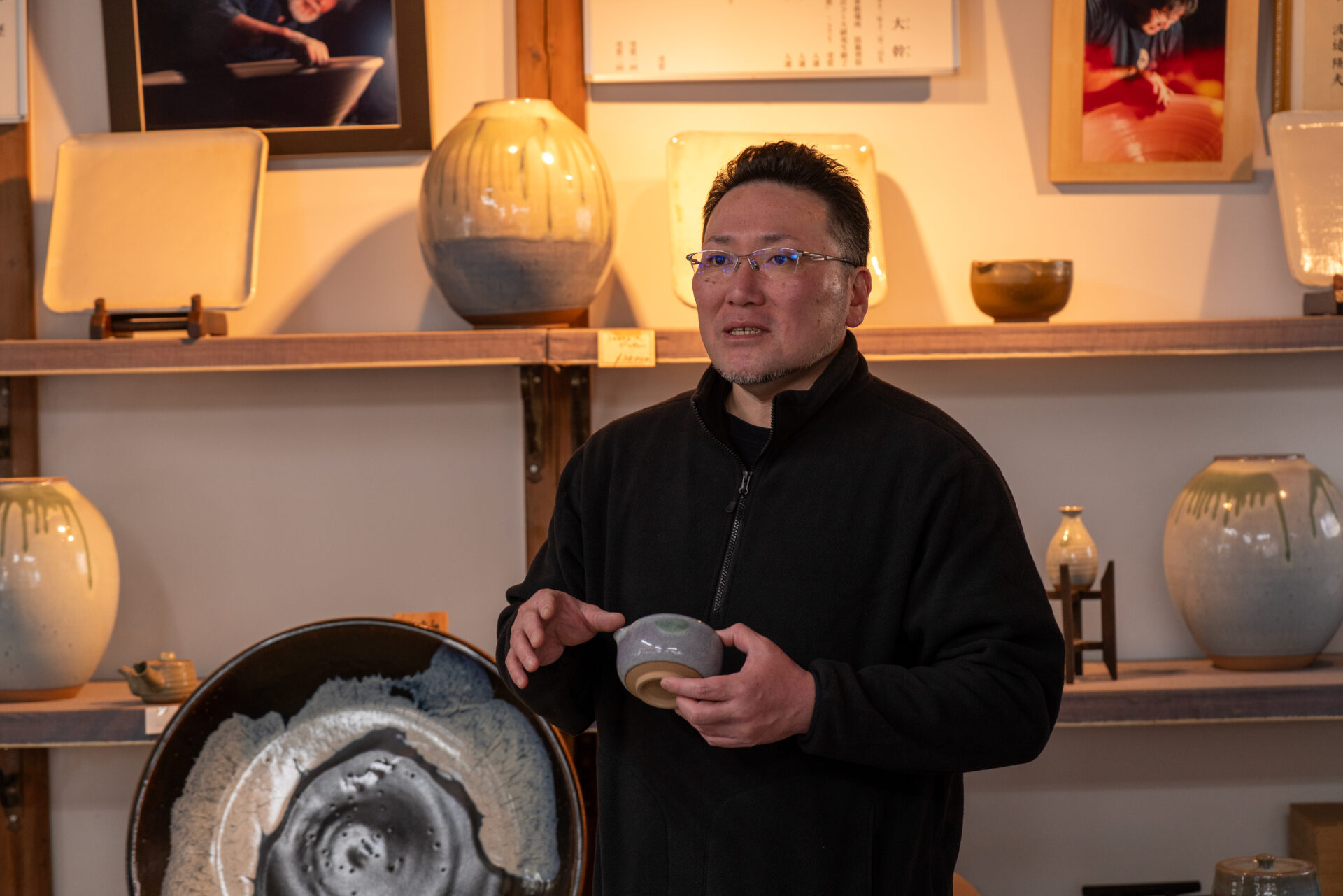
Gracefully Enjoyed — Thoughtful Pottery by the Next Sixth Generation, Made with an Eye on the Future
佐藤大幹
Hiromiki Sato

Aizu [Fukushima]
Hiromiki Sato
Born in Aizumisato Town, Fukushima Prefecture. From an early age, he helped with the family business at Touga Touraku, a kiln producing Aizu-Hongo ware. After graduating from high school, he stayed in his hometown and devoted himself to pottery-making as the future sixth-generation head. Today, he works from both his home in Aizu-Wakamatsu City and the family kiln, while also beginning to participate in pottery events and markets to help more people discover Aizu-Hongo ware.
On the slopes of Mukaihaguroyama, once the site of a castle overlooking Aizu-Hongo, stands a pottery workshop. Inside, a large gas kiln anchors the space, while vessels awaiting their final firing fill every available corner. Working there is Hiromiki Sato, the future sixth-generation head of Touga Touraku. Having grown up never far from pottery, what feelings does he hold toward Hongo ware? We spoke with him in depth.
A Lineage That Continued from “Apparently They Did It”
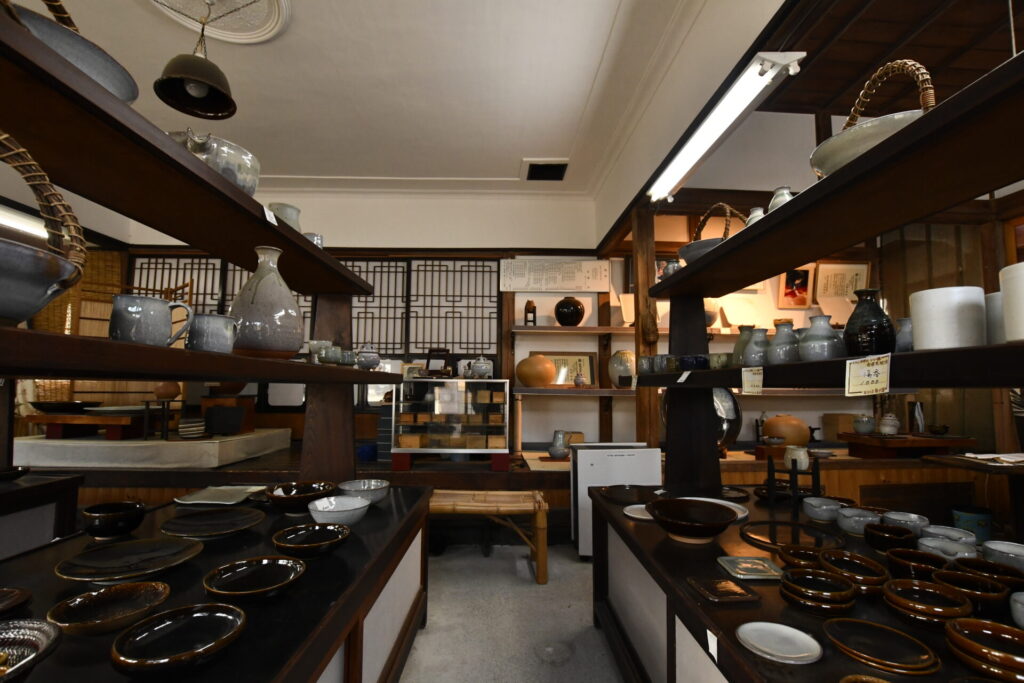
At the foot of Mukaihaguroyama, on a cold early winter day when rain was beginning to turn to sleet, I visited the workshop. The first thing I noticed upon stepping inside was a warm, unforced atmosphere. Not warmth of temperature alone, but something gentler—the vessels lined up in the space, the quiet tones of the glazes, all seeming to follow the tradition of Hongo ware while also carrying a calm presence that slipped naturally into everyday life.
This is where Hiromiki Sato works. At present, he is almost entirely responsible for keeping the kiln running and stands at the center of its daily operation.
“I’m still only the ‘future sixth generation,’” he says with a laugh.
In that expression, there seems to be less of the burden of an heir than a kind of quiet composure, along with the pride of a craftsperson who knows exactly where he stands.
The history of Touga Touraku lies, to some extent, in mist.
“I’ve heard that my great-grandfather was already involved in pottery too… but I don’t really know the details.”
There is no precisely recorded founding year. What remains is only a rough lineage: his grandfather was the fourth generation, his father the fifth, and he himself will become the sixth.
What is certain, however, is that the family had long been involved in pottery in one form or another. In earlier times, Aizu-Hongo ware was produced through a fully divided labor system. Some dug the clay, some carried it, some split the firewood, some fired the kilns. It was not the kind of work a single person could complete alone, but rather an industry sustained by the village as a whole.
“So apparently there were quite a lot of people involved.”
Even if names were not recorded, hands were moving. And on top of that accumulated labor stands the present-day Touga Touraku.
Sato does not see the lack of precise records as something tragic. Rather, within that vague “apparently,” he seems to sense the breathing presence of the unnamed artisans who supported pottery across the production area.
His own entry into this path was not marked by some dramatic decision either.
“There wasn’t really a big trigger. It just happened naturally.”
By the time he was in junior high school, he was already helping out—cleaning the potter’s wheel, carrying vessels, moving around among older craftspeople as if that world had always belonged to him. When he finished high school, he never even entered the job market. He simply thought, more or less, Well, maybe I’ll give this a try, and joined the family business.
Yet behind that word “naturally” lay years of accumulated, unspoken learning. It was a world of “watch and learn,” but to him it was already a familiar landscape. Just one month after graduating from high school, he was entrusted with glazing, one of the most important stages of the process.
“If you keep doing it, there are moments when something suddenly clicks, even in work you thought you already understood.”
He is not the kind of person who waits to be taught. He works until things settle inside him and make sense. That quiet accumulation is what now supports his technique.
Negotiating with Nature — Thirty Years to Achieve “the Same Color”
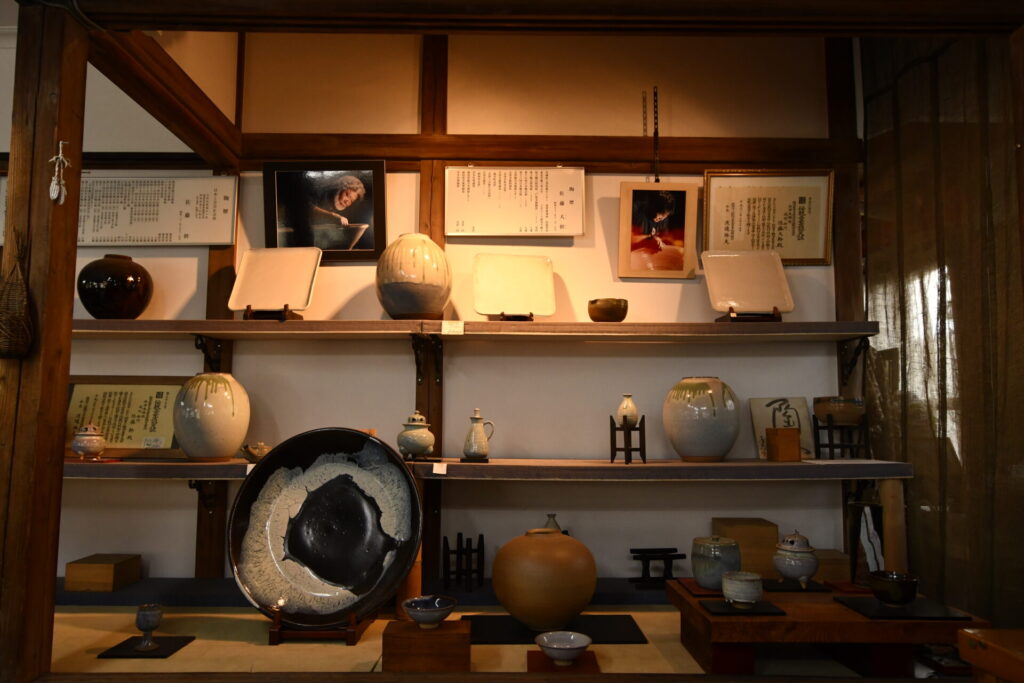
In fact, Sato works in two places: the family kiln here in Aizu-Hongo, and his home in Aizu-Wakamatsu.
Why two bases of work? The reason lies in the severe climate of Aizu.
“This workshop drops below freezing in winter, and in summer it can reach forty-five degrees Celsius.”
Such extreme temperatures are an enemy to pottery. If the moisture inside newly formed vessels freezes during winter, the clay body can be damaged. If drying proceeds too quickly in forty-five-degree summer heat, the surface can crack.
“So for shaping and bisque firing, I often work at home, where I can control the air conditioning. If I do that, pieces almost never crack.”
Rather than trying to overpower natural conditions, he avoids them skillfully by shifting location. That flexible way of thinking reflects his overall stance—one that does not cling too rigidly to tradition.
At the same time, the final firing is always done at the kiln in Hongo. Efficiency, quality, and tradition—he weighs all three coolly and chooses the best balance. That, it seems, is the way of Touga Touraku.
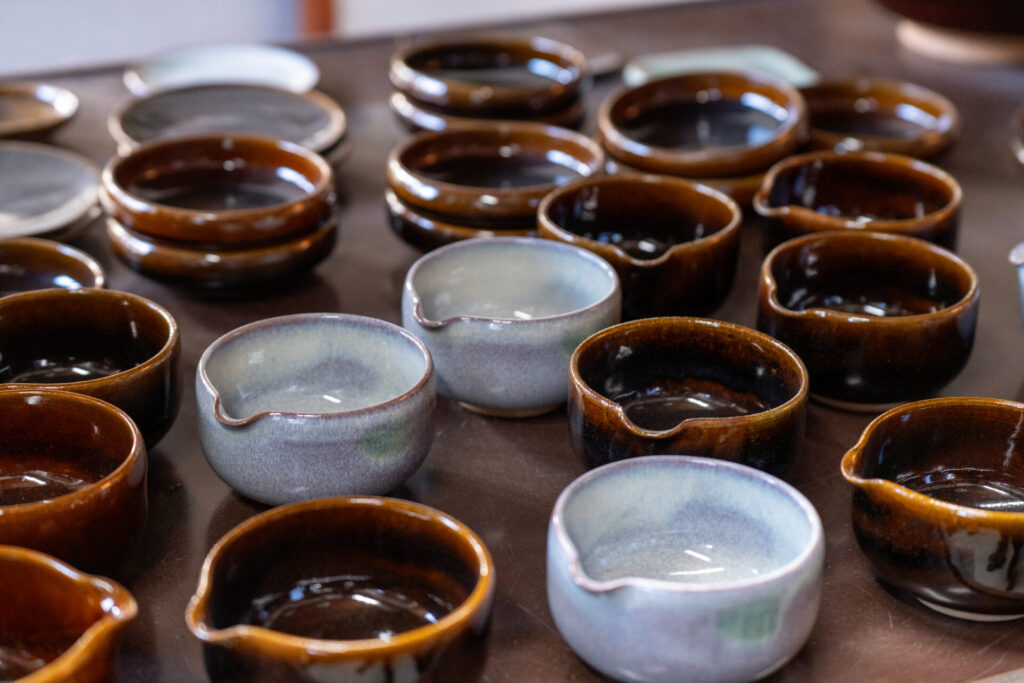
The vessels of Touga Touraku are shaped above all by two glazes: a pale blue-gray ash glaze, and a brown amber glaze.
“Basically, those are our two main colors.”
Even so, Sato has recently started experimenting little by little with additional colors: white, black, and a deep navy. But he is not adding them indiscriminately.
“I don’t want to break too far from our traditional base.”
The forms remain grounded in the traditional shapes of Hongo ware, while the colors are adjusted slightly toward contemporary sensibilities. If he wants to experiment more with form, then he keeps the color restrained. It is, in a way, a quiet hybrid.
He shows me three teacups sitting on a workshop shelf. One is pale blue, one slightly greenish, and one nearly white.
“These all use exactly the same glaze.”
Astonishingly, the apparent differences in color come from the same material.
“The density of the glaze, the moisture in the clay body, and the position in the kiln—that alone changes the color this much.”
Some might accept such variation as part of the charm of pottery. But in the present day, with online sales and catalog orders commonplace, complaints such as “This doesn’t look like the picture” must be avoided.
“I want to deliver what people expect, with confidence. I wanted to get rid of that instability.”
To do so, he spent nearly thirty years refining the process. He adjusted glaze concentration, carefully controlled kiln temperatures, and calculated the differences in heat exposure depending on placement in the kiln.
“It’s really only been this year—maybe about two months ago—that I finally felt I had found a method I could trust as stable.”
He says this lightly, but his face carries the quiet joy of someone who has finally reached something after a very long search.
The Pride of a Craftsman — and a Baton for the Next Generation
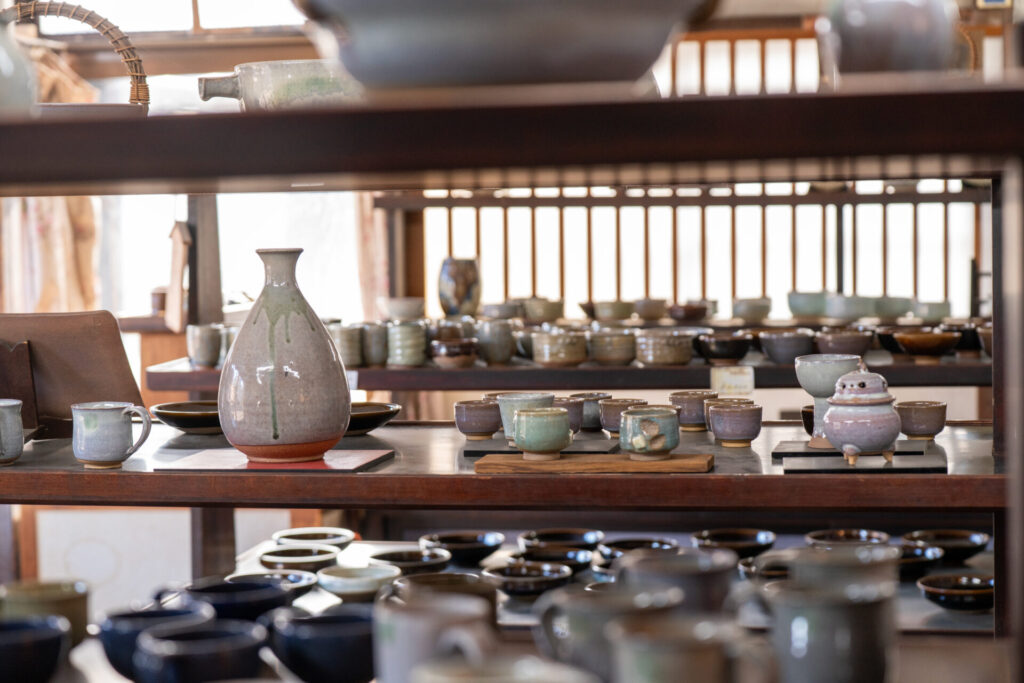
At the foundation of Sato’s pottery-making lies one simple aim: that people use his vessels in everyday life.
“I just want people to use them naturally—morning, noon, and night.”
That principle is reflected in the forms themselves. The body of a vessel is made thin, while the rim is left slightly thicker. This helps prevent chipping and keeps the piece light in the hand.
“What I hate most is when the rim chips.”
His work is also often used professionally in izakaya and restaurants. Sometimes customers from those places contact him after many years and say, “These really don’t break, do they?” For a seller, perhaps it is a little complicated not to have customers coming back to replace broken items—but still, Sato continues to make durable vessels.
“That’s because I make them not to break.”
There is real craftsperson’s pride in that single line.
When asked about the future of Aizu-Hongo ware, his assessment is unsparing.
“At this rate, I think the number of kilns will keep decreasing.”
Unlike places such as Mashiko or Kasama, Aizu-Hongo has no dedicated training school to cultivate new ceramic artists. Relying only on regional revitalization programs has its limits.
“Even if we want to raise awareness, it doesn’t rise easily. When I took part in an event in Okayama, nobody there even knew what Hongo ware was. It was frustrating.”
And yet he has not given up.
In fact, he already has one quiet calculation in mind.
“My older brother’s daughter—my niece—is studying ceramics in Tajimi right now.”
His brother and sister-in-law run Kinooto Kobo, where electric kilns are the main tools. Here at Touga Touraku, by contrast, the work relies on a gas kiln.
“The firing results are completely different with gas and electric kilns. So if she comes back here one day and can work with both, then her range of expression will expand.”
The gas-kiln techniques he has protected, and the new sensibility the next generation is acquiring elsewhere.
“I’d like to make it possible for her to choose which kind of firing is closest to the kind of pottery she really wants to make. I hope I can create that path for her.”
Then he grins.
“If that works out, maybe I can semi-retire a little early.”
He says it jokingly, but beneath the humor lies a deep affection for the next generation. He does not force anything. He simply prepares options, creates an environment, and waits. Perhaps that is also why he continues to refer to himself only as the “future sixth generation”—a way of leaving the baton easier to pass on.
What Do You Wish to Pass On to the Future?
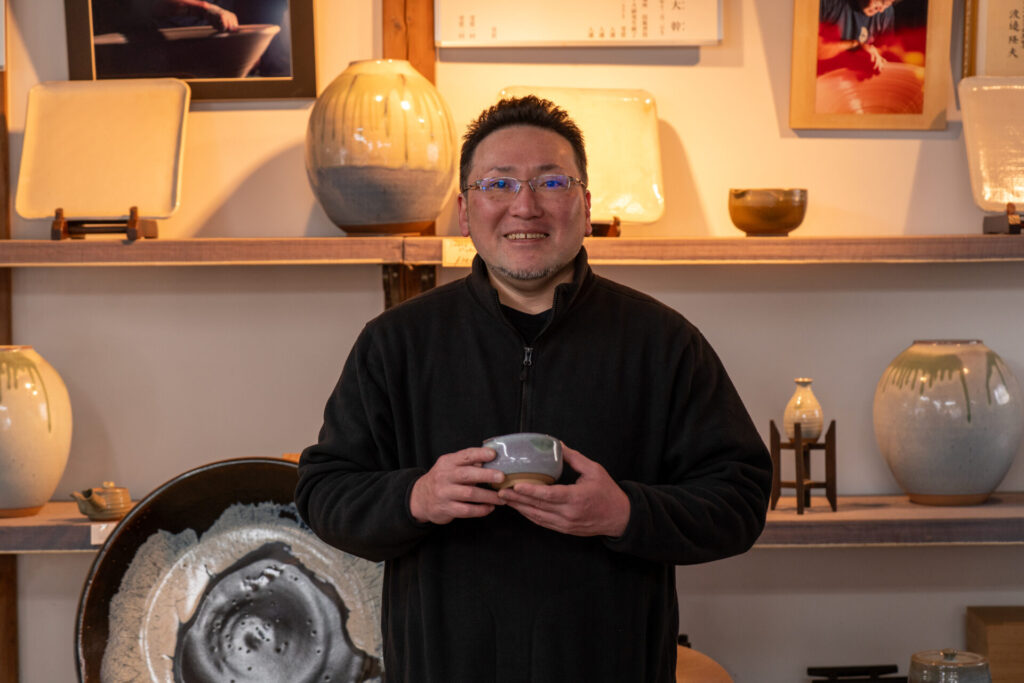
What Sato hopes to pass on to the future is the flexibility of Hongo as a place where many different choices remain possible.
A quiet hybrid that preserves traditional forms while arranging color in a contemporary way. A vision of the future that seeks to bring together the strengths of both gas and electric kilns. Hongo, he feels, is the kind of place that allows such coexistence.
Hiromiki Sato never raises his voice. And yet the vessels that emerge from his hands possess a strength that resists even heavy daily use.
“Well, maybe I’ll just give it a try.”
Behind those light words lie careful calculation, steady passion, and a deep gentleness.
By the time I left, the sleet had stopped and a pale light was beginning to fall across Mukaihaguroyama. The vessels of Touga Touraku caught the winter light and shone quietly.
To enjoy things with grace and ease—that attitude seemed somehow to be held, proudly, within the vessels themselves.