

Painting Happiness onto Warm White — The Story of Everyday Tableware Woven by a Female Potter of a New Generation of Kilns
佐藤朱音
Akane Sato

Aizu [Fukushima]
Akane Sato
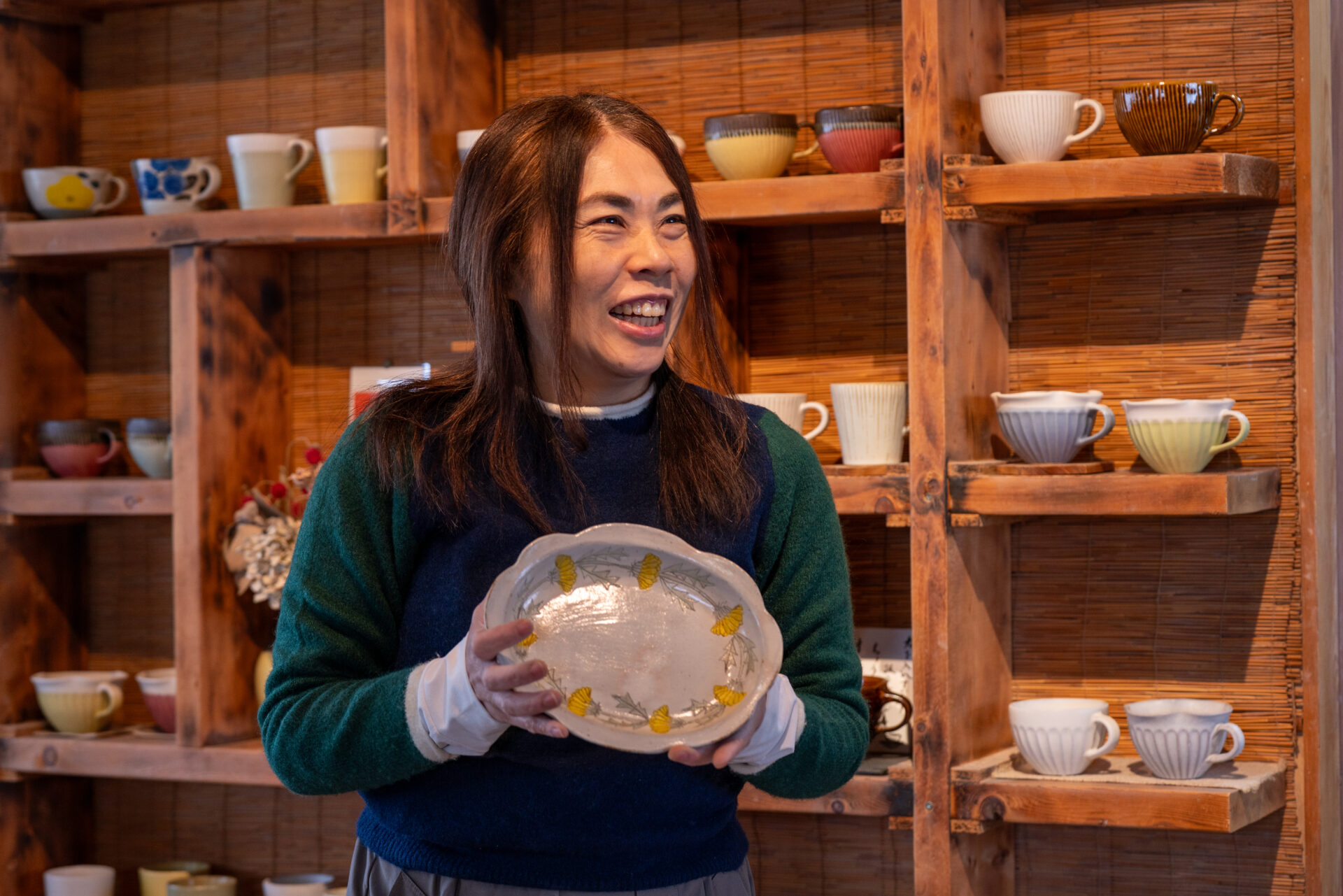
Born in Tokyo. Raised by parents who were metal artists, she became familiar with handcraft and making things from an early age. She went on to study at Tohoku University of Art and Design, where she decided to pursue ceramics. In 2001, she and her husband Daiju, whom she met at university, founded Kinooto Kobo. Today, she continues to devote herself to pottery, looking forward to one day creating works together with her daughter, who is also training to become a ceramic artist.
When she was in elementary school, a visit to a villa in Izu owned by one of her father’s acquaintances became the formative experience that led Akane Sato to dream of becoming a potter. The place she eventually married into was her husband’s hometown—Hongo in Aizumisato Town, a village known for its pottery. We spoke with Sato about the roots of the sensibility that has given rise to the warm, Nordic-inspired designs for which her work stands out within Aizu-Hongo ware.
The Original Landscape Seen by a Girl Raised in Tokyo
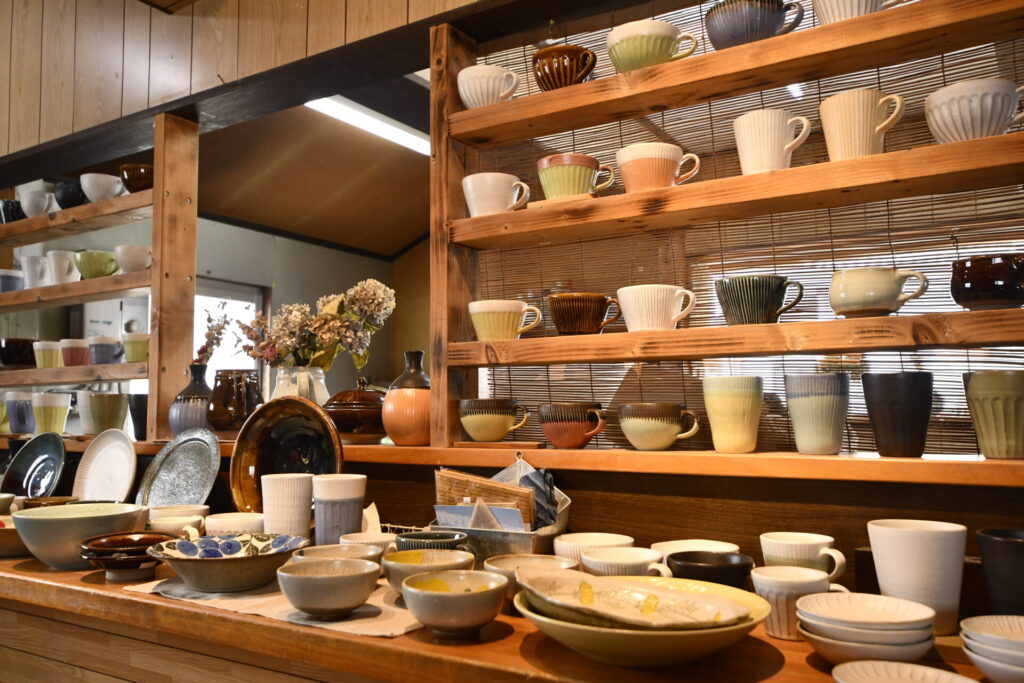
A short turn off the main street of Aizu-Hongo leads to a place that seems to have stepped out of a picture book, wrapped in an atmosphere of warmth and quiet charm. Sunlight pours in through the large windows, illuminating tableware in soft colors arranged throughout the space. From the workshop in the back comes the sound of cheerful voices. Kinooto Kobo, which also offers pottery experiences to visitors, feels somehow deeply at home.
Founded in 2001 by the husband-and-wife team Daiju and Akane Sato, the workshop is known for bringing a fresh breeze to the 400-year tradition of Aizu-Hongo ware. Later, they also opened a café space where visitors can choose vessels while enjoying coffee, expanding the scope of their activities. Their painted designs, which recall Nordic aesthetics, and their simple yet modern shinogi vessels—made by carving striped ridges into the surface—lightly leap beyond the conventional image of “traditional craft” and settle gently into everyday life.
“Sorry to keep you waiting—some customers had just come in.”
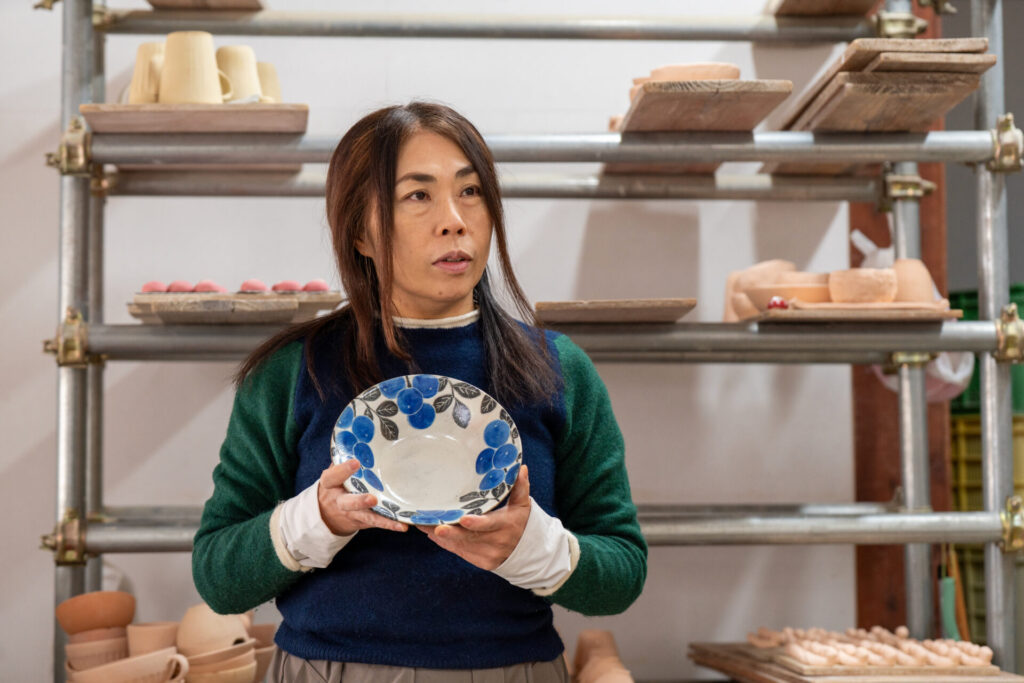
The woman who greets us with a smile so warm it softens the corners of her eyes is Akane Sato, co-founder of the workshop.
Sato was not born in Aizu. She was raised in Tokyo in a home close to the arts, with both parents working as metal artists. The original experience that led her to choose ceramics dates back to a childhood memory.
“I once visited the home of one of my father’s friends, a ceramic artist. It was in the mountains of Izu, and we all went into the hills behind the house to pick wild vegetables. His wife quickly prepared them, and he served them beautifully on the vessels he had made himself. It was just so beautiful—and so delicious.”
Things born from nature, carrying the gifts of nature. That whole sequence etched itself into her young mind as a powerful longing. When the time came to choose a major in art school, she selected ceramics without hesitation. She simply could not forget the feeling of that meal.
Her husband, Daiju, whom she met at Tohoku University of Art and Design, came from Touga Touraku, a kiln in Aizu-Hongo. At the time, however, Sato says the word kamamoto—a family-run kiln—meant little to her.
“I thought ceramic artists were individual artists. So it was only after I got married that I really came to understand there was another world, one where a kiln is inherited as a family business across generations.”
In 2001, the couple established Kinooto Kobo, taking one character from each of their names to create the name. At first, they had no shop and focused only on making work. Four years later, they opened the current store, and four years after that, they opened the café.
“We wanted people to experience time spent using these vessels.”
Perhaps that wish, too, is connected to the original scene she encountered in Izu.
Kinooto’s Signature Style — and the Painted Designs Born from a Mother’s Perspective
What has become one of Kinooto Kobo’s signature expressions is its use of shinogi carving and colorful bicolor glazing. Today, such designs can be found in many lifestyle shops, but Sato says that within Aizu-Hongo ware, it was actually their workshop that first fully embraced this technique and established it as a recognizable style.
“We started simply—with white, black, and amber glazes. Now we make them in seven colors, so they’ve become much more colorful.”
While the wheel-thrown vessel is still leather-hard, each line is carved in by hand using a spatula or trimming tool. Carve too deeply and it breaks through; carve too shallowly and the glaze buries the pattern.
“My hands already know how to do it, so I can move right along,” Sato says with a laugh.
Yet within those rhythmic carved marks lives both the certainty of a trained craftsperson and the softness that only handwork can bring. The rim of a cup is left smooth for comfort on the lips, while the body retains a textured unevenness that lets one feel the presence of the clay itself. That delicate balance creates both a pleasant weight in the hand and a sense of warmth.
“People tell us things like, ‘I want to use this in winter,’ or ‘It feels so comforting.’ Those words are the best compliments we can receive.”
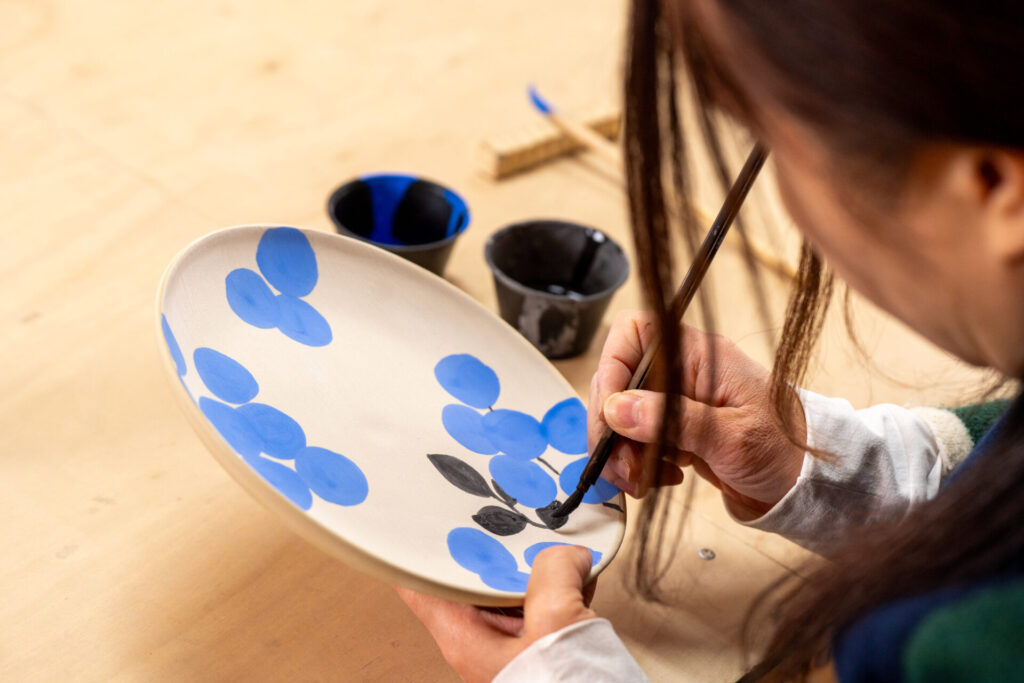
Another of Kinooto Kobo’s charms lies in the painted vessels that Sato herself creates. Wildflowers in a simple, unaffected style; small animals full of charm. These designs, she says, emerged after she became a mother.
“When my children were born, I made rice bowls for them and painted pictures on each one. They were so incredibly happy.”
A drawing made just for them—she saw firsthand how much joy that brought her children, and from there her style began to expand.
“Customers also started choosing them because they wanted their children to use them, or because they had fallen in love with a particular motif. At first I focused on form, but now what matters most to me is how the person using it will feel.”
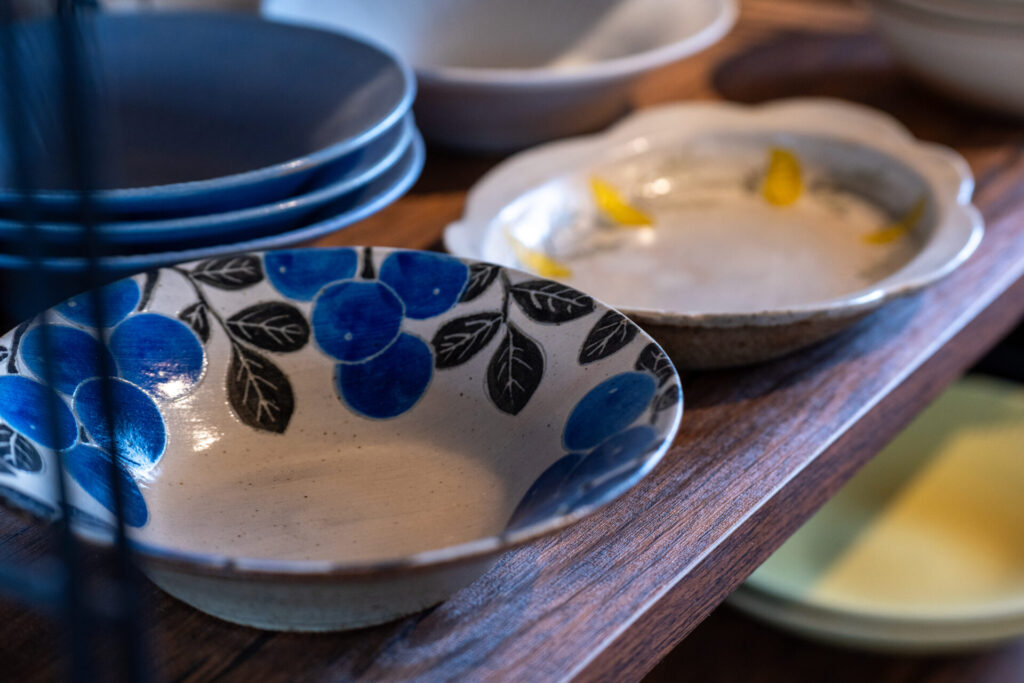
The white she favors is not a stark, blank canvas. Aizu-Hongo ware includes both earthenware (tsuchimono) and porcelain (ishimono), but Kinooto Kobo works mainly with earthenware clay. Over that, they apply a thin layer of white slip using a technique called kohiki.
“I don’t like a cold, hard white. I prefer a gentle white with a bit of the clay beneath showing through—a white that still carries the flavor of the earth.”
The images painted onto that warm white surface are bright and lovely without being overpowering, making them ideal companions that enhance food rather than dominate it.
“When people want a plate, they usually imagine it together with food, don’t they? Like, what would toast look like on this? Or salad? So I want to make vessels that make everyday life just a little more enjoyable.”
A Production Area Open to Outsiders
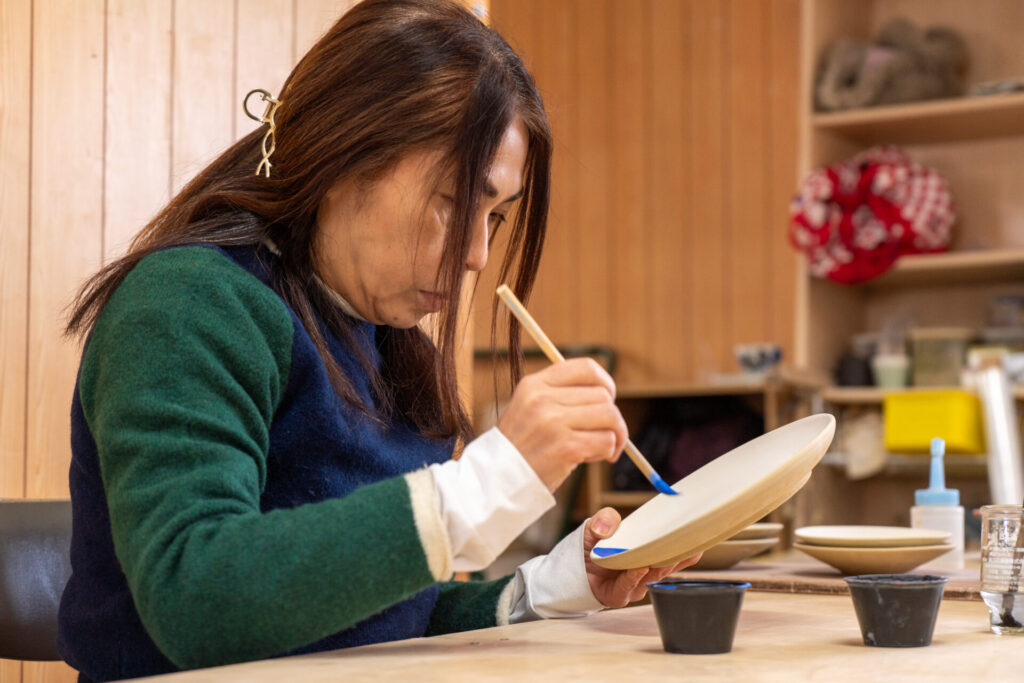
When people hear the phrase “traditional craft production area,” they may imagine a closed world—strict, insular, and unwelcoming to outsiders. But Sato says that was not her experience at all.
“Not at all. I came from Tokyo and was still allowed to do what I wanted quite freely, and the other kilns welcomed me warmly. Craftspeople have always traveled across Japan to learn techniques, haven’t they? Many potters here also trained in places like Kyoto and Seto. Maybe it’s simply the kind of spirit this industry has.”
Just as the lords of Aizu once invited skilled technicians from elsewhere, and just as artisans themselves traveled in search of new skills, Aizu-Hongo may still carry in its memory a forward-looking spirit—one willing to take in what is good and what is new.
Today, Kinooto Kobo has young people working there who came from Hyogo and Saitama through the regional revitalization program. They have dreams of one day establishing their own kilns in Aizu-Hongo, and Sato and her husband teach them generously.
“The population is shrinking, and there are fewer kilns now. But that’s exactly why we want to energize this place. Just as we were accepted when we came from outside, now it’s our turn to welcome the next generation.”
What Do You Wish to Pass On to the Future?
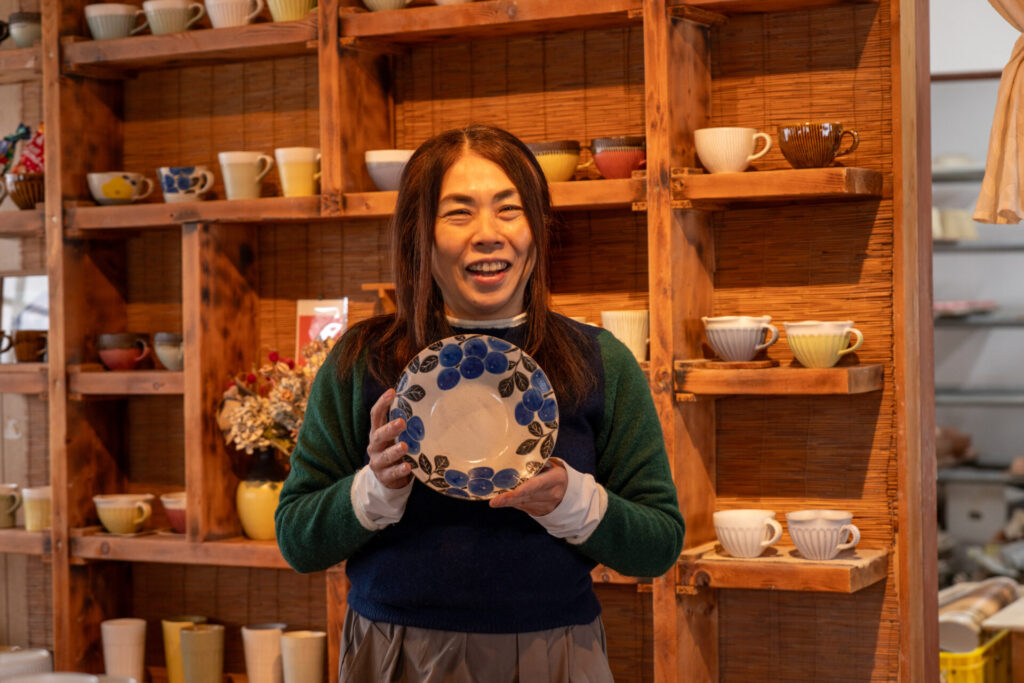
At the end of the interview, Sato spoke about the future with a bright and happy expression.
“Our daughter graduated from art school and is now training in Tajimi, in Gifu Prefecture. She’s planning to come back here the year after next.”
On a shelf in the workshop stands a flower vase her daughter sent home while in training, its softly complex glaze blending in beautiful layers.
“She’s learning new things in her own way. I’m excited already, thinking about all the things we might be able to do together.”
What Sato hopes to carry into the future is a spirit of growth—welcoming the next generation and evolving together with them.
A wife who came from Tokyo. A husband who has long supported his local community. A daughter who will return after seeing the world beyond it. As their different experiences and sensibilities mingle, Kinooto Kobo will no doubt take on new colors once again.
“If there’s one thing I want most, it’s for the people who use our vessels to feel even a little happier. If I had to sum up what matters to me in one sentence, that would be it.”
As we finish talking, a café customer who has just finished a cup of coffee picks up a plate on the way out and murmurs, “Breakfast would feel like a good start to the day on this.”
That quiet remark felt like the very wish that Sato—and Kinooto Kobo itself—has pressed into the clay.
Aizu-Hongo ware has a history of more than 400 years. Onto the rings of that long tradition, Kinooto Kobo continues to add a new layer—one called kindness.