Weaving Tradition While Exploring New Possibilities: The Allure of Kinzan Kiln
吉田 幸央
Yukio Yoshita

Ishikawa []
Yukio Yoshita
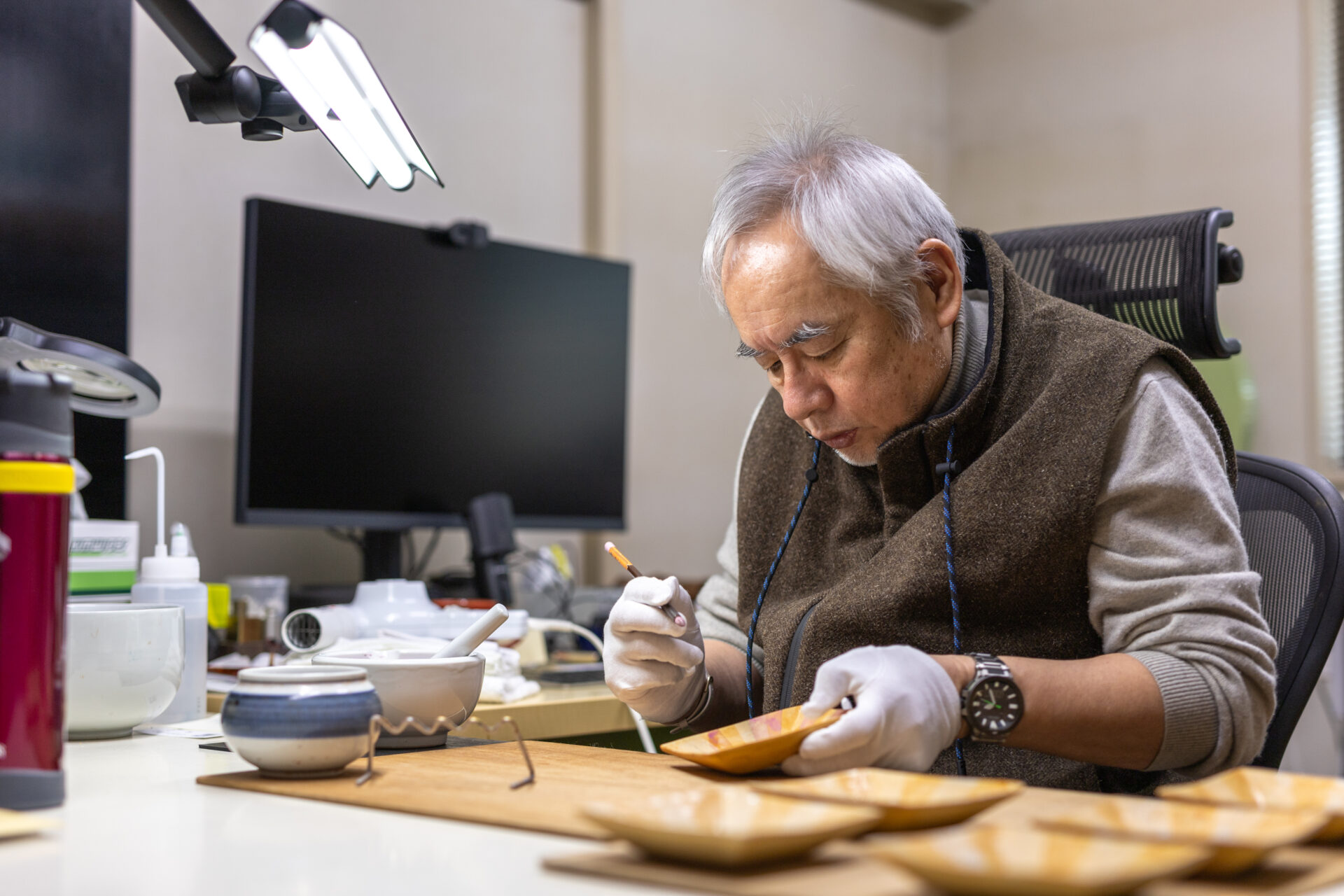
Born in Komatsu City, Ishikawa Prefecture. He is the fourth-generation head of Kinzan Kiln, a Kutani ware pottery studio. After graduating from the Crafts Department at Kanazawa College of Art, he enrolled into the Ishikawa Prefectural Kutani Ware Technical Training Institute, where he won the Asahi Ceramic Art Exhibition Encouragement Award during his studies. Before turning 30, he joined Kinzan Kiln and became its fourth-generation leader in 2009. While inheriting the tradition of Kutani ware, he continues to pursue new techniques, making him a representative figure among contemporary Kutani ware artists. His unique technique of layering colors and applying gold accents results in pieces that resemble watercolor paintings, exuding both beauty and modern sophistication.
Kinzan Kiln, located in Komatsu City, Ishikawa Prefecture, is a distinguished Kutani ware pottery studio. The kiln’s works, crafted using the "gold decoration" technique honed over its 120-year history, captivate not only the Japanese but also people worldwide. What thoughts and commitments drive the artisans behind these exquisite creations? We spoke with Yukio Yoshita, the fourth-generation head of Kinzan Kiln.
Kinzan Kiln: A Master of Gold Decoration in the Kutani Ware Tradition
Komatsu City, Ishikawa Prefecture, is a town of approximately 100,000 people, located about 40 minutes by car from Kanazawa Station, a stop on the Hokuriku Shinkansen line.
The area has long been a hub for craftsmanship, with many residents earning their livelihood through Kutani ware, one of Japan’s most renowned traditional crafts. The raw materials for Kutani ware are mined from Hanazaka Toishiyama, a local source of pottery stone. The city is also home to production facilities that refine the raw stone into clay, essential for pottery making.
Kutani ware has traditionally been produced through a division of labor, separating the creation of ceramic bases and the overglaze painting process. Komatsu City accounts for 80% of Kutani ware base production and is home to many kilns specializing in overglaze painting.
The hallmark of Kutani ware is its striking, vivid colors that leave a lasting impression. The “Kutani Gosai”—a palette of red, green, yellow, purple, and deep blue—combined with gold decoration has fascinated admirers for centuries.
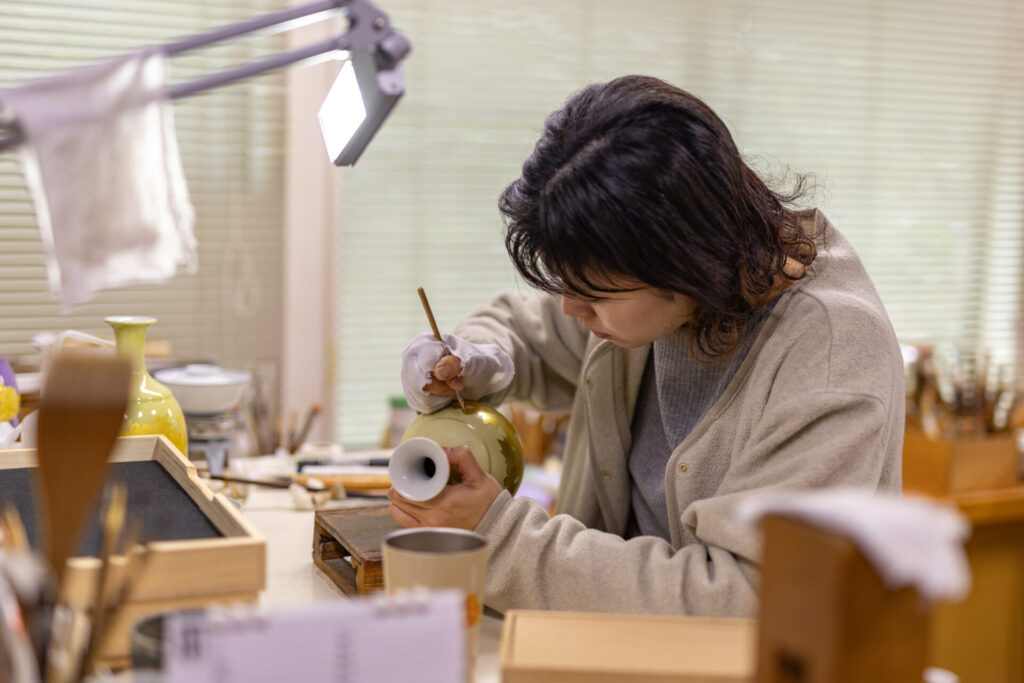
Kutani ware originated in 1655 (mid-Edo period) when Saijiro Goto established a kiln under the patronage of the Kaga domain. The early works from this period are known as “Ko-Kutani” (Old Kutani). Although Ko-Kutani disappeared within a century, Kutani ware was revived in the late Edo period. By the Meiji era, Kutani ware, particularly the ornate “Sai-shoku Kinrande” style, which combines vibrant colors with gold accents, gained international recognition as “Japan Kutani.”
Kinzan Kiln, founded in 1906 by Shozaku Yoshita in Komatsu City, has specialized in overglaze decoration for over 120 years. While mastering traditional techniques, the kiln has continuously adapted its work to suit each era.
“Overglaze kilns use a variety of materials and techniques, such as color painting, gold decoration, and glazes, but Kinzan Kiln has a particular focus on gold decoration,” says Yukio Yoshita, the fourth-generation leader.
Different Expressions of Gold Decoration Between Father and Son
His father, Yoshita Minori, the third-generation leader, is a renowned master of “Yūri Kin-sai” (Gold Under Glaze), a technique that prevents gold leaf from peeling by coating it with glaze. This method preserves the brilliance of the gold while also creating a sense of depth by layering thin and thick gold leaf. At over 92 years old, Bitoku continues to create ceramics.
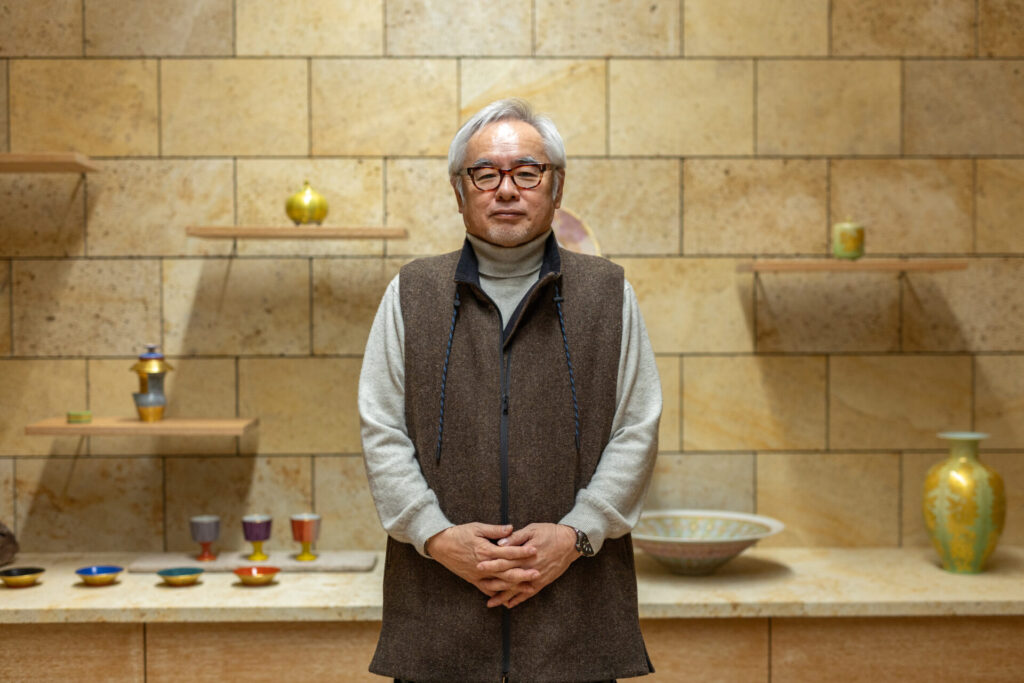
“What makes Yūri Kin-sai fascinating is that it is both scientifically logical and artistically expressive,” says Yukio.
On the other hand, Yukio specializes in “Kinrande,” a technique originating in China 500–600 years ago, where gold is applied over painted ceramics.
“When I was younger, I found Kutani ware’s gold decoration to be overly extravagant. However, as I experimented with various colors, I realized how well gold complements them. The more I used gold, the more I was drawn to its beauty.”
Due to the rising cost of gold in recent years, few kilns specialize in gold decoration. Yet, Kinzan Kiln remains dedicated to this technique, making it one of its defining characteristics.
Although both father and son work with gold decoration, their artistic expressions are entirely different.
“I never wanted to imitate my father’s work, nor did I think I could. While Kutani ware techniques can be passed down, artistic expression changes with time and the individual artist’s age. My father embraced Yūri Kin-sai as his medium of self-expression, but I find it uninteresting to simply repeat established techniques. For me, innovation and new forms of expression are essential. Both my father and I believe that tradition is built by continually layering techniques and materials that fit each era.”
Balancing the Roles of Artist and Craftsman
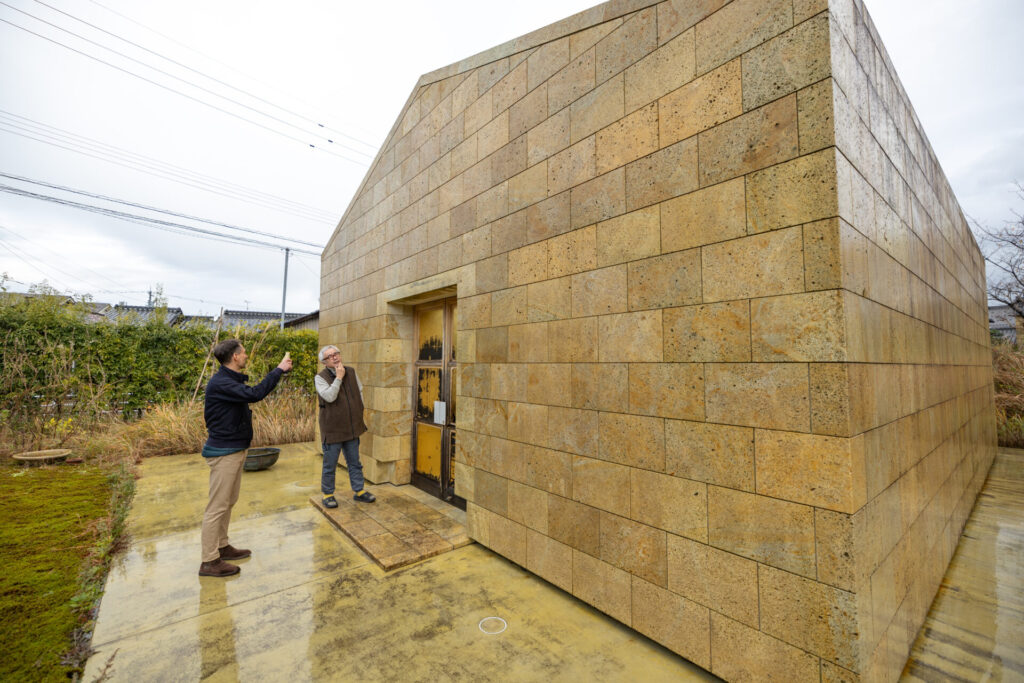
In 2009, Yukio Yoshita officially took over as the fourth-generation head of Kinzan Kiln . Did he always feel a sense of duty to continue the family legacy?
“Not really. Since our kiln has been around for only about 120 years, it felt more like a family business than a legacy to be inherited. I was naturally inclined toward craftsmanship because I was good with my hands and enjoyed making things. But honestly, I didn’t have any exceptional talents beyond that.”
Although he entered the world of Kutani ware organically, his formal training at the Kanazawa College of Art and later at the Kutani Ware Technical Training Institute helped shape his career. During his studies, he won an award at the Asahi Ceramic Art Exhibition.
“Back then, standing out in ceramic competitions was a stepping stone for moving forward in the industry. While assisting in the family business, I also pursued my own artistic work, which made me realize that I could make a living in ceramics. My university and training institute years were like a period of exploration.”
At nearly 30, he joined Kinzan Kiln.
“The smells of paints and chemicals from my childhood were still the same. The work started with lighting a brazier and involved sitting all day, painting calmly and methodically. To be honest, I wondered if I could really keep doing this forever.”
While his father did not directly teach him traditional techniques, the kiln’s craftsmen did. Balancing his work as both an artist and a craftsman was sometimes challenging.
“Creating my own works can be tough, but at the same time, it brings a sense of excitement and hope for the future.”
Through this dual role, Yukio gradually established his own artistic style.
Establishing a New Style of Kutani Ware with Soft Colors, Gold Accents, and Innovative Clay Formation
“When I decided to pursue a career as a ceramic artist, I was grateful that my family owned a kiln. I had free access to tools and materials, which helped me develop my craft. As I explored various artistic expressions, including sculptures, I believe I established the foundation of my current style.
However, I was never particularly fond of the intense colors traditionally associated with Kutani ware. Instead, I was drawn to the soft textures of glazes on white porcelain and the natural, earthy qualities of ceramics. Perhaps this preference stems from an inherently Japanese aesthetic.”
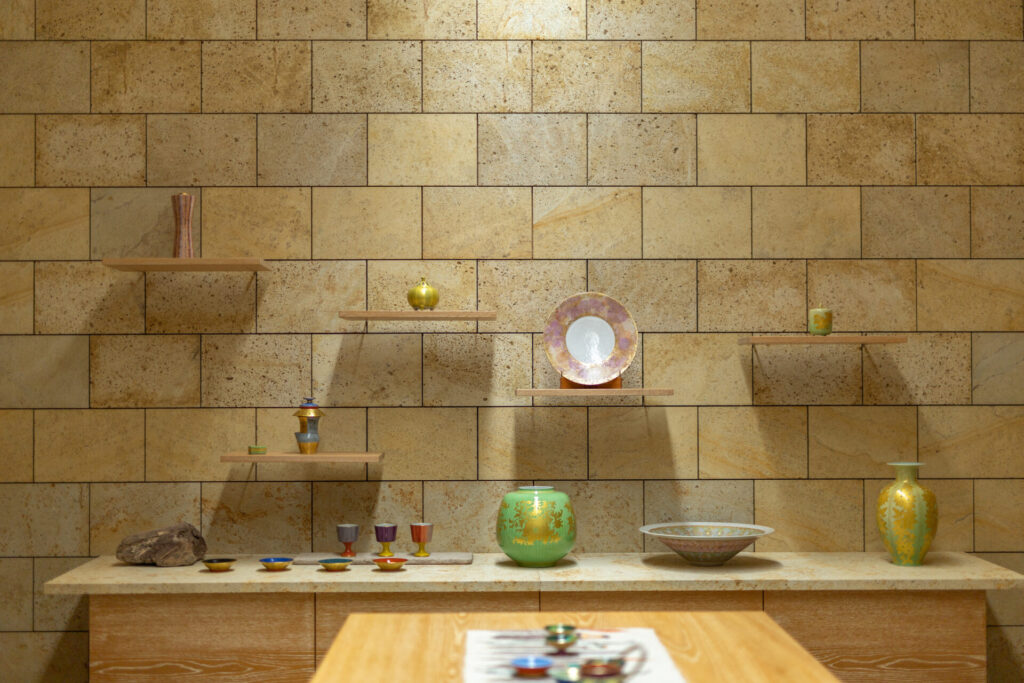
As he sought a balance between the traditional Kutani ware style and his own artistic inclinations, Yukio developed a watercolor-like color palette. Layering Western paints, he achieved a soft expression, further enriched with gold accents. His work significantly redefined the traditional image of Kutani ware.
Unsatisfied with conventional porcelain textures, he also experimented with clay formation. By applying a water-repellent agent to the clay body, the glaze repelled like water droplets. The resulting uneven surface allowed for subtle layering of colors, producing a distinctive gradation and organic blurring effect.
What did his father, Minori, think of this new technique Yukio had pioneered?
“My father never commented on it. He neither praised nor criticized my work. Sometimes, though, he would silently stand behind me while I worked… Perhaps he had things he wanted to say but chose to hold back.”
This silence reflected Minori’s belief that traditions are shaped over time, with each artist adding new techniques to the existing legacy. This philosophy has been passed down through generations. Yukio’s son, Tarou, who also works at Kinzan Kiln, has developed a monochrome style distinct from both his father’s and grandfather’s.
“Just as I once resisted certain aspects of Kutani ware, he probably has strong personal preferences of his own,” Yukio remarks. Yet, it is undeniable that his ability to immerse himself in diverse expressions as an artist is deeply rooted in the fact that he was born into a Kutani ware kiln family.
Bringing Kutani Ware into Everyday Life
In 2019, “Mutan,” a new gallery for Kinzan Kiln, was opened. Built using “Kannonshita Stone” quarried in Komatsu City, the gallery exudes warmth and tranquility, as if embraced by nature.
“Mutan serves as a space for artists and craftsmen to express themselves. Additionally, it provides an opportunity for people to learn about the values of Kutani ware—something we haven’t actively communicated in the past. While Kutani ware is not inexpensive, we also introduce ways to incorporate it into daily life.”
Having grown up using vividly colored Kutani ware for everyday meals, Yukio finds pure white tableware somewhat unsettling. However, through interactions with customers, he discovered that some people hesitate to use gilded Kutani ware because they fear the gold and colors will wear off over time.
“This realization was quite surprising. For us artisans, fading colors and gold are natural aspects of the material’s aging process, a form of beautiful patina. But I felt that this perspective wasn’t being conveyed effectively.”
Rather than simply being decorative, Kutani ware should be integrated into daily life. Motivated by this belief, Yukihisa uses “Zattan” as a base to collaborate with food, tea, sake, and fragrance, sharing the joy of using Kutani ware. Through events and workshops, he continues to explore new dimensions of its appeal.
“Kutani ware can be both art and craft. Its use can evolve depending on time and place. That is its charm. Through various opportunities, I hope to gradually introduce new perspectives on its value.”
Expressing “As Is” Beauty Through Fragments
Recently, “Mutan” has featured a unique use of Kutani ware—fragments from pieces broken during the Noto Peninsula earthquake on January 1, 2024.
“This earthquake severely impacted Wajima’s lacquerware and Suzu City’s Suzu-yaki pottery, and Kinzan Kiln also suffered significant losses. We have been repurposing these fragments into chopstick rests and using them in dining and tea gatherings.”
Even as fragments, Kutani ware, adorned with vibrant colors and gold accents, retains its beauty. But why leave the broken pieces as they are?
“Some have suggested using kintsugi (golden joinery) to repair them. However, as a creator, restoring broken pieces feels like mere ‘repair’—it carries a sense of pain. Adding anything to fragments that are already visually beautiful feels excessive. Instead, I believe it is more meaningful to preserve them in their fragmented state and explore new ways to express our sentiments through them.”
In practice, Yukio is organizing collaborations with contemporary dancers and photographers using these fragments. He describes the process as resembling a form of prayer, a way of recreating the reality of what has happened. This approach may be forging a new sense of value.
What Do You Hope to Pass On to the Future?
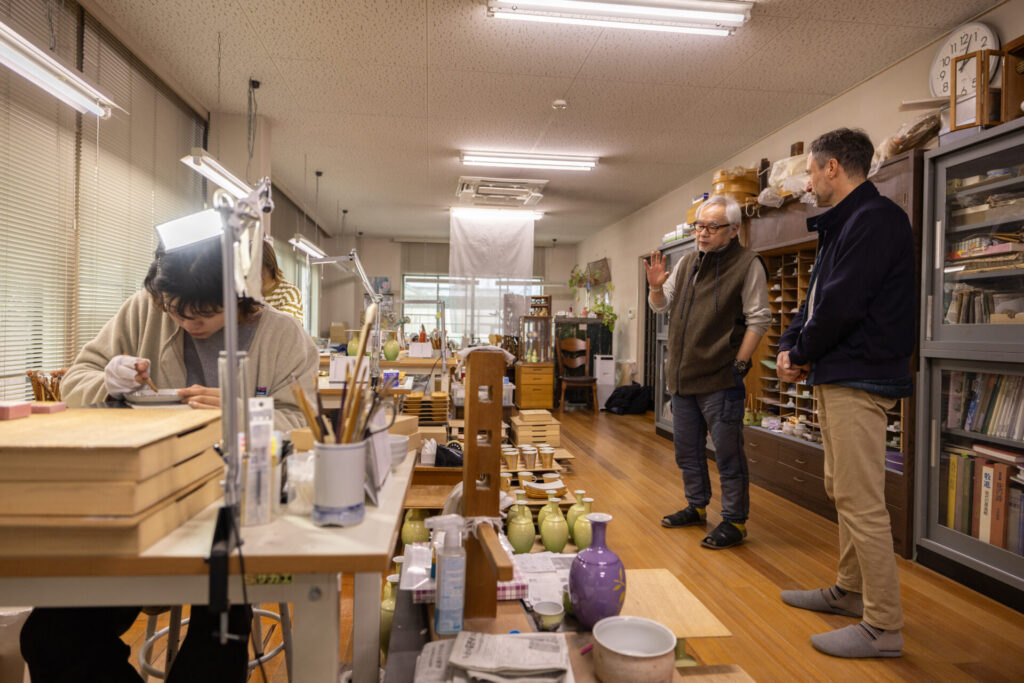
Finally, when asked about the future of Kinzan Kiln, Yukio shared his vision:
“Neither my father nor I adhere strictly to naturalism or historical methods. Instead, we focus on exploring new expressive possibilities while preserving the essence of craftsmanship, incorporating modern technology as needed.”
Minori, known for his technological expertise, contributed to the development of electric kiln control panels and the Ishikawa-style dispersion grinder for gold leaf. Yukio, too, integrates IT into his work, collaborating with a major electronics company to develop a system that simulates color combinations, uncovering new possibilities for Kutani ware.
“In the past and present, our approach has been to eagerly absorb various technologies and apply them to our craft. That’s what defines us.”
Komatsu City has recently seen an influx of young creatives, and Yukio hopes they will establish and share new cultural narratives. Over the past 120 years, Kinzan Kiln has continuously woven its traditions while embracing innovation, just as these young artists do today. As it has in the past, Kinzan Kiln will continue to unveil new facets of Kutani ware’s enduring charm in the years to come.