Passing On Hongo Ware Desired by the World — The Pride of a Kiln Protecting the Oldest Porcelain Tradition in Tohoku
佐竹敦夫
Atsuo Satake

Aizu [Fukushima]
Atsuo Satake
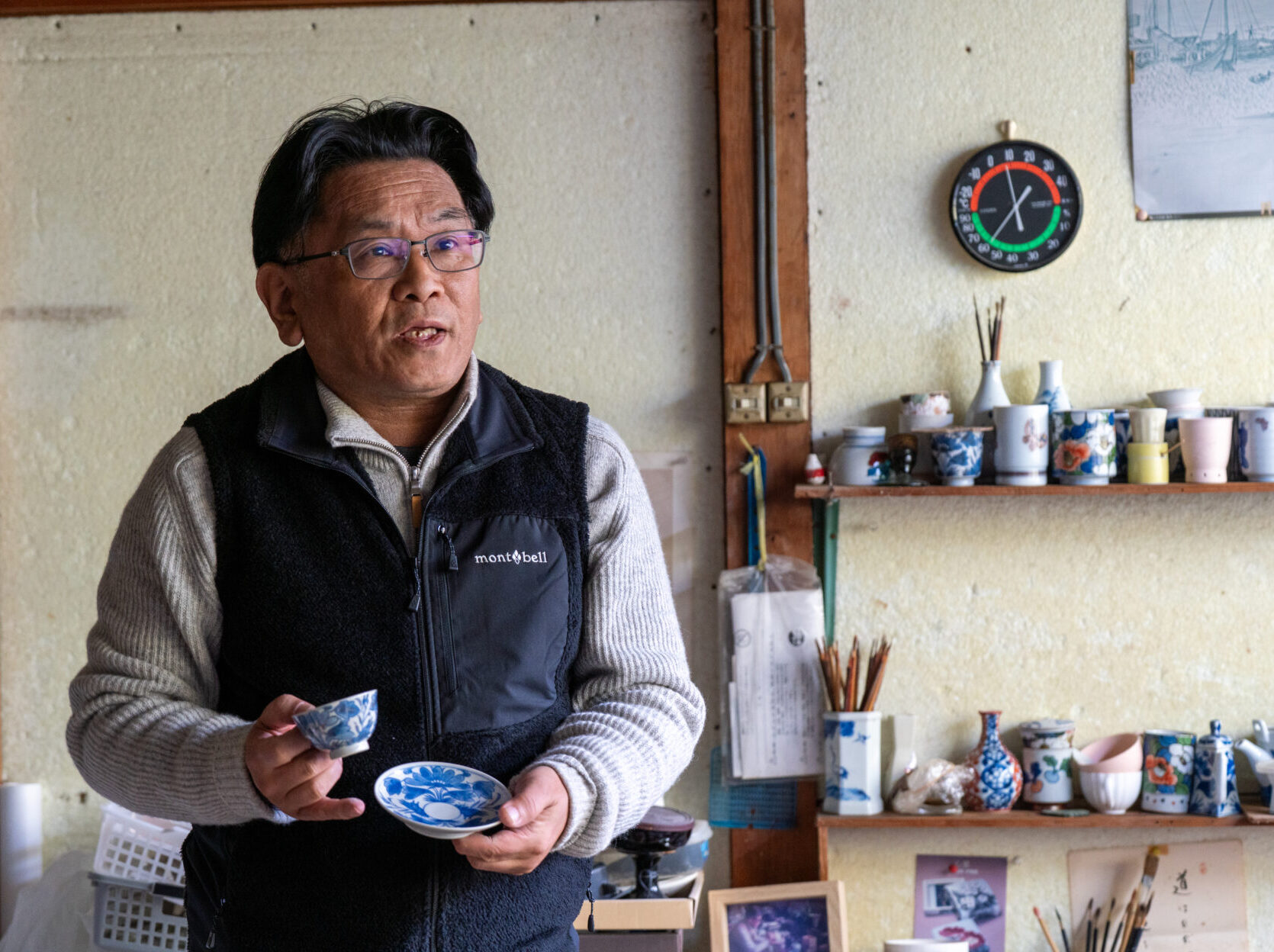
Born in Aizumisato Town, Fukushima Prefecture. The fifth-generation head of Tomizo-gama, founded in 1872. He carries on the traditions of Aizu-Hongo ware while producing both porcelain and earthenware. He studied nihonga (Japanese painting) in his student days, and even after inheriting the kiln, that artistic training continues to inform his painted decoration. In addition to the camellia motif for which Tomizo-gama is especially known, he works with a wide range of designs, from traditional auspicious patterns to modern animal motifs.
With a history spanning more than 150 years, Tomizo-gama stands in the pottery town of Aizu-Hongo. Supporting the kiln today is its fifth-generation head, Atsuo Satake. Working in both earthenware and porcelain, and making use of a broad range of techniques and methods, he continues to create a remarkable variety of vessels. What is the source of the energy that allows him to inherit tradition while also pursuing his own forms of expression, including contemporary designs? We spoke with him in depth.
Upon the Layered Ground of 150 Years — The History of Tomizo-gama
At the southern edge of the Aizu Basin lies Aizumisato Town, where peaceful rural scenery stretches into the distance. It was once known as a true village of pottery, a place where more than one hundred kilns lined the roads and smoke rising from their chimneys was said to cover the sky.
More than four hundred years later, twelve kilns still continue to keep their fires alive. Among them is one place that seems to carry time in a particularly quiet way: Tomizo-gama, founded in 1872.
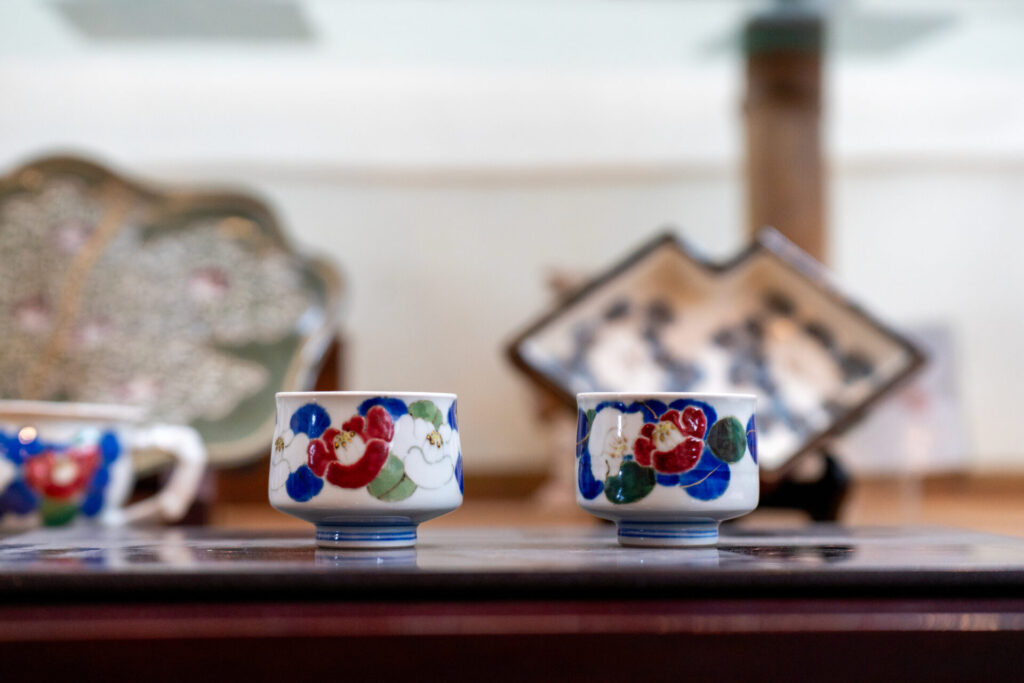
Opening the door to Hakuhodo Chikutei, the gallery of Tomizo-gama, one is immediately wrapped in a heavy, cool atmosphere tinged with moisture. Along the gallery walls are displayed works by successive generations of the Tomizo line, together with materials introducing the history of both the kiln and Hongo ware itself.
“Welcome—you must be cold.”
The man who offers a rattan chair and guides me toward an electric heater is Atsuo Satake, the fifth-generation Tomizo.
“You see, this used to be a mountain,” he begins, pointing toward the workshop grounds with a faraway look in his eyes. “This was where the climbing kiln once stood.”
The history of Tomizo-gama goes back to the early Meiji period. Originally, the main branch of the Satake family operated a large kiln on this land. The beginning of Tomizo came when a second son branched off from that family and established an independent kiln of his own.
Since then, more than 150 years have passed. The world moved from Meiji to Taisho, Showa, Heisei, and now Reiwa. The site where the climbing kiln once stood became a supermarket, and its appearance changed entirely. The main family’s kiln eventually disappeared. And yet Tomizo-gama has continued, still kneading clay on this same land.
Vanishing Memories of Handwork — and the Alchemy That Lives On
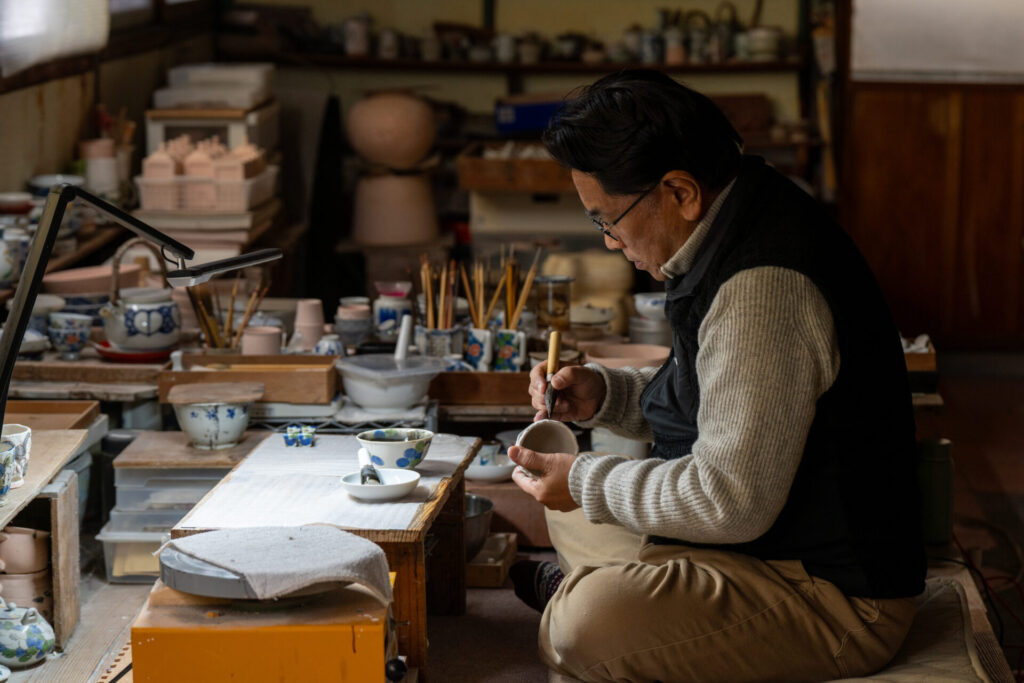
One of the greatest distinctions of Aizu-Hongo ware is that, within a single production area, both earthenware and porcelain are made—an unusual duality even in Japan. Tomizo-gama too works in both, but what has especially made its name known is its mastery of sometsuke, the blue-and-white style of delicate painting on luminous white porcelain.
“For generations, our family has been good at fine work,” Satake says. “In particular, the techniques for painting geometric patterns known as shonzui and other auspicious motifs were things the previous generations preserved with their whole lives.”
He showed me an old design book in which patterns copied from works by famous Edo-period painters such as Hokusai and Hiroshige appear alongside detailed sketches made by artisans themselves. There are traces everywhere of the thought process behind the work—how to lay a chosen design onto a vessel, how to balance the composition.
These were not simply design drawings. They were records of the fierce determination of earlier craftspeople competing to survive through their skill.
“In the old days, the fine brushes used to paint lines for shonzui and landscapes were made from rat hair,” Satake says with a quiet smile. “The finest quality came from rats living around Lake Biwa, but they disappeared more than twenty years ago. Now we use brushes made in China or substitutes. Even so, the number of artisans who can make those brushes is itself decreasing. When the tools disappear, that is the same thing as the techniques disappearing.”
As he says this, Satake unexpectedly brings up the film series Otoko wa Tsurai yo.
“There’s an episode with Ayumi Ishida as the heroine, you know. In it, there’s a Kyoto potter, and there’s a scene where the wheel is turned by hand. It looks almost charming in the film, but that really was the original form. You turned the heavy wheel with one hand and had to pull the clay before the centrifugal force died away. Since both hands weren’t free, it was done one-handed.”
Even now, in an age where electric wheels have become standard and efficiency is taken for granted, there remains in his hands a memory of the speed at which one must move in dialogue with clay. He has not forgotten the kind of rotation that follows human breath. Perhaps that is part of what gives Tomizo-gama’s vessels their subtle warmth, despite their technical precision.
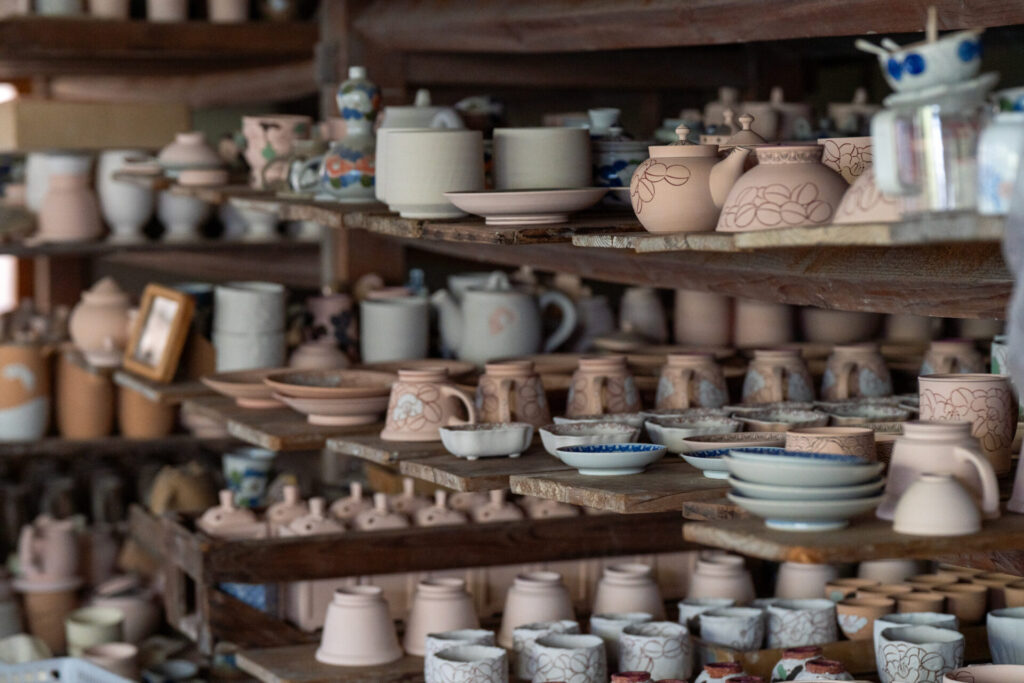
The white that characterizes Tomizo-gama’s work is not a simple white. It carries a faint bluish tone, along with both a cool dignity and a sense of depth. That color is produced by the local raw material known as Okubo pottery stone, together with a firing method called reduction firing.
“In pottery, there are two approaches: oxidation and reduction. Oxidation means firing with plenty of oxygen. But if you do that with porcelain, it turns cream-colored. To get that true white—or the beautiful bluish white—of porcelain, you have to cut off oxygen inside the kiln and fire it in a kind of incomplete combustion. That’s reduction.”
When Satake speaks, his words sound almost like those of a chemist. It is said that in the Edo period, it took eighteen years before this reduction-firing technique was fully established.
“Earthenware is fired at about 1,200 degrees Celsius. Porcelain is 1,300. It’s only a difference of 100 degrees, but they’re completely different worlds. Earthenware clay contains iron and is darker in tone, so to make it appear white, you apply a slip known as white makeup. Porcelain, on the other hand, is made by firing stone itself until it vitrifies. Since we work in both, it takes a real shift in the mind.”
To know and control the chemical reactions of clay and flame—this is, in a sense, a form of modern alchemy.
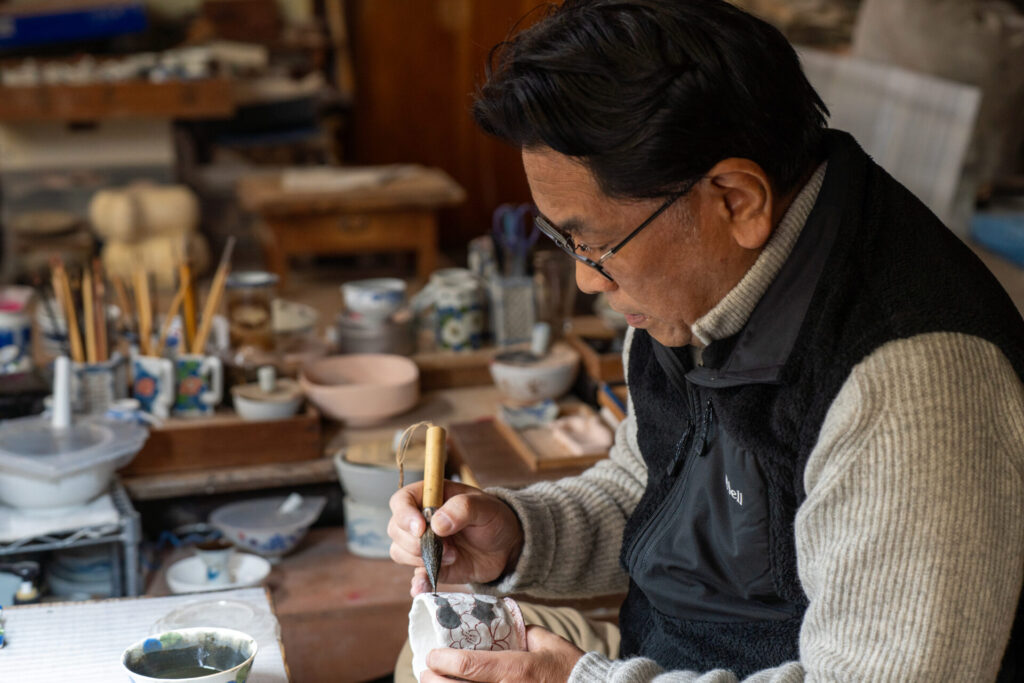
The process of painting onto bisque-fired white vessels also contains one of the traditions that supports Tomizo-gama’s signature camellia motif: a technique known as dami, or tonal filling.
A thick brush is loaded with gosu, a bluish-gray pigment, and then used to fill the interior of outlines previously drawn with a finer brush. But the point is not simply to fill the area. By controlling the moisture in the brush through fingertip sensation alone, the artisan creates infinite gradations within a single color.
Once the brush is placed, there is no going back. The bisque-fired body instantly absorbs water, so no correction is possible. If one makes a mistake, the weeks of work that went into shaping, drying, and bisque firing are all lost.
Whether in the geometric rigor of shonzui, the landscapes of sansui, or the tonal shading of dami, Satake moves his brush without hesitation in a world where even a tenth of a millimeter cannot be off. The concentration it demands feels close to prayer.
The Dream of Painting — and a Return to Playfulness
For someone so deeply versed in traditional techniques, it may come as a surprise that Satake once resisted inheriting the family business.
“To be honest, I wanted to go to an art university in Tokyo. I wanted to study nihonga.”
To the young Satake, the work of tracing already-established traditional patterns may have seemed cramped and uninspiring. Although his parents persuaded him to go to Kyoto for training, the fire within him—the desire to draw—never went out. Now, that desire has blossomed into a spirit of freedom and play grounded in tradition itself.
On a shelf in the gallery stands a beer mug unlike the others. Painted on it is the yōkai known as Tenaga Ashinaga, a creature with unnaturally long limbs. It is avant-garde, humorous, and immediately striking.
“I designed this in my twenties and submitted it to a prefectural exhibition. Every so often, someone finds these older pieces interesting and buys them.”
That is not all. There are modern penguin designs, as well as charming rabbits rendered in blue-and-white decoration.
“I want younger people to use them too—and above all, they’re fun to paint.”
The sensibility of the young man who once wanted to pursue Japanese painting has, over the course of forty years, found full expression within the framework of traditional craft. Rather than simply preserving old patterns, he plays with them, bringing the atmosphere of the present into them. That, perhaps, is the style of the fifth-generation Tomizo.
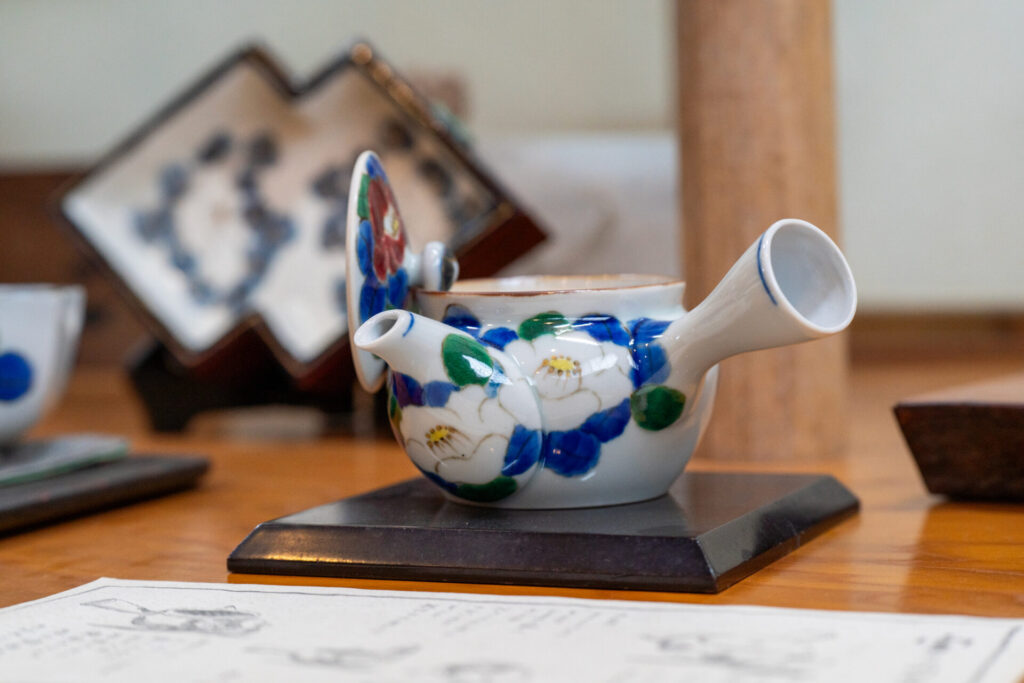
Toward the end of the interview, Satake picks up a teapot.
“A truly good teapot can stand.”
With that, he places it on the flat table—not upright on its base, but balanced so that its handle stands vertically and the whole teapot supports itself.
“If the balance isn’t perfect, it won’t do this. And if you’ve also paid attention to the spout and the strainer, then a teapot balanced like this pours differently. You can brew delicious tea right down to the very last drop.”
His pursuit is not limited to visual beauty. He pushes the functionality of a vessel as a tool to its furthest point. That attitude has earned recognition even beyond Japan.
“Recently we’ve had many customers from China. They truly understand tea culture, so they can instantly tell when a tea utensil is good. Sometimes overseas visitors appreciate the value of this kind of handwork more readily than younger people in Japan do.”
Japanese porcelain once began in admiration for Jingdezhen in China, first through imitation of Arita ware. And now, after a long historical journey of its own, it has developed into something unique that once again surprises people from the Asian mainland. One cannot help feeling the strange circulation of history in that.
What Do You Wish to Pass On to the Future?
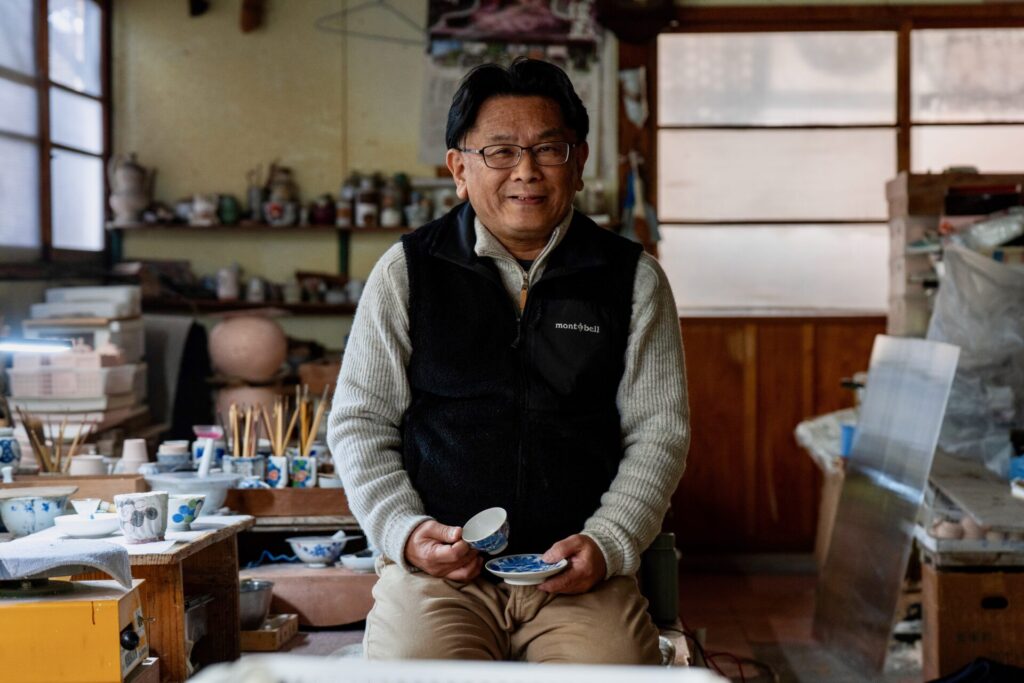
Satake says that his nephew is currently in training in ceramics.
“My job now is to make sure I can hand things over properly to the next generation.”
And yet, his gaze does not rest only on the survival of his own family kiln.
“I want to raise the level of Aizu-Hongo ware as a production area overall. I want us to keep learning from and challenging other pottery villages across Japan, until ceramic lovers around the world say, ‘I want a vessel from Aizu.’”
What Satake hopes to pass on to the future is Aizu-Hongo ware that the world itself desires.
There were once one hundred kilns here. Now there are twelve. But that does not simply mean decline. It also means that those who remain are the ones who have endured, each sharpening a distinct individuality.
When I step out of the gallery, the sky over Aizu is high and perfectly clear. Within the coolness of white porcelain live the warmth of hand-painted lines and an unending sense of play. The fire of Tomizo-gama continues to burn—quietly, but with unmistakable strength.
The blue born from Satake’s brush seems destined to color the next hundred years of Aizu-Hongo ware.