From Images on a Monitor to Hand-Felt Color — A Husband and Wife Exploring a New Kind of Kiln
馬場源次
Genji Baba

Aizu [Fukushima]
Genji Baba
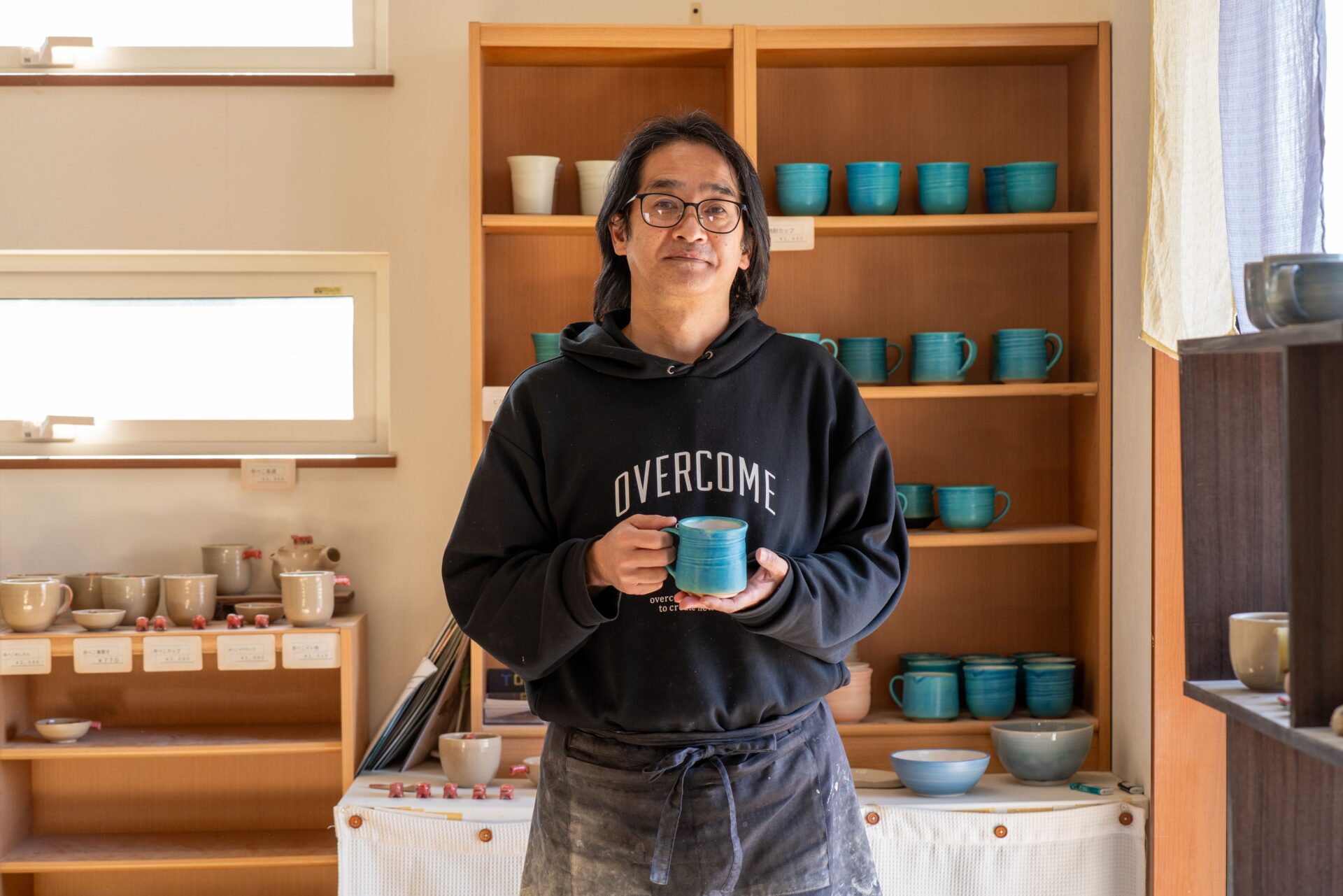
Born in Minamiaizu Town, Fukushima Prefecture. He once worked in video production and event-related jobs in Tokyo, but after being deeply moved by pottery he encountered in Kyoto, he made the life-changing decision to become a ceramic artist. After returning to his home region of Aizu and training for ten years at Ryumon-yaki, a kiln producing Aizu-Hongo ware, he founded Tobo Irori together with his wife in 2007.
In a house in Aizumisato Town stands Tobo Irori, a new kiln of Aizu-Hongo ware established in 2007. The colorful vessels displayed there give an impression quite different from what many people imagine as “traditional Hongo ware.” After years of training at a historic kiln, why did Baba choose to step beyond tradition and create something new? In order to explore the diversity of Hongo ware, we spoke with him about the path that led to Tobo Irori.
The Day He Switched Off the Monitor at Twenty-Five
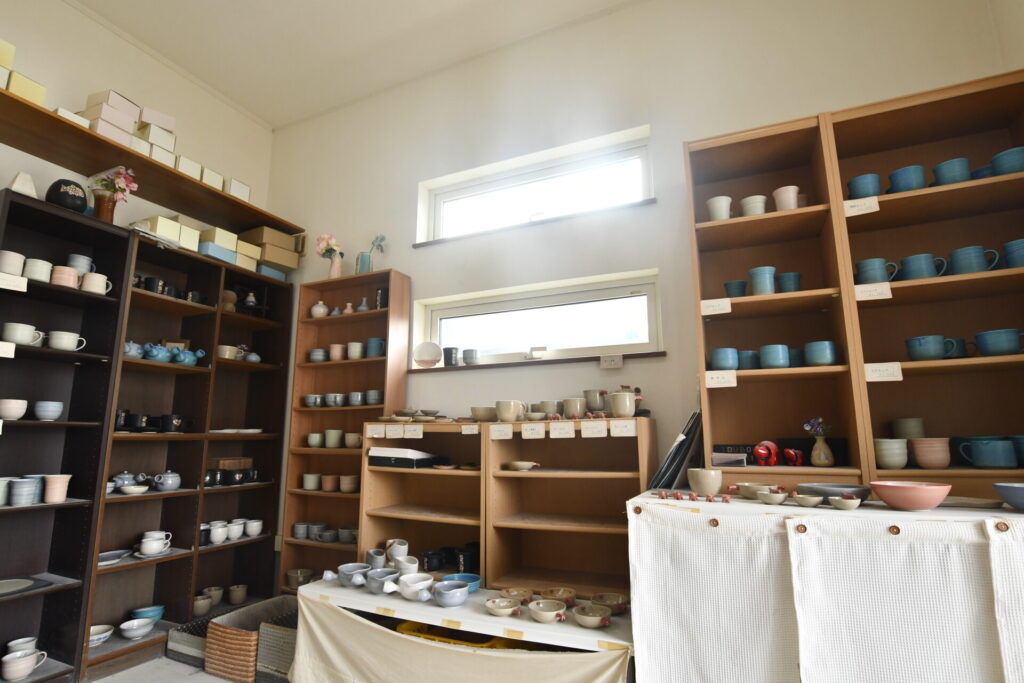
A little away from the main street of Aizu-Hongo, in a quiet residential neighborhood, stands the workshop. Outside, the winter sky is heavy and gray. But once the door opens, the scene inside feels as though it belongs to another season entirely.
There are vivid colors everywhere: bright turquoise blue, cherry-blossom pink that seems to carry the warmth of spring, and cheerful little Akabeko figures whose humor makes you smile without thinking.
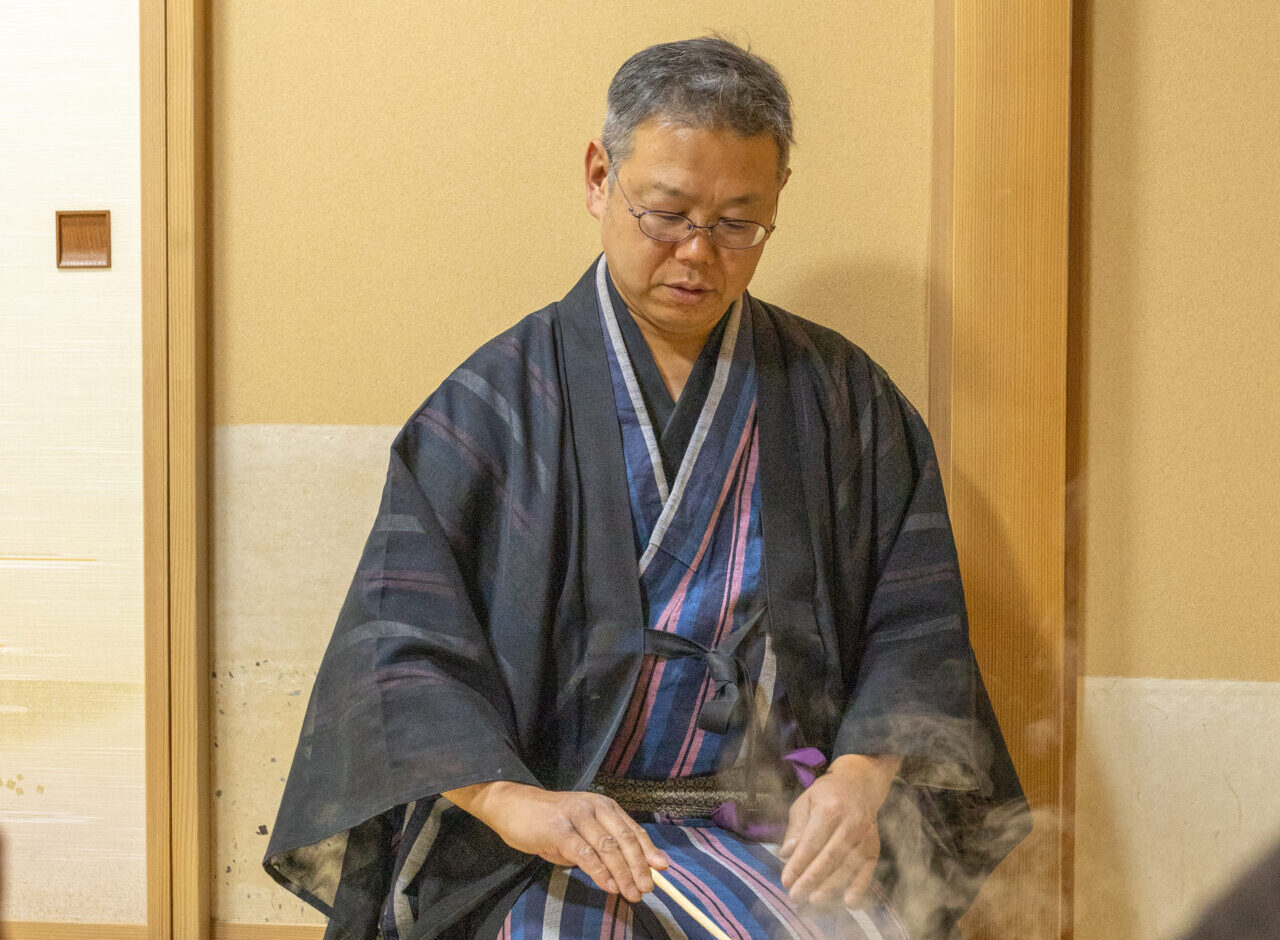
This is Tobo Irori, a kiln that became independent from Ryumon-gama in 2007 and has since gained support especially among younger generations and women. Seated at the wheel is Genji Baba, the husband of the couple who founded the kiln. In contrast to the playful brightness of the works he creates, his profile is quiet and serious, his gaze intensely focused.
He was once a video creator in Tokyo, spending his days looking at images on monitors in studio spaces. Why did he leave the cutting-edge digital world and turn instead to one of the most primitive forms of making—earth and fire? And within the 400-year history of Aizu-Hongo ware, how did he come to establish this unique position of being at once “cute” and “fun”?
Tracing that path reveals the story of a young man who trusted his instincts and pushed forward—and of the warm partnership that supported him all along the way.
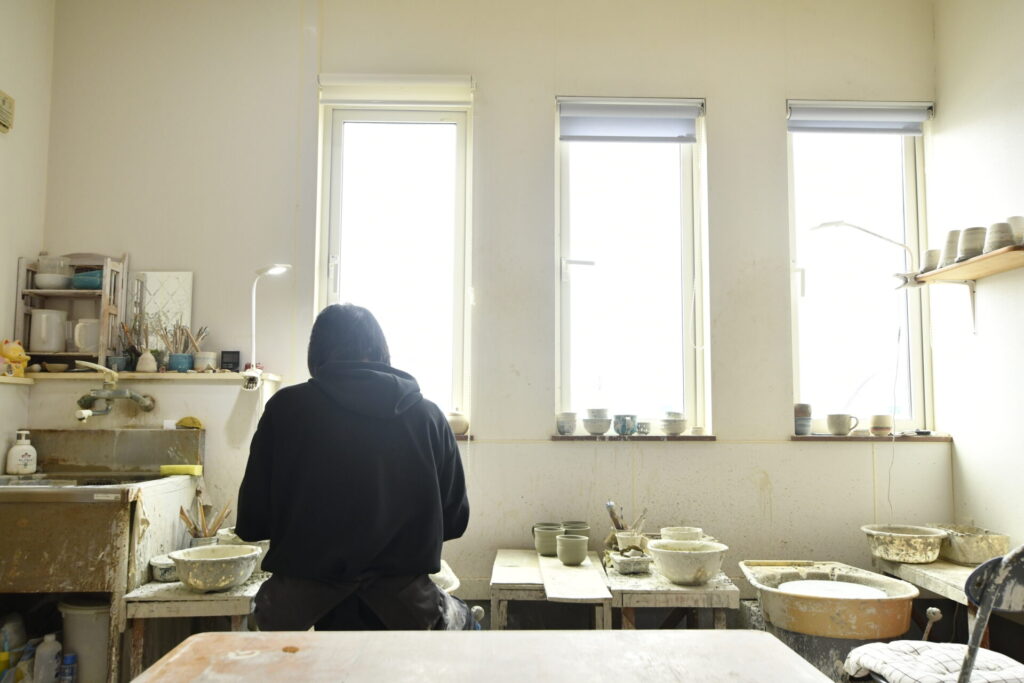
In a sense, it may have been inevitable that Baba would one day enter the world of pottery. In his early twenties, he was working in Tokyo in event video production. Glittering venues, dim editing rooms, cutting and assembling footage, layering music, shaping entire spaces through images—it was stimulating, creative work.
“It wasn’t that I had hit a dead end in my job. I enjoyed it,” he says, looking back.
And yet a business trip to Kyoto changed the course of his life.
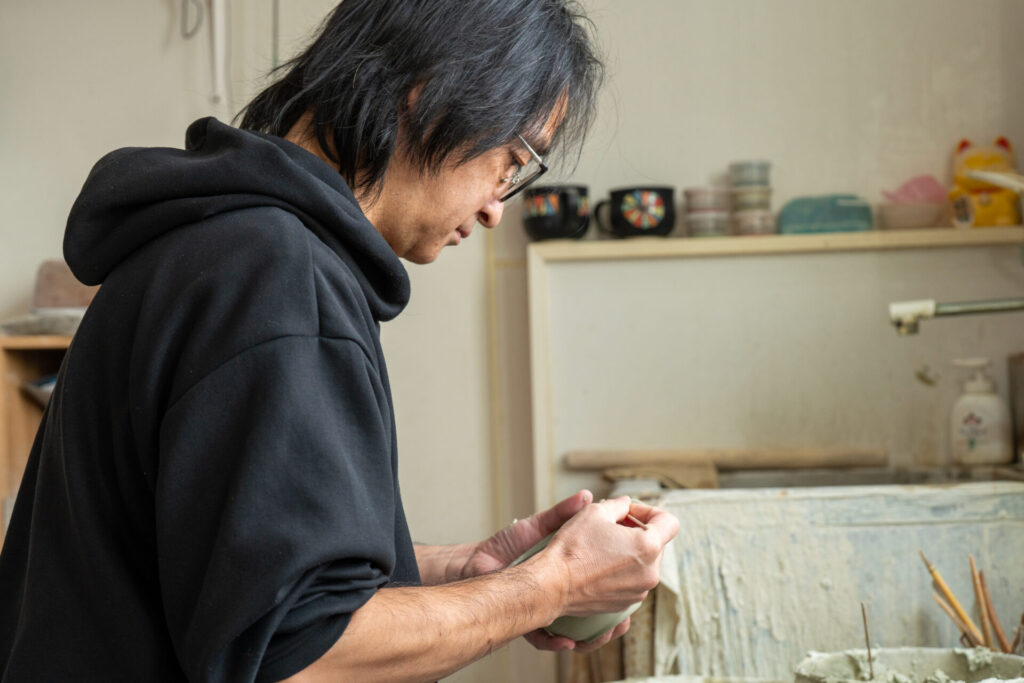
He happened to step into a pottery shop, and the moment he saw the vessels lined up on its shelves, a powerful intuition struck him.
“This looks fun.”
A lump of clay, transformed by human hands, passing through flame, and becoming a vessel that could endure for something close to eternity—its overwhelming physical reality stirred something in him that was very different from what he had experienced in the world of images.
“If I was going to do this, I thought, there was a pottery-producing area back in my home region of Aizu…”
Once the thought came, it would not leave. He quit his job, left Tokyo behind, and at the age of twenty-five returned to Aizu. Abandoning a stable career to throw himself into a muddy life of apprenticeship was, from the outside, an audacious decision.
Back in Aizu, Baba knocked on the door of Ryumon-yaki, one of the largest and most prestigious kilns in Aizu-Hongo. Known for its roots in the technology of electrical insulators, Ryumon-yaki is distinguished by strong porcelain and complex glazes with flowing effects. There Baba trained for ten years, learning the fundamentals of the wheel, clay preparation, and the chemistry of glazes. Perhaps the sense of composition and balance he had developed in video editing also found new life in pottery. But acquiring technical mastery does not happen overnight. Day after day, he simply continued facing clay.
During those years of apprenticeship, however, what he calls the greatest good fortune of his life arrived. He met the woman who would later become his wife and co-founder of Tobo Irori. She too had joined Ryumon-yaki as an artisan-in-training.
“We were basically an office romance,” Baba says with a shy smile.
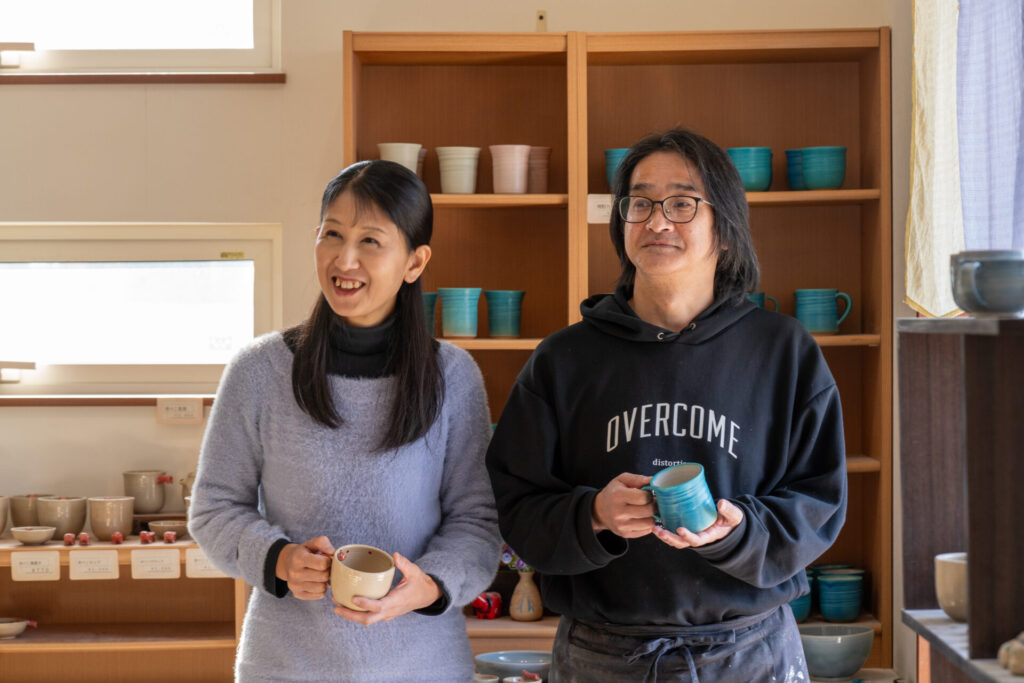
But the bond between the two runs deeper than that of an ordinary married couple. They shared meals, trained under the same master, and endured the same hardships and joys.
“We’ve already been independent together as Tobo Irori for eighteen years now.”
He says it quietly, but those eighteen years tell the story of two people who recognized each other’s talents, supported one another, and continued walking the same road.
Irori’s Colors — Red and Blue
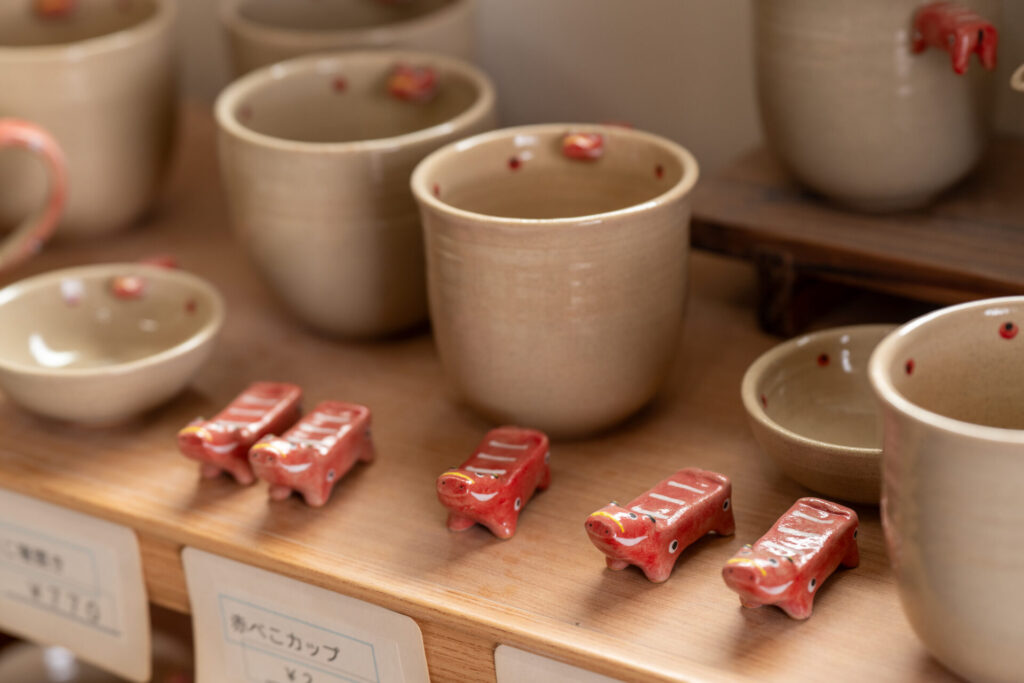
When the couple became independent in 2007, they chose as their concept “tableware that adds color to everyday life.” What emerged from that vision, and has now become one of Irori’s signature creations, is the Akabeko series.
Round, full-bodied forms topped with small, charming Akabeko figures adorn cups and chopstick rests in a way that makes almost anyone exclaim, “How cute!” In fact, Baba says, the original idea came from his wife.
“In the first year after we started, my wife just kind of began making them. At the time there wasn’t really any Akabeko boom yet—maybe it was around the time the mascot character Akabee was first starting to appear.”
There was no elaborate market research behind it. It began simply with, “This might be fun to make.” That lightness of spirit is one of Irori’s defining qualities.
“Rather than working something out through long trial and error, it’s more about inspiration. While I’m turning the wheel, I’ll suddenly think of something and try it. If it seems possible, I do it. If it doesn’t work, I forget it. That’s basically how it goes.”
That is how Baba describes his own creative style. He does not brood over detailed plans or draft careful blueprints in advance. Instead, he entrusts himself to the spinning of the wheel and captures the passing impulse or idea that arises through the dialogue with clay. That is why the vessels of Irori seem to hold within them the joy of their making—a brightness free from self-consciousness.
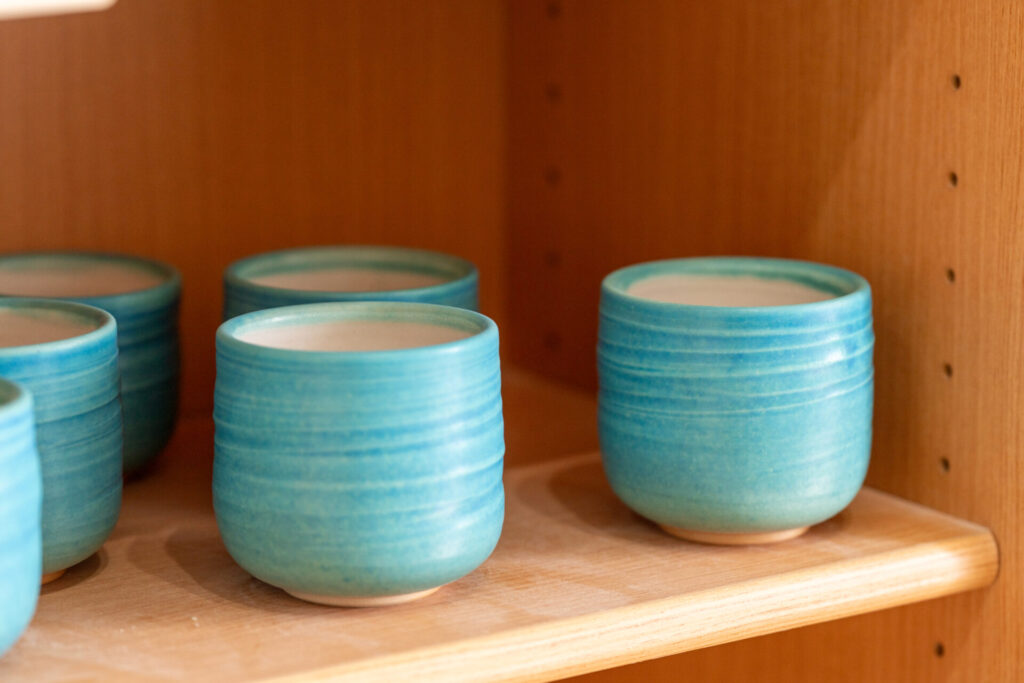
Another of Irori’s major charms lies in its unique sense of color. Among its colorful works, one hue in particular stands out: a vivid turquoise blue. It is a modern, pop-like color rarely seen in conventional Aizu-Hongo ware. But Baba had a clear reason for wanting to pursue it.
“People’s living spaces are different now than they used to be. More homes have bright dining rooms and Western-style interiors with wooden floors. In spaces like that, I thought brighter colors would feel more natural.”
Traditional subdued browns and navy blues are wonderful in their own way. But to add color to contemporary life, he felt that more freedom in color should be possible.
That spirit of exploration is also visible in one of his more recent creations: the stained-glass style series. Set against a black glaze, bright colors appear scattered like mosaic pieces. In reality, these vessels are created through an unexpectedly labor-intensive process.
“After applying the black glaze, I mask off areas with tape, remove sections of color, and then fill those parts with other colors.”
It is almost like coloring in a video frame one layer at a time.
“It takes time, but if everything is just black, it isn’t very interesting. So I thought, why not play a little?”
He chooses interest over efficiency. And it is precisely that attitude that gives Irori’s pieces a depth and luminosity found nowhere else.
Chosen by an Embassy — Color Crossing Borders
Baba’s sense of playfulness has also traveled to places he never expected.
“It’s a strange feeling to know that something I made is being used in a place like that.”
What he shows us is a large plate in a bicolor design, made from overlapping squares and circles. It caught the eye of someone in Tokyo’s restaurant world and, remarkably, is now being used at an embassy.
“It was originally made as part of a project through the local association, and an embassy representative happened to see it and like it.”
A vessel made in a small workshop in Aizu-Hongo simply because it seemed interesting now adds color to a diplomatic table beyond Japan’s borders.
“What feels ordinary to us locally can look special to people from outside.”
Just as he himself had once been captivated by pottery in Kyoto, now his own work was moving people in faraway places. That must surely have become a deep source of confidence for him as an artisan.
Irori’s work is also highly sought after in roadside stations and local shops.
“I thought I was making things mainly for younger people, but it turns out older customers often buy them saying, ‘I want my grandchildren to use this.”
Feelings like “cute” and “fun” have no age limit. The positive energy in Irori’s pieces is loved across generations.
“When someone comes back and says, ‘I came to buy again,’ that’s what makes me happiest,” Baba says with a smile.
What Do You Wish to Pass On to the Future?
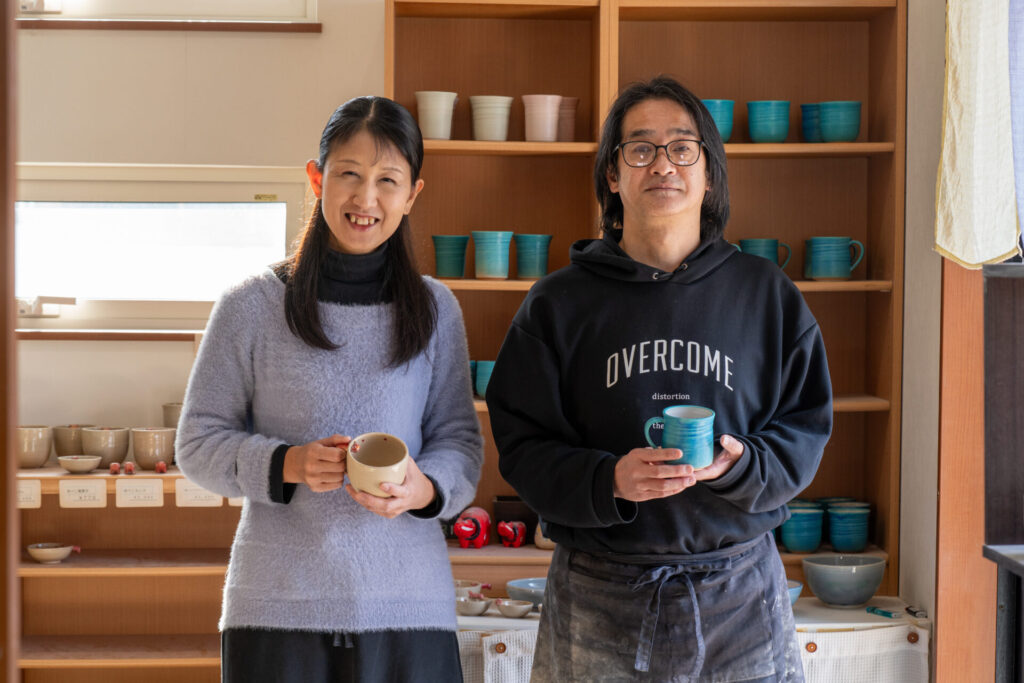
“What do you hope for the future of Aizu-Hongo ware?” Baba pauses for a moment before answering seriously.
“With the number of kilns decreasing, I hope new people will come in. Aizu-Hongo is a place with real depth.”
What Baba and his wife hope to pass on to the future is the breadth of Aizu-Hongo ware itself—a place capable of embracing many kinds of kilns and ways of making.
He continues:
“There are kilns that are firmly protecting tradition, and I think that’s wonderful. Because those kilns are there, places like ours can go ahead and play freely. Maybe it’s better if we stick out of the frame a little.”
This is not merely a carefree attitude. It is his own proposal for how roles can be shared across the production area as a whole. Not every kiln needs to move in the same direction. Some protect a weighty historical tradition. Others make pop and playful works as they please. That diversity itself is the strength of Aizu-Hongo.
Turning over one of Irori’s vessels, he points to the signature scratched into the base. His own has a distinctive handwritten form, with the dot of the “i” drawn out almost like a flowing line. His wife’s, by contrast, is more neatly written.
“You can tell right away who made what if you look at the bottom.”
Their personalities and strengths are different. But the direction they aim toward is the same.
“Ease of use comes first. On top of that, I want to make vessels that brighten your mood the moment you see them.”
The color they create is not just visual color. It is the color of the heart—a kind of brightness that makes someone’s daily life a little happier.
In winter, in a snowbound town of Aizu, these vivid vessels are fired. Perhaps they are, in their own way, the colors of hope for people waiting for spring.
Open the door to Tobo Irori, and there will always be a warm and cheerful spring waiting inside.