Pure White Porcelain as a Reflection of the Self — Devoting a Lifetime to the Pursuit of the Pinnacle of Beauty and Strength
田崎宏
Hiroshi Tazaki

Aizu [Fukushima]
Hiroshi Tazaki
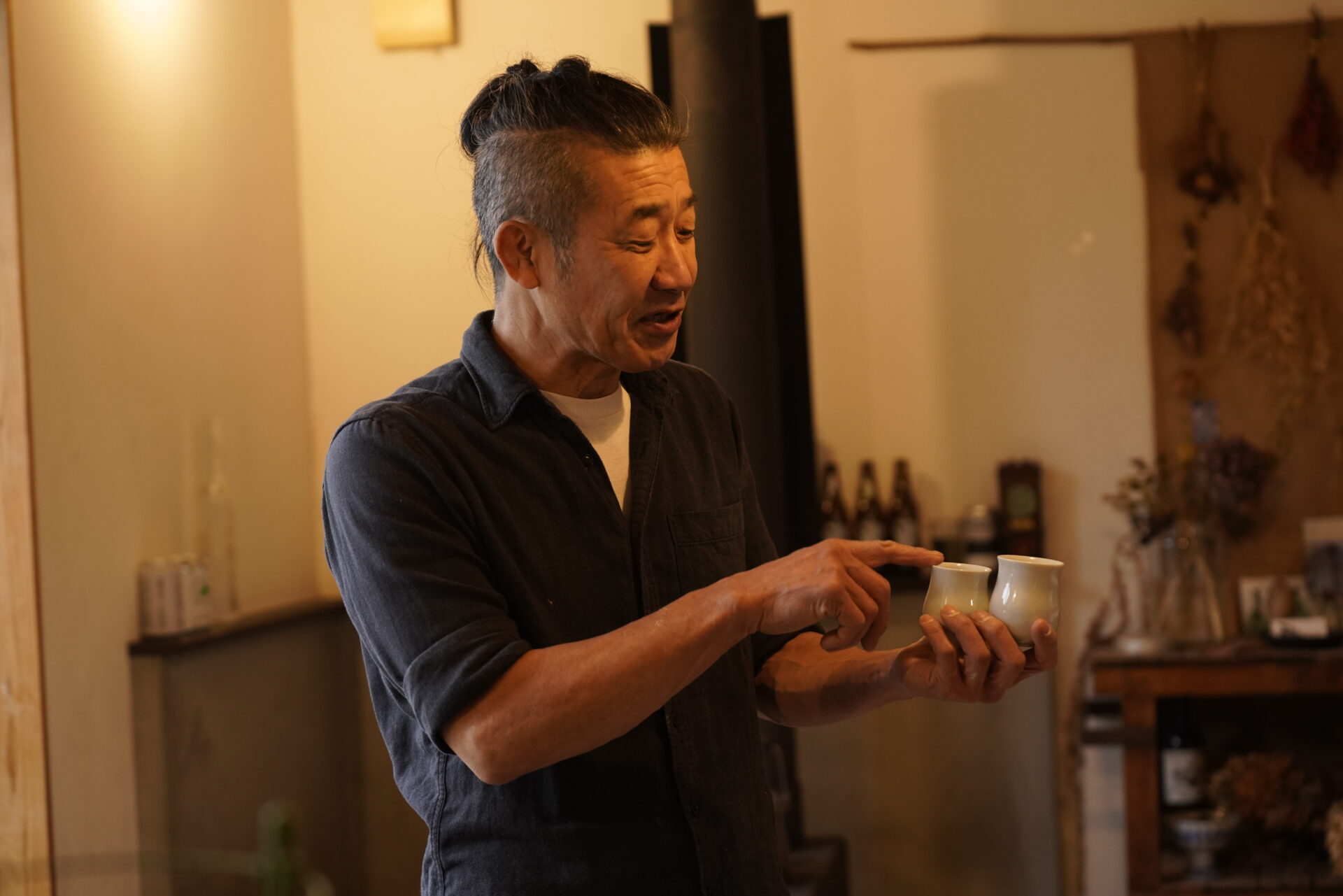
Born in Aizumisato Town, Fukushima Prefecture. After working for a major automobile manufacturer, he chose to pursue craftsmanship and succeeded his father’s kiln, Soshun-gama. Moving away from the painted vessels of the previous generation, he began creating his own original line of white porcelain. Because his style differs so greatly from that of his father, he established his own artistic line under the name Kobo So, and is now active mainly through exhibitions and solo shows.
Within the diverse world of Aizu-Hongo ware—where earthenware and porcelain, painted designs and colored glazes all flourish—there is one kiln devoted almost entirely to white porcelain. Hiroshi Tazaki, who once worked for a major automobile company assembling manufacturing machinery for car parts, now stands at the wheel in Hongo. In the striking contrast between the work of his father, the previous head of Soshun-gama, and his own, one senses the remarkable breadth of Hongo ware itself. We spoke with Tazaki about the path that led him to inherit the kiln and, beyond that, to devote himself to white porcelain.
Pop, Pop — The Emptiness and Precision of Mass Production
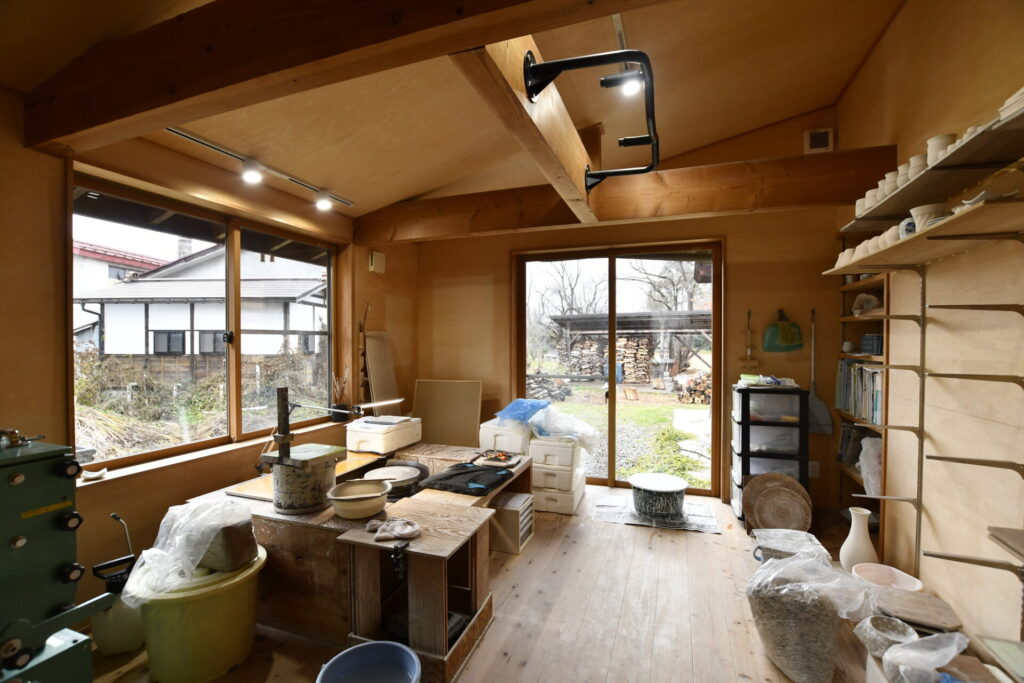
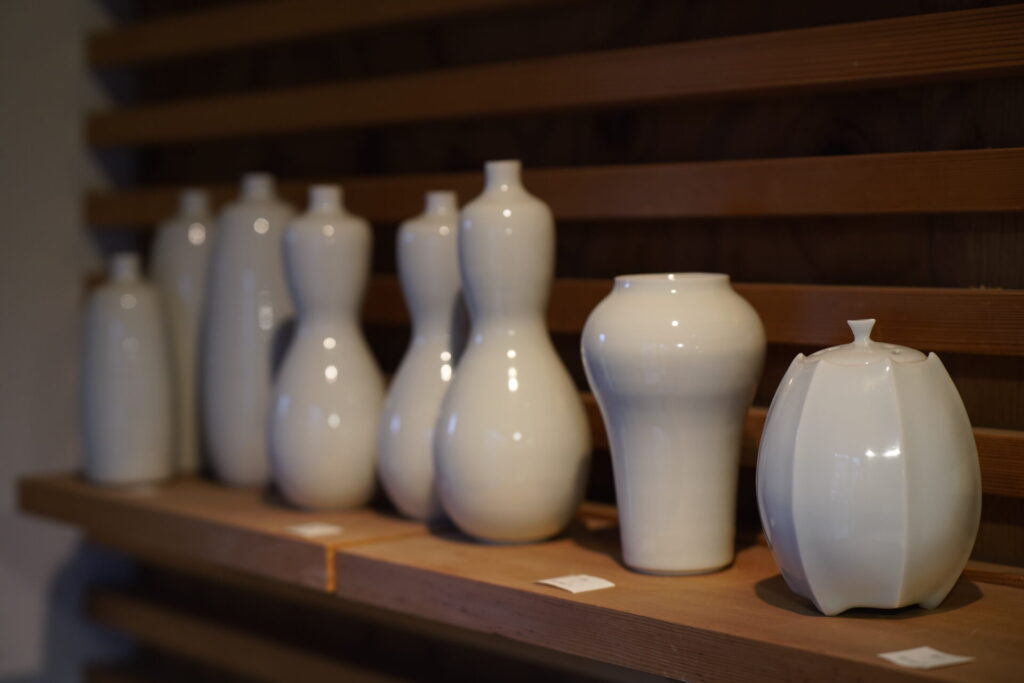
A short turn off the main street of Aizu-Hongo leads to a workshop standing quietly along a narrow lane. Opening its wooden-framed glass door feels almost like stepping into a contemporary art gallery—serene, still, and filled with light. Arranged neatly on natural wooden shelves are translucent white porcelain vessels: dignified teapots, flower vessels with organic curves, and cups so thin and delicate they seem to let light pass through them.
This is the world of Hiroshi Tazaki, the second-generation head of Soshun-gama and the creator behind his own brand, Kobo So. He is a disciplined ceramic artist who has even installed a pull-up bar in the beams of his workshop, training his body every day. “Beautiful and resilient,” he says with a smile. In his white porcelain lies the quiet heat—and logic—of someone who stepped out of a vast system and chose to live as an individual.
Tazaki did not choose ceramics from the beginning. In fact, as a high school student, he had no interest at all in the family business.
“My father was doing something with pottery, sure—but I never once thought I’d take it over.”
Instead, he chose a different path: employment at a major automobile manufacturer in Saitama Prefecture. He was assigned to a production engineering department, where his work involved assembling processing machines used on manufacturing lines for mass-producing specific parts.
“You press a button, and pop, pop—the parts just keep coming out. Every thirty seconds, every minute, they move on to the next stage.”
It was a world of extreme efficiency, the sort of system for which Japanese manufacturing is known. Precision management that tolerated not even a micron of deviation.
“It’s incredible technology. Because that level of quality control exists, we can drive high-performance cars at accessible prices instead of paying something like Lamborghini money.”
Tazaki has nothing but respect for the world of mass-production technology. Yet at the same time, while working as just one part of that immense system, he found himself becoming aware of a growing emptiness within.
“The parts just move on to the next process. I’m responsible for only one small section of the whole.”
He was merely one cog in an enormous machine. Day after day, he produced precision without ever fully seeing the whole picture. And in that state, he began to think again about the work his family had always done.
“With pottery, I can complete everything myself.”
Shaping, trimming, glazing, firing—every stage could reflect his own will, and every stage would be his own responsibility. It was, in a sense, the ultimate world of freedom and responsibility. And so he made the decision to leave Saitama and step once more onto the soil of Aizu.
The Courage to Let Go of His Father’s Painted Style — The Birth of Kobo So
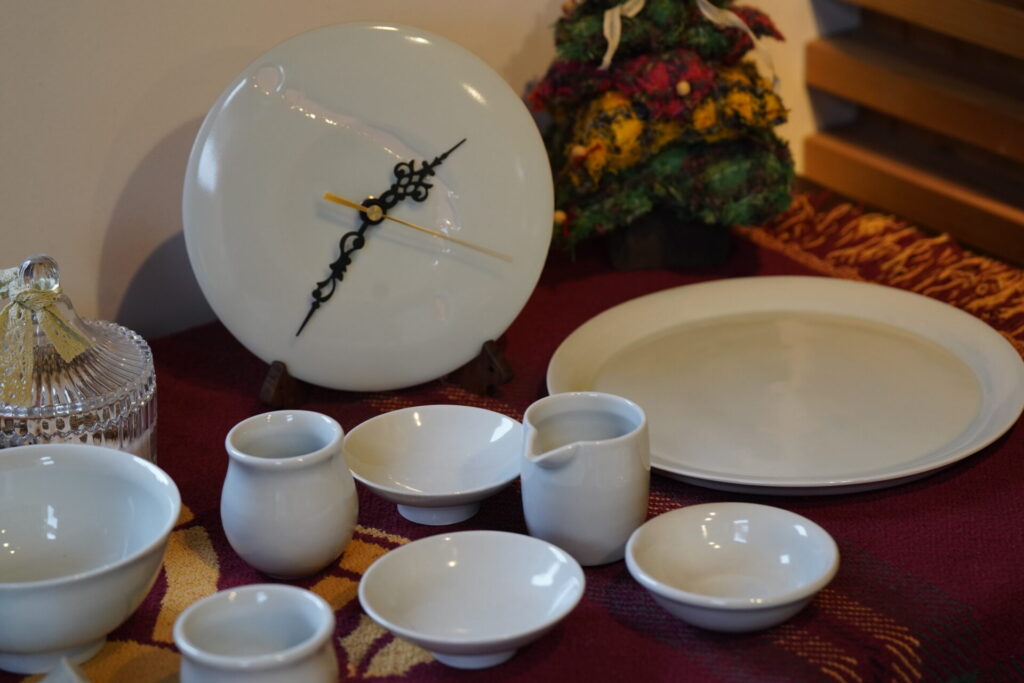
The family kiln, Soshun-gama, had been founded by Tazaki’s father some forty-three years earlier. His father had studied under the great mingei-style porcelain master Koichi Takita and was especially known for painted decoration.
When Tazaki first returned home, he too tried his hand at painted pottery. He picked up a brush and attempted to decorate vessels as his father had done. But when he looked at the pieces that emerged from the kiln, he found himself pained by their poor quality.
“I just felt, ‘I can’t ask people to pay money for this…’”
After struggling with that frustration for some time, he made a decision.
“I’m going to stop painting altogether and try doing an exhibition using only white porcelain.”
It was a major gamble. Many customers associated Soshun-gama with painted work. Yet the result was surprising.
“People really started looking carefully at my work.”
By stripping away the “decoration” of painted design, the forms he had worked so hard to refine—and the texture of the glaze itself—could finally be seen directly, without distraction. It was a form of expression entirely his own, distinct from his father’s Soshun-gama. He named his new artistic line Kobo So and began walking his own path as a white porcelain artist.
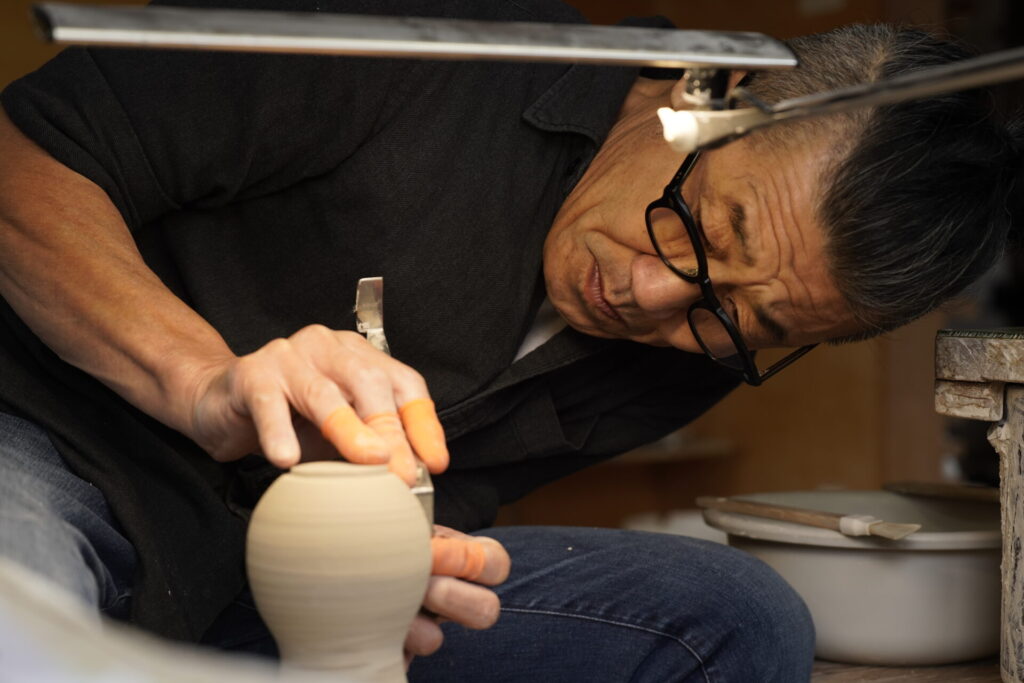
What distinguishes Tazaki’s white porcelain is its faint bluish translucence.
“The glaze itself has a slight blue tone, and when it pools in the grooves, that blue becomes deeper, creating a beautiful contrast with the rest.”
What brings out that beauty is a carving technique known as shinogi. Once the body has dried, he carves lines into it with engraving tools, creating ridges. When light hits the surface, shadow and highlight emerge, giving the vessel a vivid sense of dimension.
And yet, his method of shinogi is unusually difficult.
“I carve only after the clay is completely dry.”
Normally, such carving is done when the clay is still leather-hard. But Tazaki waits until all moisture has left the body.
“If you carve when it’s still half-dry, then as it continues to dry and shrink, the balance of surface tension can shift and you risk cracks. So as a safer method, I carve only after it’s fully dry.”
To cut into clay that has already become hard as stone—with the constant risk that one lapse in concentration could cause it to crack—is a dialogue with porcelain in its purest form.
His attention to detail also extends to tools and functionality. Consider, for example, the spout of a teapot.
“I want it to have a slightly rounded, swelling shape because it’s cute. But that kind of shape makes it easier for tea leaves to clog. So I want the strainer set higher up. But then the balance of the spout changes…”
To resolve the contradiction between function and design, he takes the fired porcelain—already hard—and grinds the angle of the spout using a disc grinder fitted with diamond tools.
“There’s no point if it isn’t easy to use as a tool.”
He adjusts the angle of the spout by fractions of a millimeter, pouring water again and again to test it. At that moment, he seems less like a ceramic artist than an engineer—the same sort of person who once pursued exactitude in automotive manufacturing.
The union of beauty and usability is not born of intuition alone. It emerges through repeated calculation and verification.
“Daughters of TESORO” Born of Chance — Playing Between Abstraction and Figuration
In one corner of the studio stands an object with an uncanny presence. It looks almost like the torso of a woman, a flower vessel formed in smooth curves. Embedded within part of it is a fragment of another ceramic object.
“I call these the ‘Daughters of TESORO.’”
Three years ago, on the night before the installation for an exhibition in Fukushima City, an earthquake struck. Pieces that had been displayed on shelves fell and were chipped. These were works from a series called hitogata, each one wheel-thrown individually and given its own personality. They were not shattered completely, but they had suffered damage that made them impossible to sell as finished works.
“But I couldn’t throw them away. So I started wondering if there might be a way to give them new life rather than simply repair them.”
That was when he turned to Mirai Watanabe, the creator of the Aizu-Hongo jewelry brand TESORO.accessory, with whom he had already built a friendship.
“My damaged work merged with fragments of old Hongo ware and became something new.”
Embedded into the chipped areas were fragments of older pottery—pieces once used by someone long ago, later broken and discarded. Those fragments fused with Tazaki’s contemporary white porcelain, creating a one-of-a-kind scene in each piece. Rather than hiding damage, the series accepts it as part of history and transforms it into something even more beautiful. A few of these Daughters of TESORO are still, as he jokingly says, “in the hospital” with Watanabe. The series is also a story of connection—one that could only happen in a place where a production area still lives as a community.
Tazaki’s works, though made of hard porcelain, somehow possess an organic softness. At times they resemble plants; at others, living creatures.
“What does this look like to you?” he asks, holding out a mysterious object shaped in a spiral.
Seen from behind, it looks a little like the curved back of a seated cat. But the protrusions resemble antennae, making it seem almost like a snail.
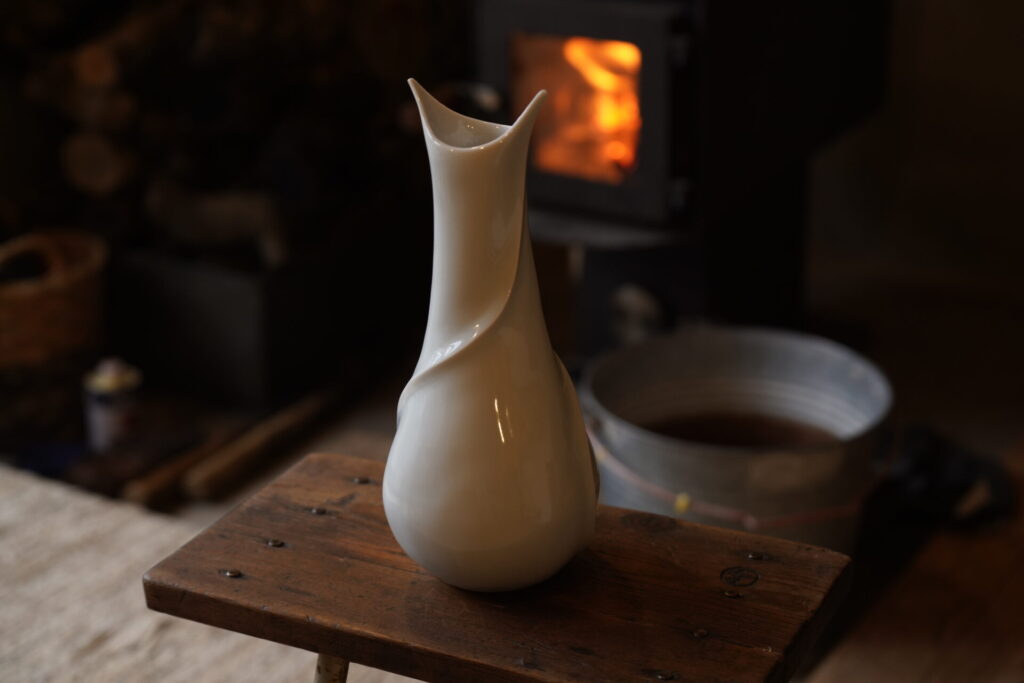
“People who love cats say, ‘It’s a cat!’ But to me it looked like a snail. A slightly sensuous one, too—so I named it Enka, or ‘sensuous snail.’”
Another work bears the name Getto—literally “moonlit peach.” It is a poetic image, yet the curve of the form also suggests the warmth of living things.
“When I name something, I wait for the right words to arrive. At first I’ll just give it a temporary title, and then later there’ll be a moment when I suddenly know: yes, that’s it.”
All of his forms are born on the potter’s wheel. Within the restriction of rotational symmetry, he searches for lines that still feel organic and alive.
The hitogata series seen in the opening photographs of this section, too, is not produced by making identical forms to the same height. Each piece is individually thrown, then carved to suit its own personality.
“I’m not trying to make dolls. I want to make living individuals.”
Using the seemingly inorganic medium of white porcelain, he manages to trap within it a warmth of body and the breath of living beings. That subtle balance between abstraction and figuration is perhaps the essence of Hiroshi Tazaki’s work—and what makes it so difficult to look away.
“Beautiful and resilient.”
This motto of his is not merely an abstract ideal. His porcelain may look delicate, but it is astonishingly strong.
“One of porcelain’s characteristics is that it doesn’t absorb water. So even if it gets stained by tea, you can bleach it clean—and you can use it in the microwave without hesitation.”
It can be used hard every day without complaint. There is something in that combination of beauty and toughness that feels almost like his own body, trained through daily pull-ups: a fusion of function and strength.
“I want people to use my work freely, as a partner in everyday life.”
What Do You Wish to Pass On to the Future?
What Tazaki hopes to pass on to the future is a way of being as a craftsperson—one that keeps surpassing yesterday’s self while continuing to aim for the summit over the course of an entire lifetime.
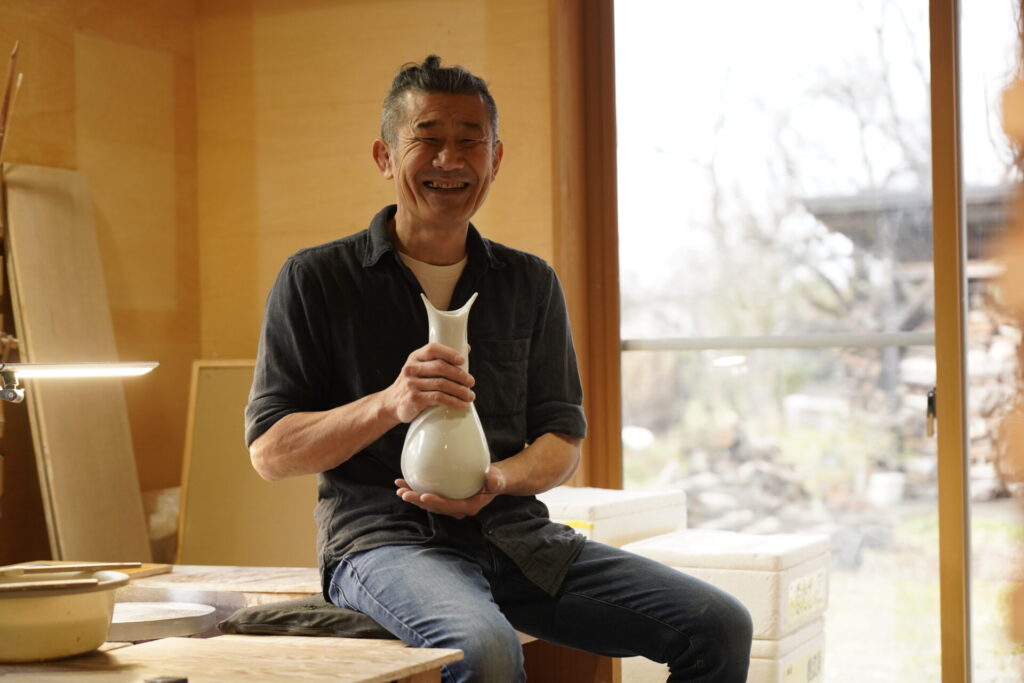
“The moment you think, ‘This is the final form,’ I think making things is over.”
When he looks back at works from ten years ago, he sees only immaturity. And he believes that ten years from now, he will look at his present work and feel the same.
“From the time I began this work, I could already see the summit I ought to reach. I keep working toward it, but no matter how many years pass, the distance to that summit never seems to shrink. And yet, when I turn around, I realize I’ve climbed quite a height. That, to me, is what making things is.”
There is no final satisfaction. One must always keep surpassing the self of yesterday. In a way, this is his answer to the perfectly completed systems he once encountered on the automobile production line. It is also the expression of a passion that can never be exhausted: the passion of creating something by one’s own hand and taking full responsibility for it.
Today, once again, he stands in the workshop, facing clay, carving, and later raising his body on the pull-up bar overhead. In that back-facing figure one sees a life lived as a fiercely independent individual—free, and also severe.
The vessels of Soshun-gama / Kobo So are the crystallization of a freedom won by a single person who stepped out of the system and claimed it through his own muscles and intelligence.