An Unbroken Flame for 150 Years — The Survival Formula of a Traditional Craft Through Turbulent Times
西田理人
Michito Nishida

Aizu [Fukushima]
Michito Nishida
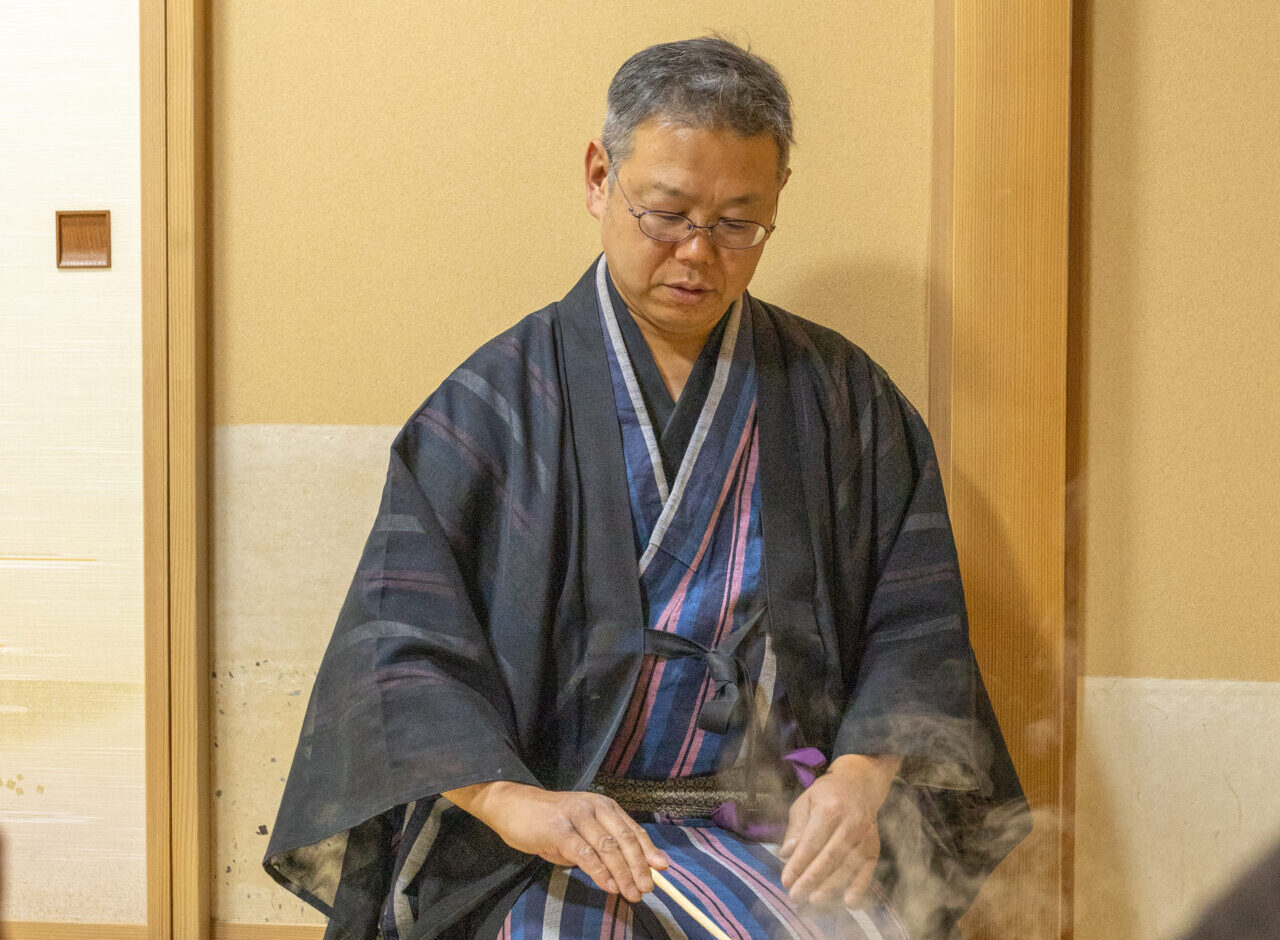
Born in Aizu-Wakamatsu City, Fukushima Prefecture. Fifth-generation head of Suigetsu-gama. Although he originally worked as a mathematics teacher, he was asked by his family to take over the kiln after the death of his grandfather, the fourth-generation head. While continuing the traditional craftsmanship of Suigetsu-gama, he has also developed designs using his own original glaze known as “Merchen Glaze.” In addition to running the kiln, he is also active as a writer, making use of his talent for storytelling.
At the end of a narrow lane in Aizumisato Town, a large old brick chimney rises above the rooftops. No longer in use today, it still hints at the prosperity of the pottery boom that once swept through the region. We spoke with Michito Nishida, the fifth-generation head of Suigetsu-gama, about the kiln’s history and its strategies for survival in an industry that has experienced both flourishing success and harsh decline.
A Samurai Who Laid Down His Sword — Glory Lost to a Great Fire
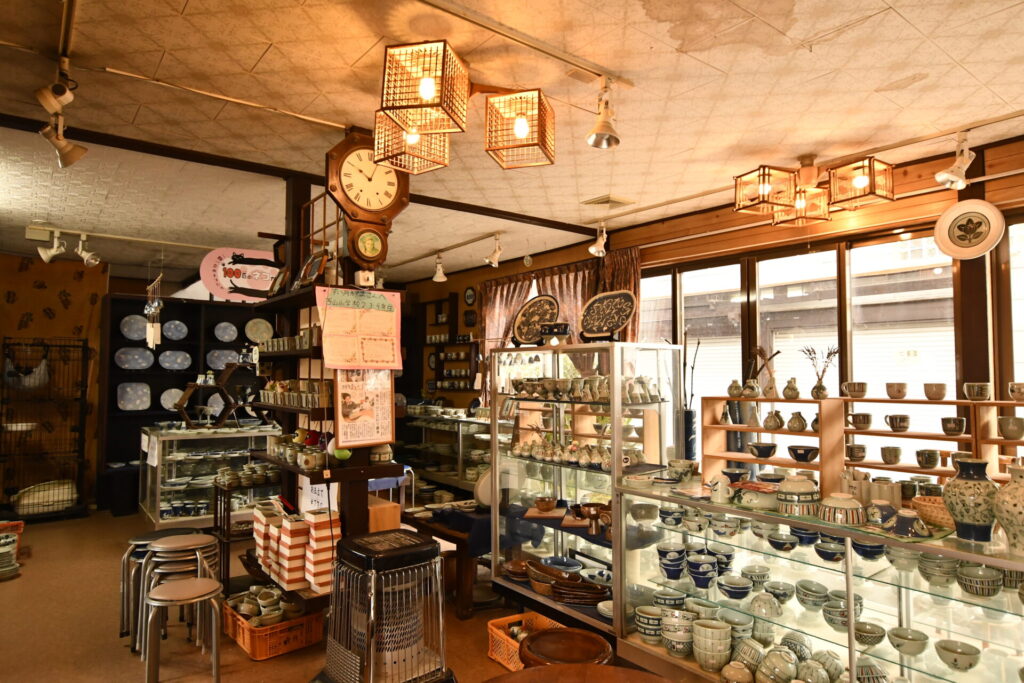
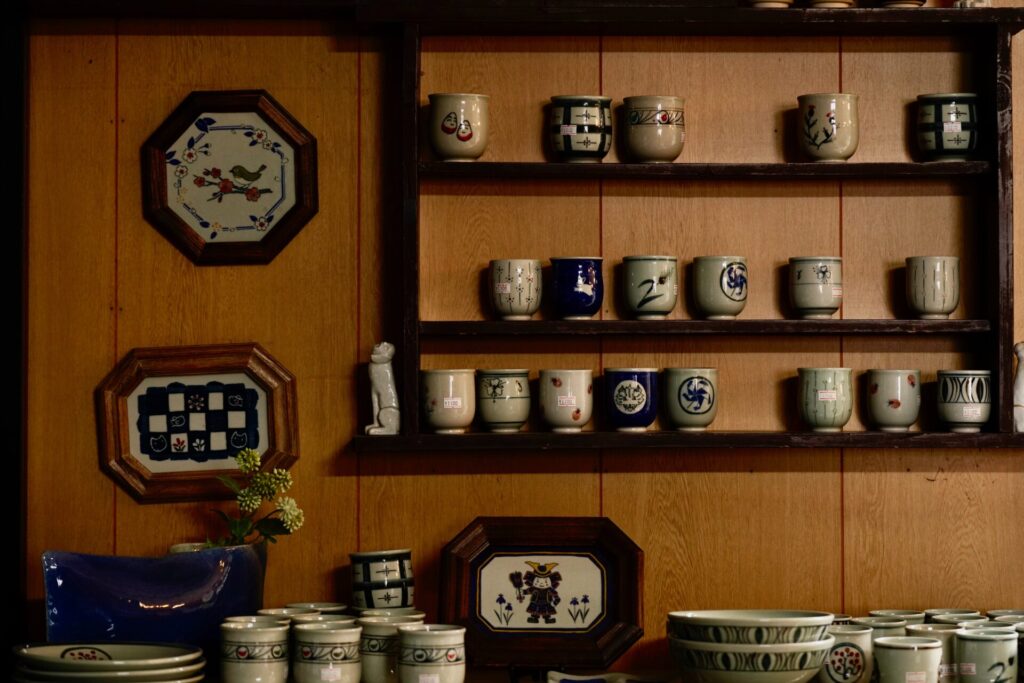
Opening the sliding door reveals glass display cases filled with a quiet array of vessels. Patterns inspired by the land of Aizu—kanoko, mishirazu persimmon, and wheat ears—are modest rather than flamboyant, yet each carries a quiet but unmistakable presence.
On a shelf further inside, the atmosphere changes completely: unique ceramic vessels shaped like cats, each a one-of-a-kind piece, line up neatly. Looking up toward the wall, bright vessels reminiscent of blue skies and drifting clouds bring color to the room.
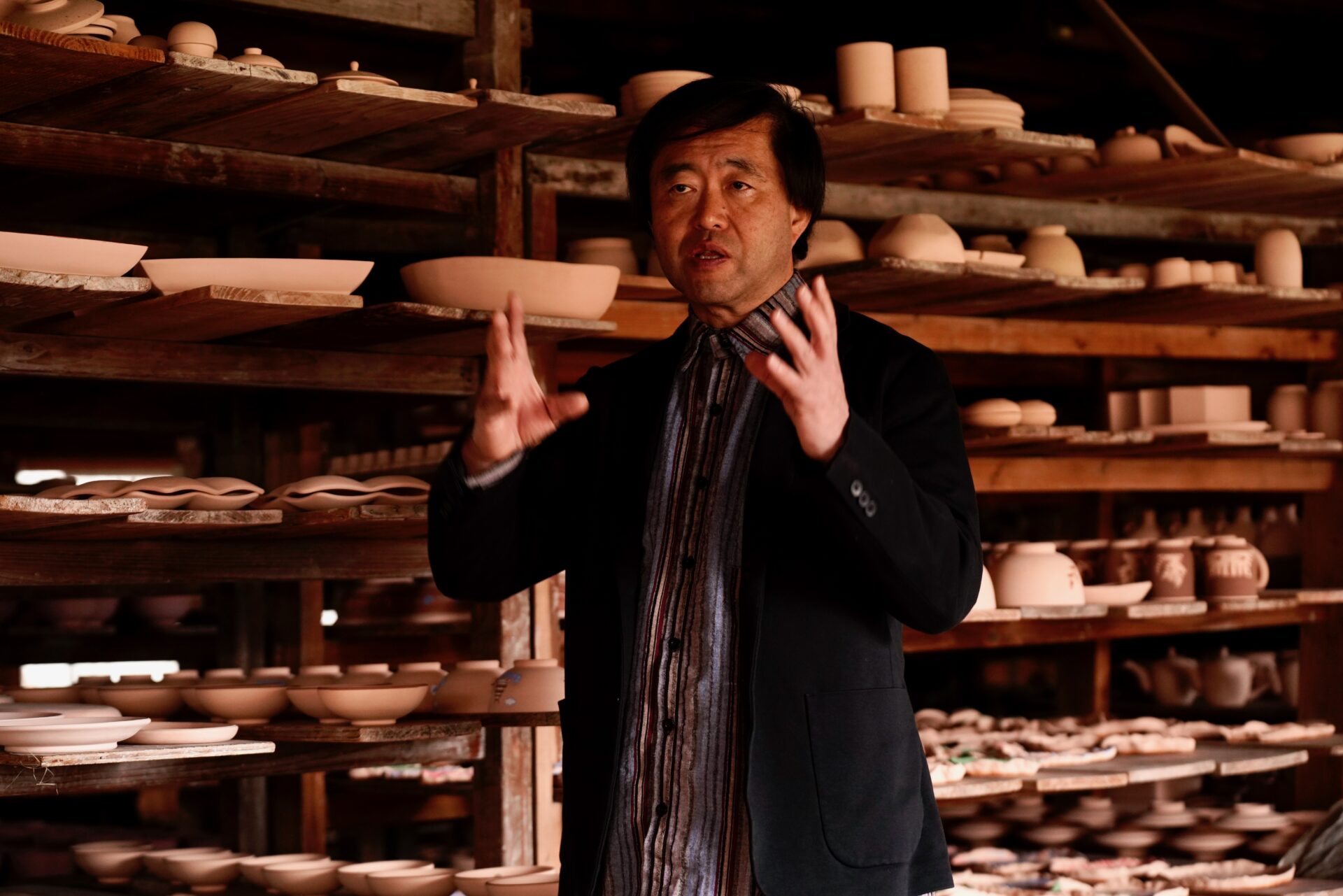
“We’ve made all kinds of things over the years,” says Michito Nishida, the fifth-generation head of the kiln, smiling gently.
His way of speaking lacks the stubbornness often associated with artisans. Instead, it is logical and clear. That may be because he once stood at a classroom podium teaching mathematics.
How has he preserved—and transformed—the flame of a kiln that has burned since 1870, in the third year of the Meiji era? Within that story lies both the romance of history and the reality of management: a thoroughly modern strategy for survival in the world of traditional craft.
The origins of Suigetsu-gama trace back to the defeat of the Aizu domain in the Boshin War. The founder, Sankuro Nishida, had been a samurai of the Aizu domain. When the samurai system collapsed and he lost his livelihood, he laid down his sword and chose instead to knead clay in Hongo.
The year was 1870.
Perhaps the spirit of a warrior also lived within his pottery. In 1877, at the Domestic Industrial Exposition—something like a national world’s fair—his work won the Gold Prize. The award certificate, still preserved today, bears the name Toshimichi Okubo, silently conveying the weight of history.
Yet the prize-winning work itself no longer exists.
In 1916, a catastrophic fire swept through Hongo, destroying half of the town’s 400 households. In the chaos of the blaze, the award-winning piece disappeared.
It is said that someone had safely moved the work as the fire approached, yet after the flames were extinguished it could never be found again.
“It must have been complete chaos because of how large the fire was,” Nishida says quietly. “Someone once said they knew where it had been moved to, but that person has passed away as well. Apparently it was a hibachi with amber glaze…”
The certificate still hangs carefully on the wall, but the form and presence of the award-winning work itself are now lost to history.
Okubo Pottery Stone and Suigetsu Gosu
Generations later came the era of the fourth-generation head, Yoshihiko Nishida, Michito Nishida’s grandfather. He is often described as the reviver of Suigetsu-gama.
“The pottery world is a constant cycle of appearing and disappearing. So the question is always: how do we survive?”
Unlike the reserved stereotype of Aizu people, Yoshihiko possessed a friendly personality and remarkable drive. Speaking in the local dialect, he traveled everywhere, easily connecting with people wherever he went. He was both a researcher and a businessman.
He traveled across pottery-producing regions throughout Japan, conducting thorough research. What he ultimately discovered was pottery stone from Okubo, a local area nearby.
Although this stone is used for porcelain, it also carries qualities similar to earthenware. It does not become pure white like porcelain, instead producing a slightly grayish body. But it is lighter in density and allows vessels to be made thicker without becoming heavy.
“That’s why they’re durable. It creates the perfect thickness for everyday use.”
Another essential element of Suigetsu-gama is Suigetsu Gosu. Made from iron-rich clay from Yōkamachi in Aizu-Wakamatsu, this pigment is mixed by the kiln itself. The resulting color is a deep indigo—somewhere between blue and black, almost like ink.
“I’ve tried many different clays, but none of them produce the same color.”
The contrast between Okubo pottery stone and Suigetsu Gosu eventually became the signature of the kiln.
A Crisis of Closure — A Mathematics Teacher’s Thirty-Year Survival Strategy
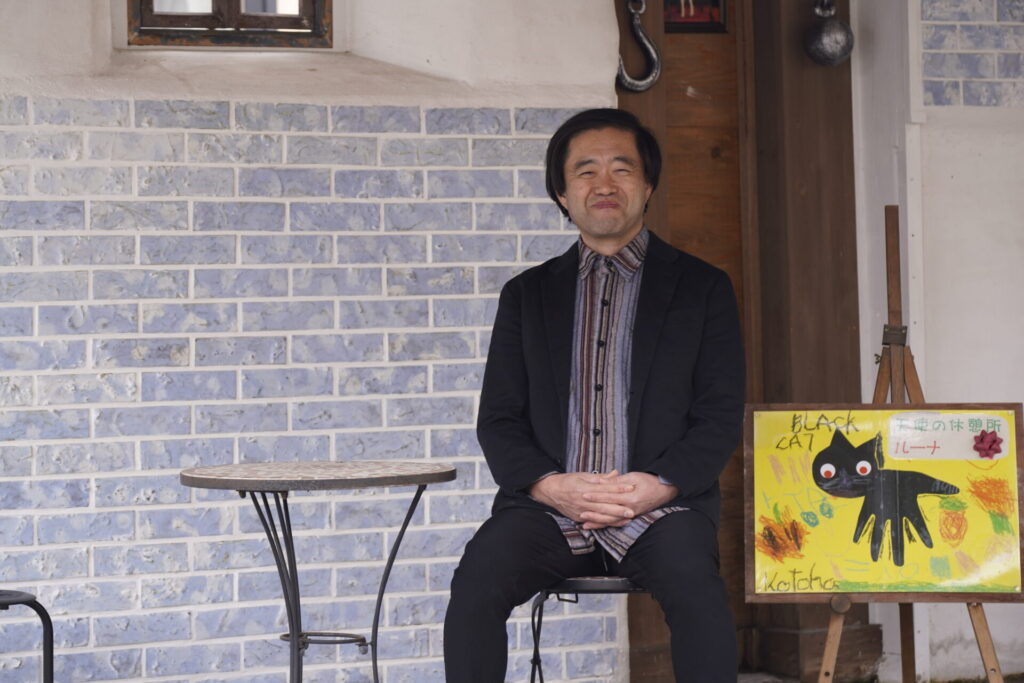
Despite having such a remarkable grandfather, Nishida never originally intended to inherit the kiln.
“My grandfather himself told me that pottery wouldn’t be enough to make a living in the future. He encouraged me to think about other career paths.”
Following that advice, he became a mathematics teacher, teaching at a high school in Fukushima Prefecture and living a stable life.
But fate intervened.
After his grandfather passed away, the relatives who had been managing the kiln grew too old to continue. Closing the kiln while employees still depended on it was unthinkable. During a family meeting, all eyes turned toward Nishida, who had been teaching for three years.
“Well, in the end this suited me better than teaching,” he says with a laugh. “And my grandmother—who had always been very kind to me—said she couldn’t bear to close the kiln she had built together with my grandfather.”
When he took over 35 years ago, the situation was harsh. The workforce had already shrunk from nearly 100 employees, and the economic downturn following the burst of Japan’s bubble economy struck the pottery industry hard.
At that moment, the rational thinking of a former mathematics teacher came into play.
“Of course artisans must refine their craft. But what matters most is management.”
He states this without hesitation. Rather than prioritizing artistic ambition alone, the first priority had to be ensuring the company’s survival: how to repay debt, how to steer the business when sales were declining.
“If you focus too much on simply making a living, you end up producing things you don’t really want to make. In order to keep creating what we ourselves think is good, the business itself has to remain healthy.”
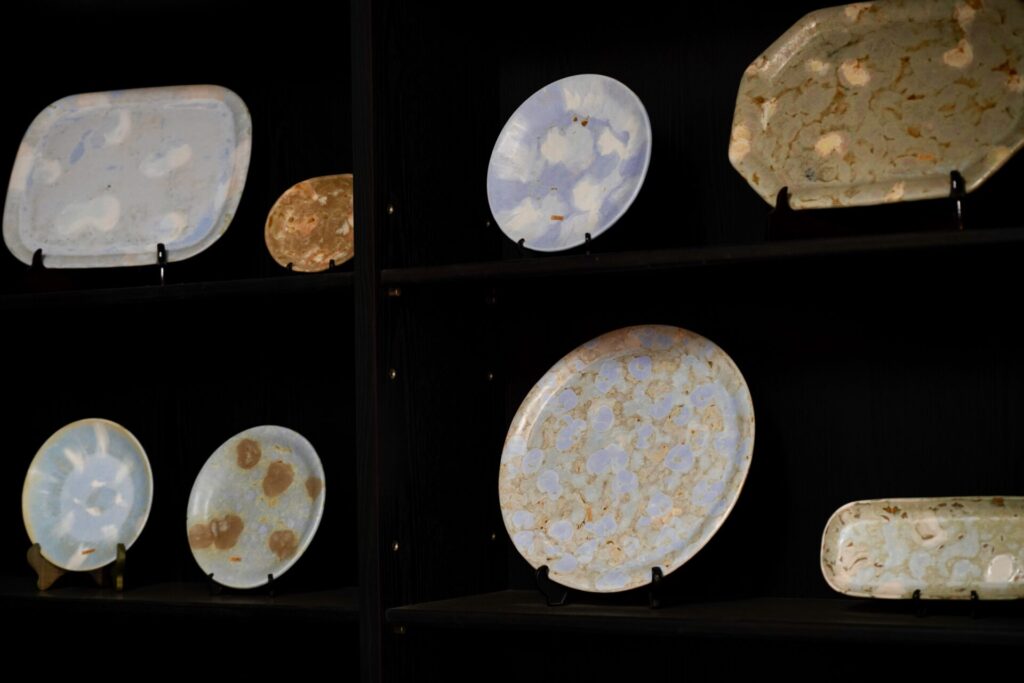
One of the tools Nishida developed to stabilize the business was Merchen Glaze.
Unlike the traditional subdued aesthetic associated with Suigetsu-gama, this glaze features pastel tones and bright blues, creating Western-style vessels. By layering glaze with a brush and intentionally creating unevenness, the surface develops patterns reminiscent of skies and clouds.
“Painting designs takes time. Since we have skilled decorators, it makes more sense for them to focus on that while I concentrate on running the kiln. But as a ceramic artist I still wanted to express myself through glazes. Glaze work takes less time than painting, so it’s a good balance.”
This was not a casual idea—it was a strategic decision based on careful analysis of labor and market demand.
“It doesn’t become our main source of revenue. But when events call for something ‘not typical of Suigetsu,’ this becomes a strong hook.”
In fact, the series has attracted younger fans who visit specifically to see it.
Innovation in order to protect tradition.
It was the moment when his artistic creativity—long present within him—flourished through the logic and calculation of a mathematician.
The appeal of Suigetsu-gama does not lie only in its vessels.
“Look at this,” Nishida says, holding up a bottle shaped like the mask of a Great Tengu.
These bottles once sold explosively as souvenirs. The body itself is ceramic. They are produced for Daitengu Sake Brewery in Motomiya City, Fukushima.
The most interesting part is the production process.
“We make the body and apply the base color. But the final step—painting the eyes—is done by the brewery’s staff.”
Imagining them painting the eyes together during quiet moments between brewing seasons brings an involuntary smile.
“Perhaps because of the weak yen, they’re apparently very popular with overseas customers right now.”
Work circulates within the region. Unexpected successes emerge.
Perhaps such chance encounters are rewards that only come after many years of persistence.
What Do You Wish to Pass On to the Future?
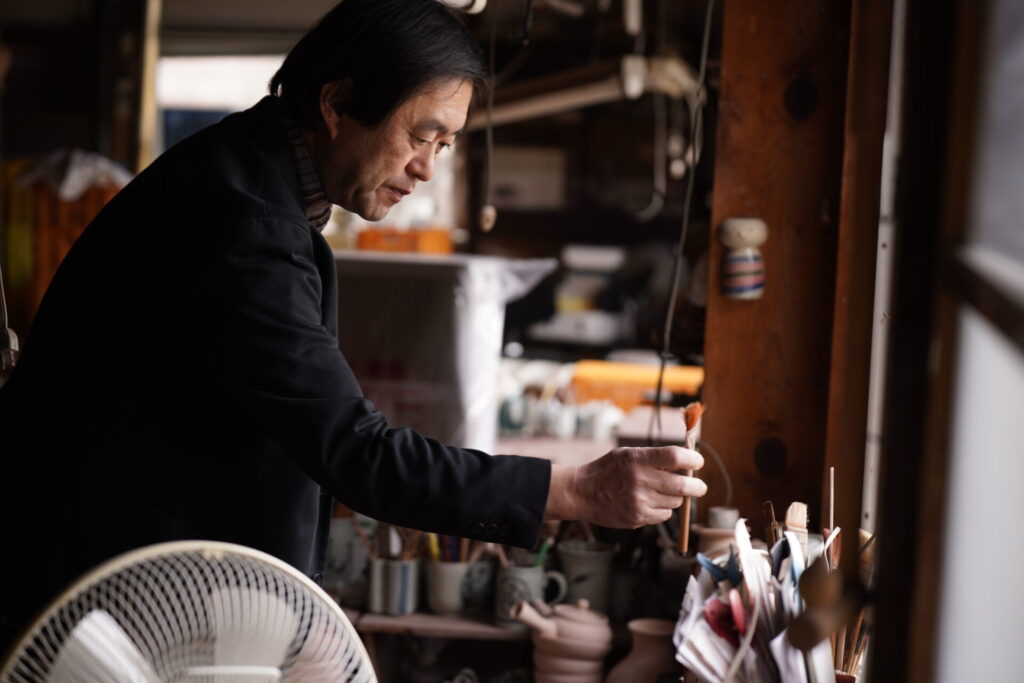
For Nishida, the future of Suigetsu-gama ultimately comes down to continuing.
Everything that has been cultivated and inherited. Everything that has been adopted—or let go—along the way. All of it together forms the living history of the kiln.
“I think of Suigetsu as a kind of culture.”
Tradition is not only about inheritance. It is also about continuously changing in order to survive. The entire process itself is what forms the culture called Suigetsu.
What Nishida hopes to pass on to the future is precisely that culture—Suigetsu, capable of surviving in any era.
“My daughter will inherit the kiln next. In the past people might have said it had to be a man, but that’s no longer the case.”
Just as his grandfather traveled across Japan gathering techniques. Just as Nishida himself protected the kiln through management after leaving his career as a teacher.
The next generation will surely find her own way to keep the flame alive.
One hundred and fifty years ago, a samurai laid down his sword and picked up clay. Today that same clay blends logic, creativity, and management—transforming more freely and flexibly than ever before.
When we hold a vessel from Suigetsu-gama, we are not simply holding tableware.
We are touching a crystallization of wisdom—refined through generations of adaptation and survival.