Discovering Freedom Through Independence from a Prestigious Kiln — The Depth of Hongo Reflected in White Porcelain
宗像眞弓
Mayumi Munakata

Aizu [Fukushima]
Mayumi Munakata
Born in Aizumisato Town, Fukushima Prefecture, as the eldest daughter of Ryoichi Munakata, the seventh-generation head of Munakata-gama. At the age of 27, she began helping with the family business as an employee of Munakata-gama, while also continuing to create works as one of the kiln’s artists. After more than two decades there, she was on the verge of becoming independent when she experienced the Great East Japan Earthquake, an event that led her to confront the direction of her own work as an artist. She later established her independence and has since built a distinctive world of expression through white porcelain, different from the style of her family’s kiln.
Among the 400-year history of Aizu-Hongo ware, one kiln stands as an embodiment of its traditional lineage: the prestigious Munakata-gama, which has continued for more than 300 years. Born into that lineage and devoted to carrying on its tradition, one woman nevertheless chose to step beyond that position and spread her wings. We spoke with Mayumi Munakata about the traditions and innovations she has witnessed, and about the new appeal of Hongo ware that she has come to express in her own way.
As the Eldest Daughter of a Prestigious Family — and as a Craftsperson
Munakata-gama is one of the most distinguished names in Aizu-Hongo ware. Since the Edo period, successive heads of the kiln have produced numerous masterworks, and its name has become known far beyond Aizu itself.
And yet, apart from that “main house,” there is one woman who has quietly, but with great inner strength, pursued her own path as an individual artist. That woman is Mayumi Munakata.
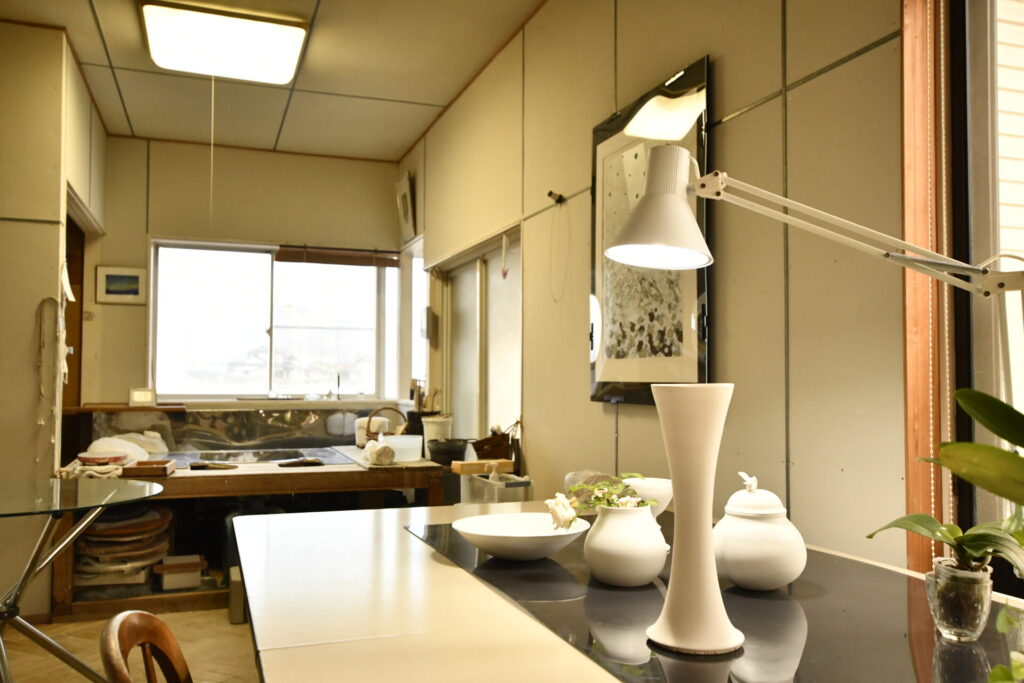
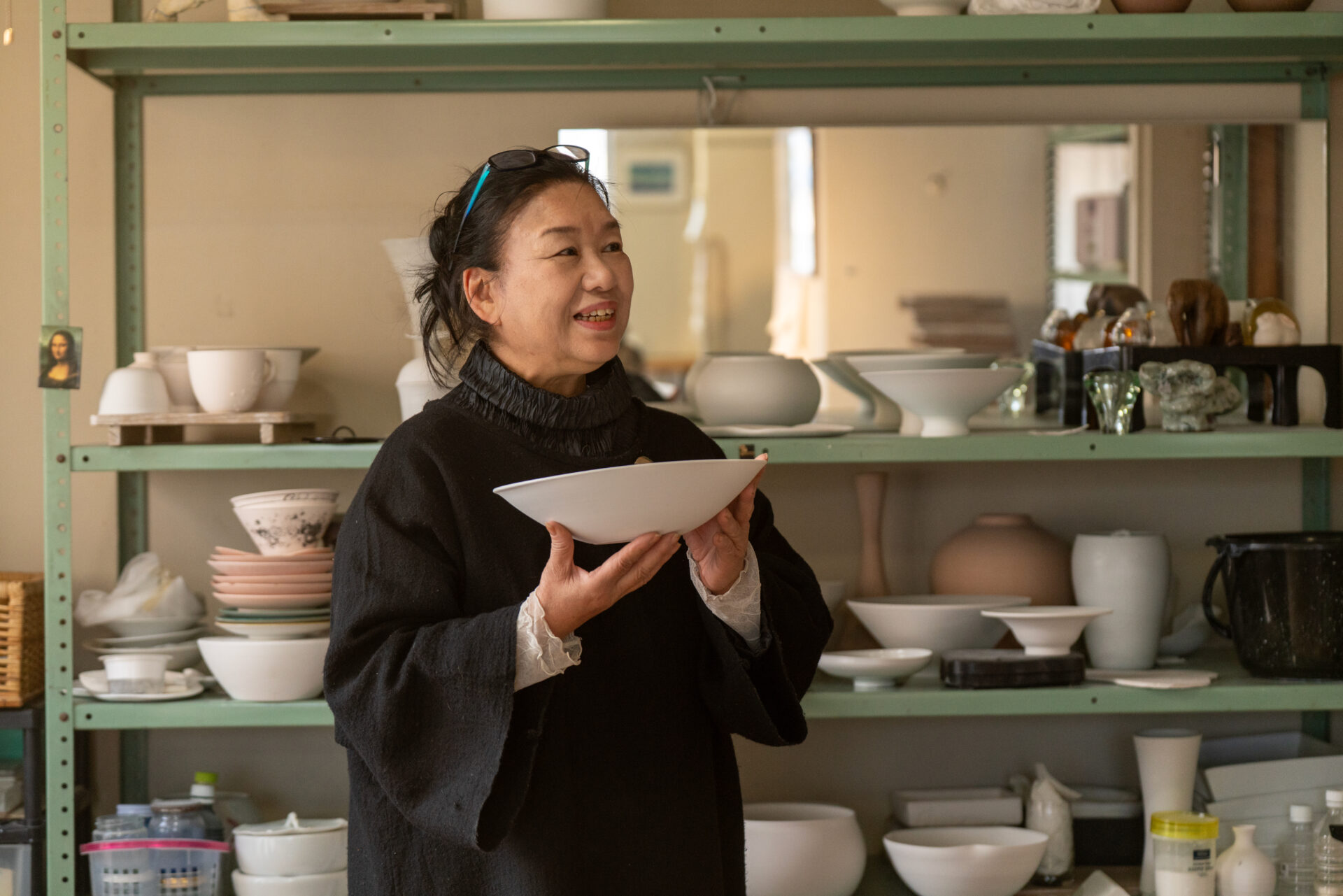
Visiting her studio, one finds a space filled with light and clarity, seemingly untouched by the weight one might imagine accompanies such a family legacy. Through the wide open windows stretches a landscape of harvested rice fields, with the ridgelines of distant mountains standing out beautifully against the blue sky.
“I’m sorry there isn’t much here right now—I’ve only just finished a solo exhibition,” Munakata says as she brings tea and sweets.
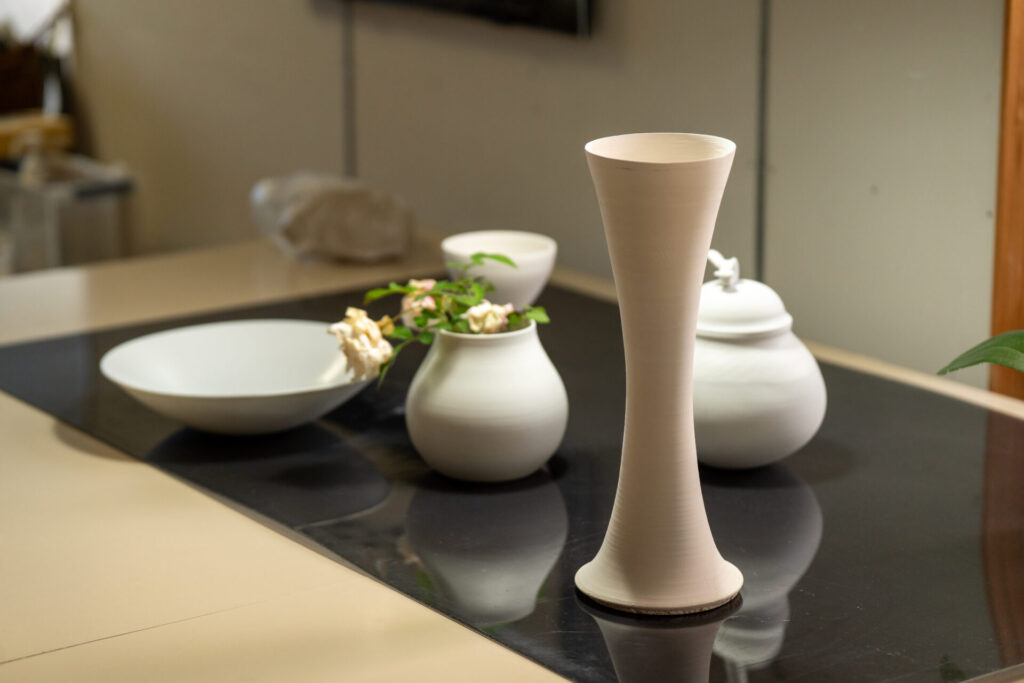
In front of us are translucent white porcelain cups and delicately designed confectionery vessels. They belong to a world of white—subtle, refined, and almost glass-like in texture—entirely opposite to the vivid, powerful blue and purple-glazed earthenware that have become synonymous with Munakata-gama. It is a world she reached only after a long journey, and one that seems to have become her own sacred territory.
Munakata was born as the eldest daughter of Ryoichi Munakata, the seventh-generation head of Munakata-gama. She grew up surrounded by clay and flame, but in those days the world of pottery was still governed by unspoken rules of a male-dominated society.
“At the time, people would say it wasn’t women’s work.”
She recalls this matter-of-factly. In the world of traditional crafts, where hereditary succession remained strong, it was far from common for an eldest daughter to work at the wheel and live as a potter.
And yet, at the age of 27, she returned to her family home and began helping with the business as an employee of Munakata-gama.
“My father gave me a potter’s wheel. I helped with the kiln’s work while also continuing my own creative practice.”
For about twenty-five years, she quietly honed her skill—both as a behind-the-scenes presence in a prestigious kiln and as a craftsperson in her own right. Her father and brother stood in the spotlight, but the clay turning in her hands never lied. Through daily repetition, the sensitivity in her hands grew steadily more precise and reliable.
“It wasn’t exactly an apprenticeship, but daily training was essential. No matter how many ideas you have, if the technique isn’t there, you can’t turn them into form.”
In those words one senses the pride of someone who faced her craft steadily and patiently, never relying on the signboard of being born into a famous family.
The Great East Japan Earthquake, Just Before Independence — and the Choice of White Porcelain
The turning point came in March 2011, at the time of the Great East Japan Earthquake.
In fact, just before the disaster, Munakata had already decided to become independent from her family kiln.
“My brother had said to me, ‘Maybe it’s about time you became independent.’ By coincidence, the timing of my resignation overlapped with the earthquake.”
With the unprecedented disaster, everything came to a stop. The kiln fires went out, and ordinary life was disrupted.
“Even at the point when I had decided to go independent, I still hadn’t figured out exactly what I wanted to do, or what kind of ceramics I wanted to make.”
In the midst of that confusion, she was forced to stop and stand still. Yet perhaps that “blank period” became the fateful interval she needed in order to look directly at what she truly wanted to create.
Munakata-gama, which her brother inherited, continues to preserve the tradition of earthenware.
“If I was going to become independent, I wanted to do something different from what my family kiln was doing. There was no point in making the same things—if that was what I wanted, I could always just stay there and do it.”
What she chose instead was porcelain, the very opposite of her family kiln’s earthenware tradition.
“At Munakata-gama, mixed tones, flowing glazes, and those accidental effects are what create its charm. But once you decide to make pure white, all of those things suddenly become negative factors. It’s interesting, isn’t it?”
By making that choice, she deliberately picked up the pure white porcelain clay that stood at the opposite pole.
“I loved white. And becoming independent meant I had to create a world of my own.”
She had to gather everything from scratch—tools, clay, all of it. Perhaps it was her quiet determination to release herself from the 300-year name of Munakata-gama and live simply as Mayumi Munakata.
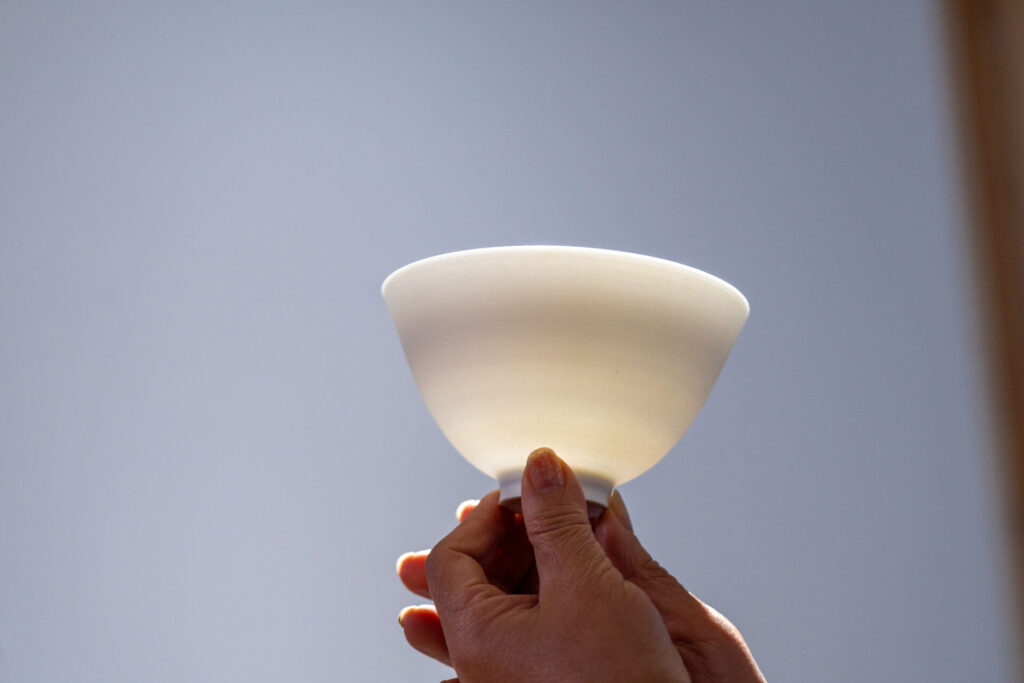
Her vessels are thoroughly white. Unlike earthenware, which sometimes welcomes impurities to create texture, porcelain requires what one might call an aesthetics of subtraction.
“Porcelain is closer to glass. Earthenware has tiny invisible pores on its surface, which gives it a kind of warmth, almost like it’s breathing. Porcelain is fired more tightly and has a much greater density.”
Some of her works are adorned with delicate carved or molded patterns. Held up to the light, the deeper carved areas turn into shadow, while the thinner areas allow light to pass through. These gradations alone give expression to the pure white vessel.
“When I started wondering what kinds of expression were possible with white, I realized you can actually do all kinds of things. You can let glaze pool, you can carve into it…”
The patterns that emerge from her fingertips often carry a sense of rhythm.
“Natural forms, the shapes of clouds, the shape of light. And music too. When I listen to music, I sometimes think, ‘This piece has this kind of shape.’”
For her, making vessels may be something close to translation—translating sound, light, and inner sensation into the language of porcelain. That may be why her works feel so artistic, and why no two ever seem quite the same.
“My problem is that what I want to do changes all the time. So I can never really say, ‘This is my signature work.’”
She says this with a laugh, but her lightness is clearly different from the solemn weight one might expect of someone guarding a traditional lineage. It is the kind of supple strength one sees in a bird flying freely through the sky.
A Solo Exhibition After Eight Years — and the People Who Had Been Waiting
After gaining independence, Munakata worked mainly through solo exhibitions and commissioned pieces. She had no store of her own and preferred to work at her own pace, meeting customers directly and one by one.
However, around the time of the pandemic beginning in 2019, she entered a period in which her activities were largely on pause.
“This recent solo exhibition was my first in eight years.”
Eight years is long enough for an artist to fear she may have been forgotten. She held the exhibition with deep anxiety, but once it began, she found that many people had in fact been waiting for her return.
“I was frightened, thinking perhaps no one would remember me. But then at some point, I thought maybe I should just enjoy even that uncertainty. And once I did, I suddenly felt so much lighter—and I ended up truly enjoying it. It had been a long time since the previous exhibition, but both longtime customers and new visitors came.”
Among the stories she shared was one of receiving a request to make dozens of cups and saucers for a grandmother’s seventy-seventh birthday celebration.
“I was surprised, of course—but also so happy.”
There is something in her work, something difficult to put into words—perhaps dignity, perhaps story—that has the power to move across generations.
What Do You Wish to Pass On to the Future?
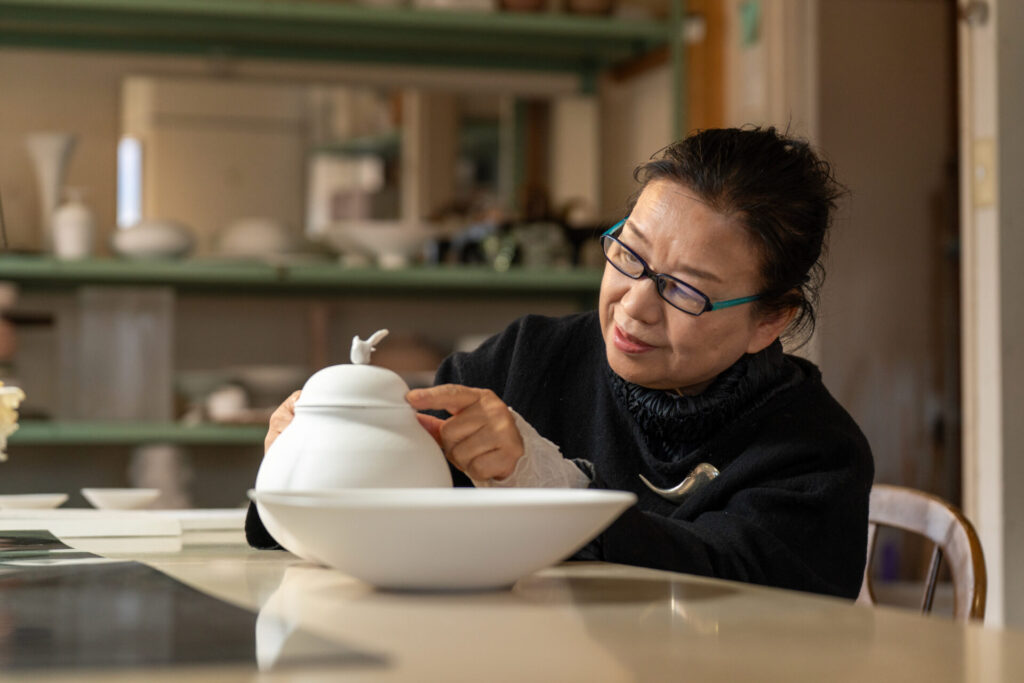
What Mayumi Munakata hopes to pass on to the future is the depth of Hongo ware as a tradition that can embrace all kinds of expression.
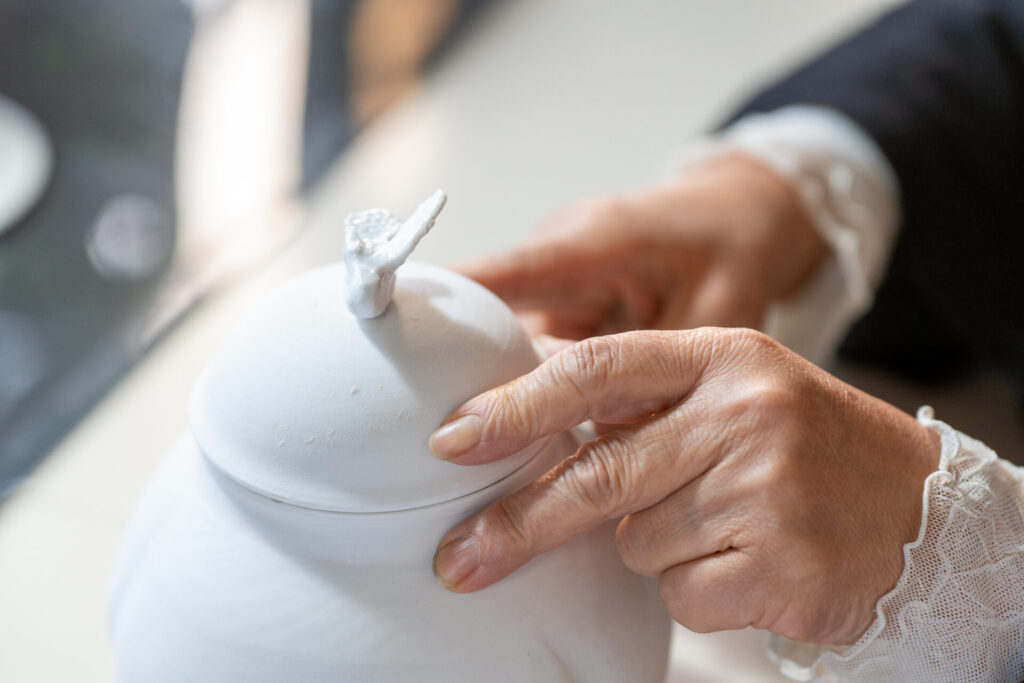
During the interview, she showed me a new incense burner she had recently made. It stood on a tall foot like a goblet, topped with a domed lid, and on that lid perched a charming little bird.
“You can place incense in the hole on the bird’s back—and more than anything, doesn’t this shape make you want to eat ice cream?”
It was a work full of playfulness. As she spoke, her eyes sparkled with a youthful excitement, as if already wondering what interesting thing she might make next.
When the interviewer remarked, “For those who follow an artist, it’s actually exciting to see their style change over time,” she nodded deeply.
“Yes, exactly. I have artists I love too, and it’s fun to look at a piece and think, ‘Ah, this must be from that particular period of their work.’ So maybe it’s okay for me to keep changing too.”
In the world of traditional crafts, “not changing” is often seen as a virtue. But Mayumi Munakata continues to change lightly and freely. The work she makes today may be entirely different from what she makes tomorrow. That unpredictability is perhaps the very charm of her work—and perhaps also the very joy of the way she lives.
When asked what she hopes to do going forward, she thought for a moment before answering.
“I’d like to continue holding exhibitions wherever I have a meaningful connection. I want to meet customers directly, listen to their requests, and enjoy making things together.”
She also spoke of the place where she was born and raised—Aizu-Hongo ware itself.
“In my own way, I was brought up within the world of Hongo ware. So I hope to express that in a good way, and help people all over the world come to know Aizu-Hongo ware. It doesn’t matter who becomes the gateway—if I can help be one of those starting points, I would be very happy.”
She says she has had very little direct experience abroad. And yet the universal beauty in her work seems to hold the potential to cross language and borders alike.
“Come visit anytime,” she says with a smile.
In her studio, one senses that the seeds of still-unseen masterpieces are quietly waiting for their moment.
Like a bird that has flown out from the great tree of Munakata-gama to chart its own sky, Mayumi Munakata’s white porcelain path will no doubt continue to move us—free, beautiful, and full of quiet power.