A New Shape for the Future of Pottery — Creating New Value from the “Treasures” Found at One’s Feet
渡部未来
Mirai Watanabe

Aizu [Fukushima]
Mirai Watanabe
Born in Aizu-Wakamatsu City, Fukushima Prefecture. Assigned to Aizumisato Town as a member of Japan’s Community-Reactivating Cooperator Squad. After working on PR activities for Hongo ware, she launched the accessory brand TESORO.accessory in her third year, using pottery fragments known locally as jaran-kake. She now has a shop in COBACO, a shared space in Aizumisato Town.
Hongo is a pottery town with a history stretching back 400 years. Walk through its streets, and you will notice fragments of broken ceramics scattered here and there. The person who saw value in these overlooked pieces was Mirai Watanabe, who had come to the town as part of a regional revitalization program.
What is it about Hongo ware that inspired her to start a business here and choose to remain in Hongo even after completing her official term? We spoke with her to learn more.
The Hidden Brilliance of “Jaran-kake,” Which No One Had Noticed
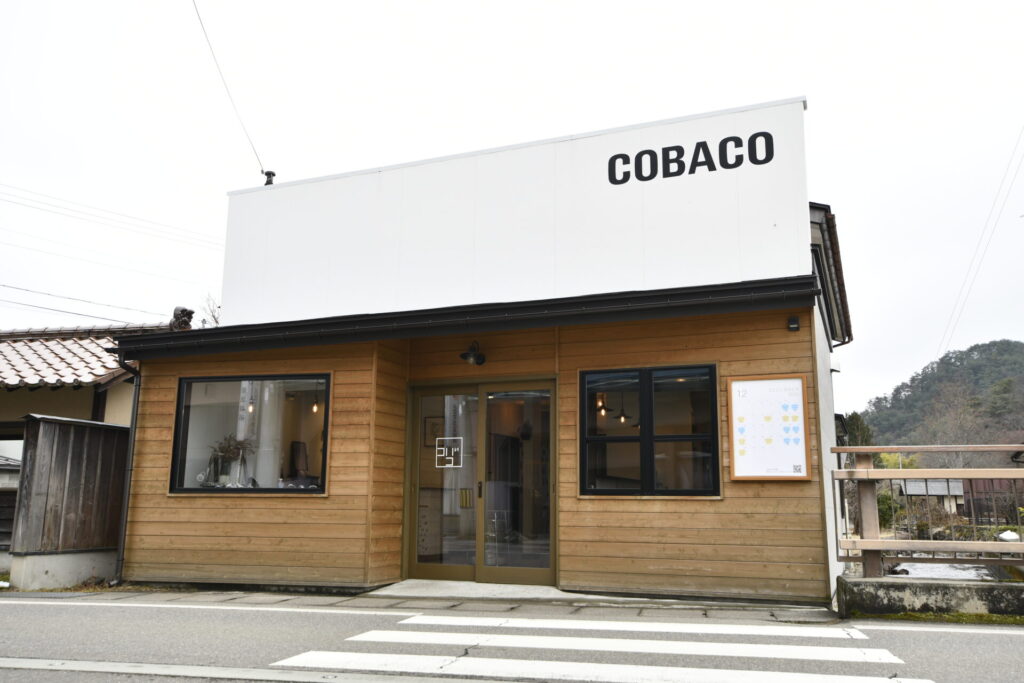
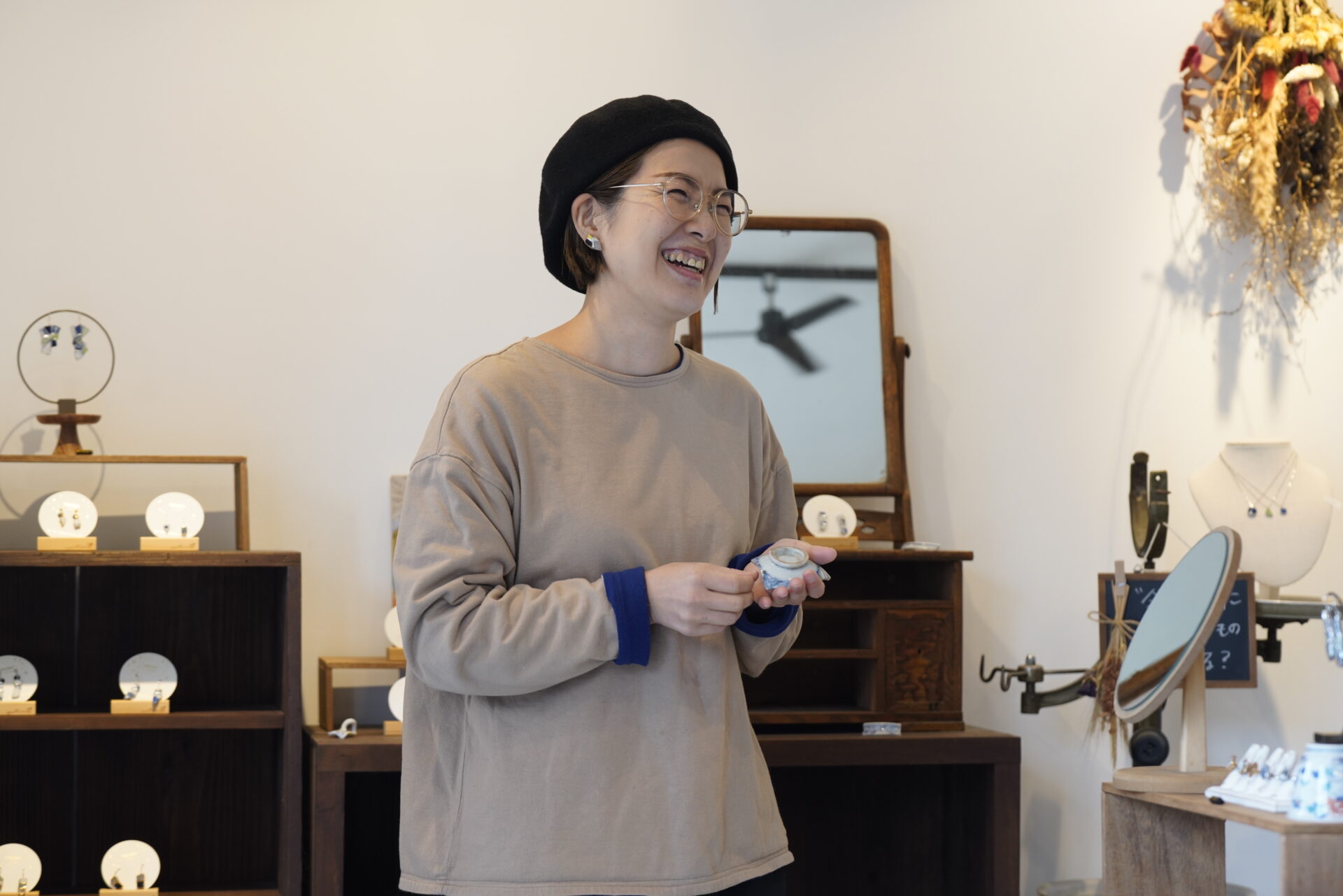
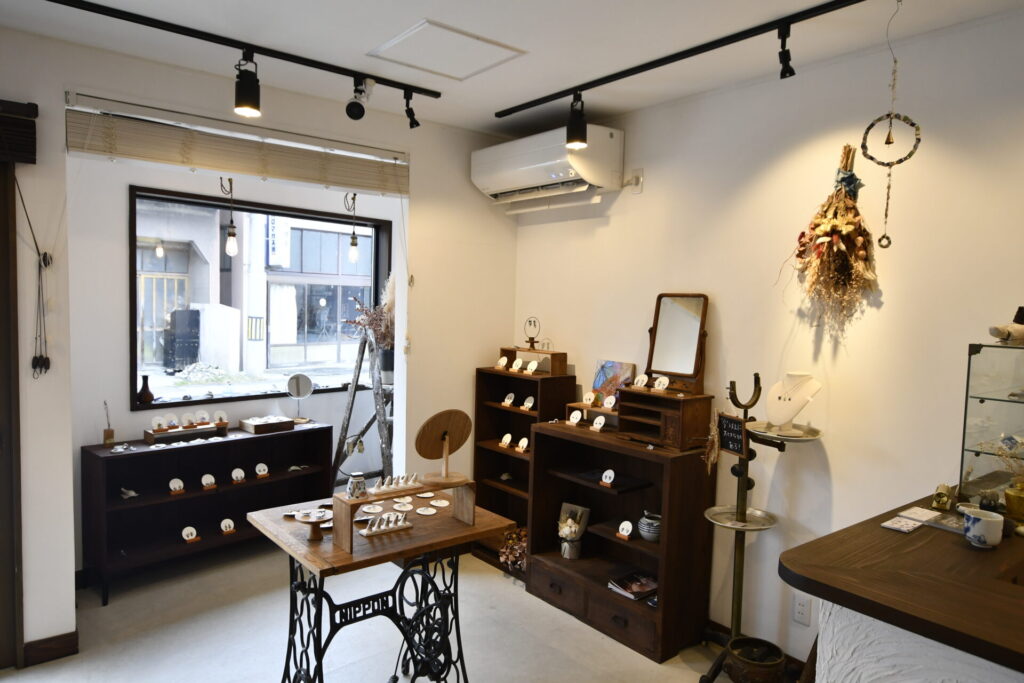
Inside COBACO, a shared space on the main street of Aizu-Hongo, a calm and unhurried atmosphere flows together with the aroma of coffee. On dark wooden shelves—perhaps repurposed from an old Japanese chest—small sparkling accessories catch the eye. Looking closer, no two pieces are alike. Some are triangular, others square, and still others irregular polygons. The gold and silver lines tracing their broken edges make a quiet yet unmistakable statement.
“We’re a little short on stock today. I’m working on some new pieces in the back.”The person welcoming me is Mirai Watanabe, the founder of TESORO.accessory. The large earrings swaying from her ears glimmer as she smiles. Tesoro means “treasure” in Italian and Spanish. And yet the materials she uses were once discarded fragments of broken pottery—pieces no one paid any attention to.
As you walk around Aizu-Hongo, you begin to notice small ceramic fragments scattered in unexpected places: on the earth, between gravel stones, in drainage channels. They are remnants of Aizu-Hongo ware—once fired in this town, once used, and then broken. Local people call them jaran-kake, sometimes affectionately, sometimes simply as rubble.
Watanabe first encountered Aizu-Hongo ware after coming to Aizumisato Town as part of the Community-Reactivating Cooperator Squad. Her mission was to promote Hongo ware and communicate its appeal. But what she first felt, more than anything, was a strong sense of urgency.
“There just weren’t any young people. Older visitors would come, but people my age or younger were hardly anywhere to be seen.”
How could younger people be encouraged to visit? How could they be drawn into the world of traditional crafts, which often feels a little intimidating? One day, while walking through town and turning these questions over in her mind, she noticed a small shard lying at her feet. She picked it up and wiped away the dirt. Beneath it appeared vivid glaze colors, traces of delicate painting, and the texture of clay visible in the broken cross-section.
“It was so beautiful—I couldn’t believe no one had noticed!”It felt like treasure hunting. “Oh, there’s another one!” “This color is lovely too!” She found herself collecting fragments obsessively. These jaran-kake, in all their various colors, sizes, and shapes, were scattered everywhere—proof that this was truly a pottery town. No one could now know which kiln had made them or in what era. And precisely because of that, they sparked the imagination even more. To local people, they were the remains of discarded vessels—waste, one might say. But to her, they were unmistakably TESORO—treasures.
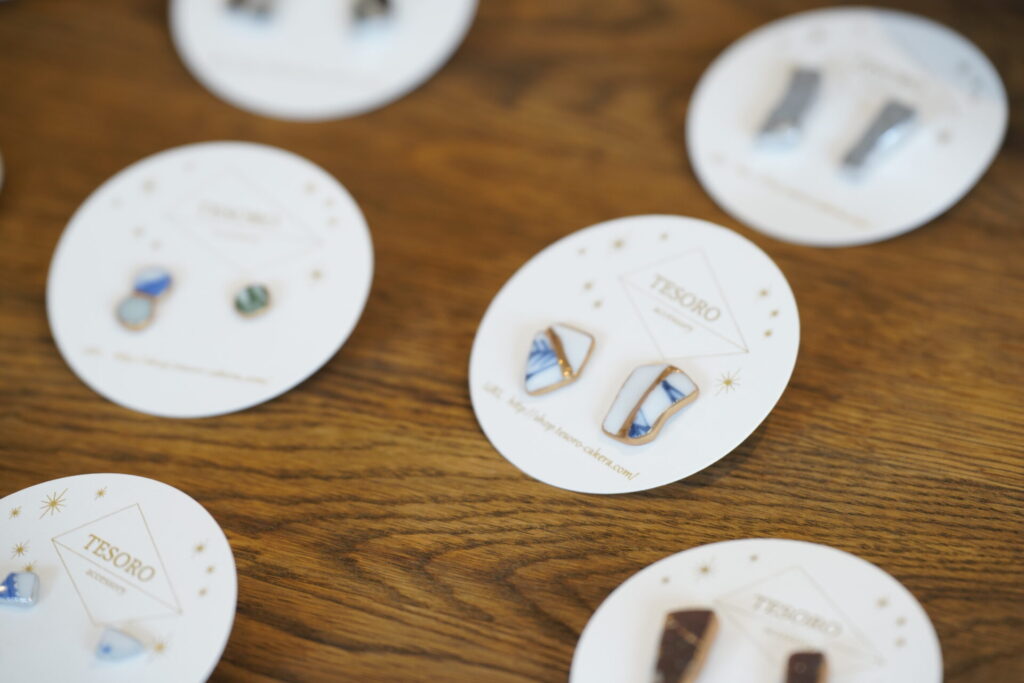
“At first, I began with workshops where the pieces were set in resin and turned into charms.”
She was not going to become a potter herself. Instead, she wondered whether something already existing could be given new value. It was in that process of experimentation that she encountered kintsugi—the traditional Japanese technique of repairing broken pottery with urushi lacquer and decorating the joins with gold powder.
“That was it, I thought. Why not join these fragments with kintsugi and turn them into accessories?”
She consulted artisans of Aizu lacquerware and trained at a vocational school to learn the techniques. That is how TESORO’s accessories came into being.
The making process is highly intuitive. She spreads the collected fragments out across a table and begins testing combinations by feel alone.
“Would this shape work with this one? What if I put these two colors side by side?”
It is like assembling a puzzle through instinct.
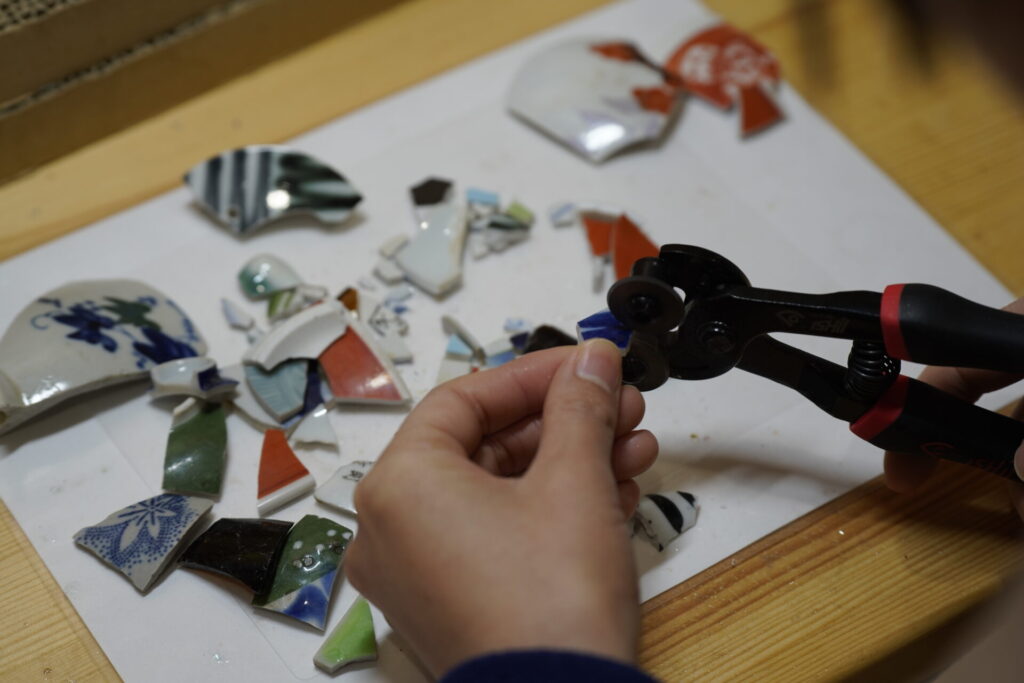
Sometimes she even breaks the fragments further, using a tile cutter.
“I don’t calculate where to break them. I just snap them without overthinking it, and then use whatever shape happens to emerge,” she says with a laugh. “I don’t want to create too many rules about how things have to be.”
Rather than imposing the maker’s intentions too strongly, she respects the chance qualities and accumulated history held within each shard. That is why TESORO’s accessories possess such an unforced, natural beauty.
The Everyday Struggles Behind the Glittering Success
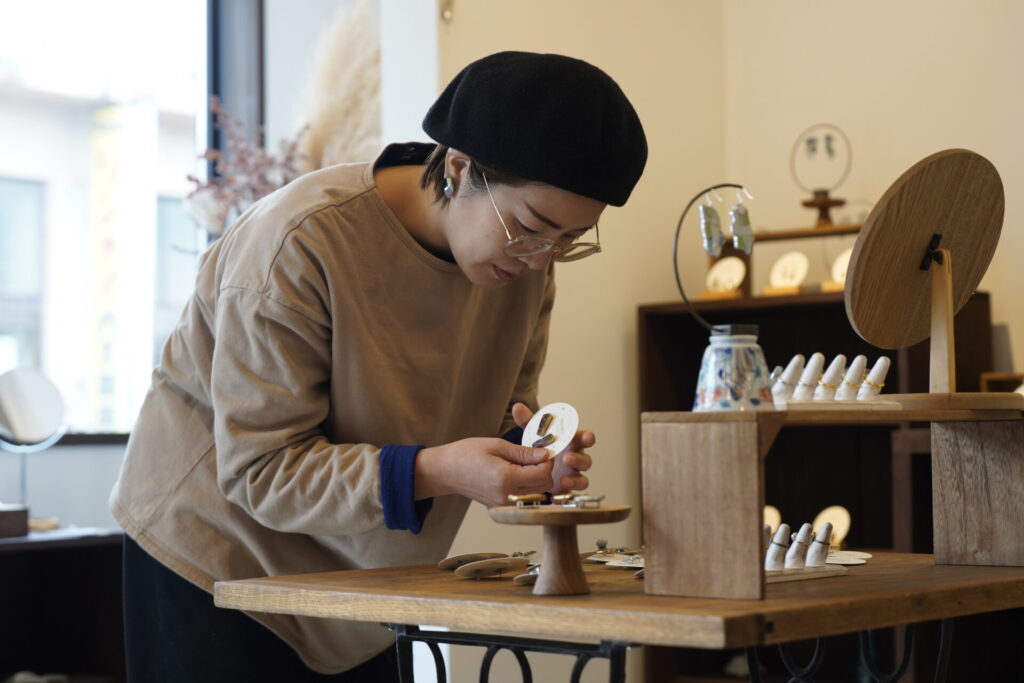
In the third year of her community revitalization work, Watanabe launched her brand and started her own business. Her story attracted attention as a successful example of regional entrepreneurship. Newspapers, television, magazines, events outside the prefecture—and even participation in Japan Expo in Paris. Seeing such a flourishing career, people praised her.
“They say, ‘That’s amazing,’ ‘You’re shining,’ ‘Everything is going so well for you.’”
But Watanabe herself seems almost puzzled by those descriptions.
“I’m not shining at all. Making things by yourself and then selling them by yourself—that’s lonely, and it’s full of uncertainty.”
She speaks candidly about worries over monthly sales, the pressure to continue growing as a creator, and the fear that comes with change.
“I just happened to be lucky with timing and the people I met. Honestly, I sometimes feel that if I could do it, anyone could.”
She does not hide her vulnerability.
“I think every maker feels this way. We all genuinely worry, and we all genuinely struggle.”
There is no carefully constructed mask of a “successful entrepreneur” in those words. What comes through instead is the real breathing presence of one woman trying to stand on her own feet and make a life for herself.
In the midst of those struggles, there is one thing that supports her deeply: the people who make Aizu-Hongo ware.
“When I talk with the potters, I feel my posture straighten. More than as creators, the way they live as human beings is just so admirable.”
Their determination to keep aiming higher without fearing change—and the unexpectedly playful side they sometimes show—has left a strong impression on her.
“I feel lucky to have such wonderful adults so close by.”
Once, as a member of the revitalization program, she had been “the one doing the interviews.” Now, as a maker herself, she stands on the same ground as the craftspeople she once observed. And perhaps they, too, no longer see her as merely someone in charge of publicity, but as one of their own. After all, it was she who picked up the fragments, polished them, and released them into the world—bringing new attention to Hongo ware as a place of production.
“KINTSUGI” Crossing the Sea
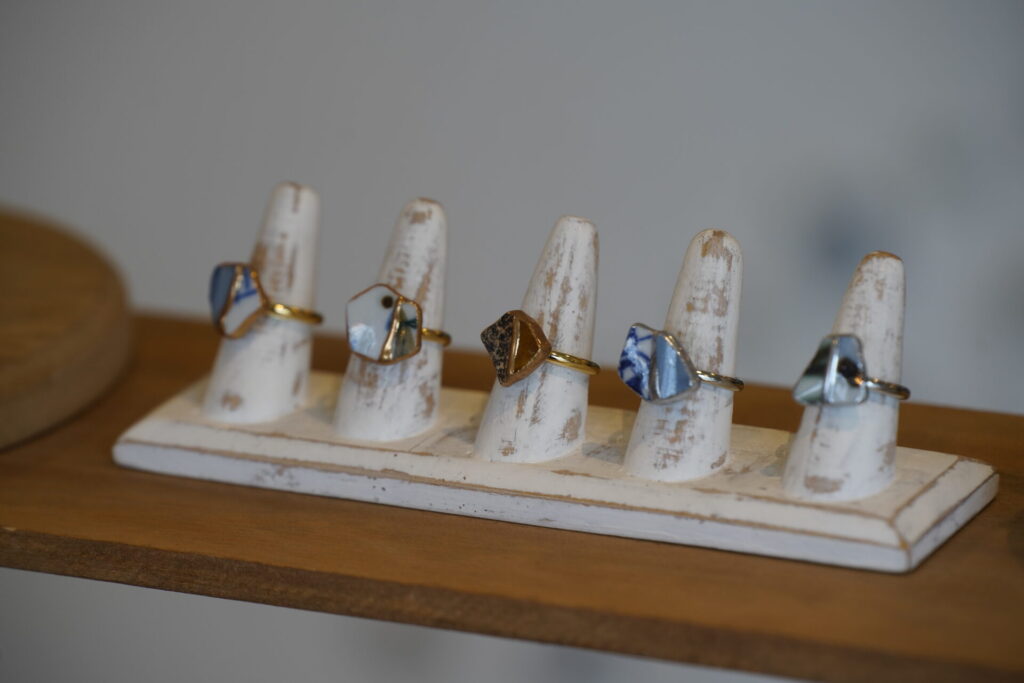
TESORO’s possibilities are not limited to Japan. When Watanabe exhibited at Japan Expo in France, she witnessed something surprising.
“The word ‘KINTSUGI’ was understood as if it were completely natural.”
Visitors there were deeply interested in the Japanese sensibility of repairing broken things and continuing to use them with care.
What was even more interesting was the difference in aesthetic preference.
“In Japan, subtle kintsugi tends to be preferred. Overseas, though, bold kintsugi is much more popular.”
Large breaks, emphasized with thick lines of gold, were embraced enthusiastically. In other words, the aesthetic many people overseas responded to was precisely the design language of TESORO itself.
“I’d like to explore possibilities overseas as well. And I also want to continue offering workshops in many different places, so I can share the joy of making things.”
Her gaze is already fixed on the next stage.
What Do You Wish to Pass On to the Future?
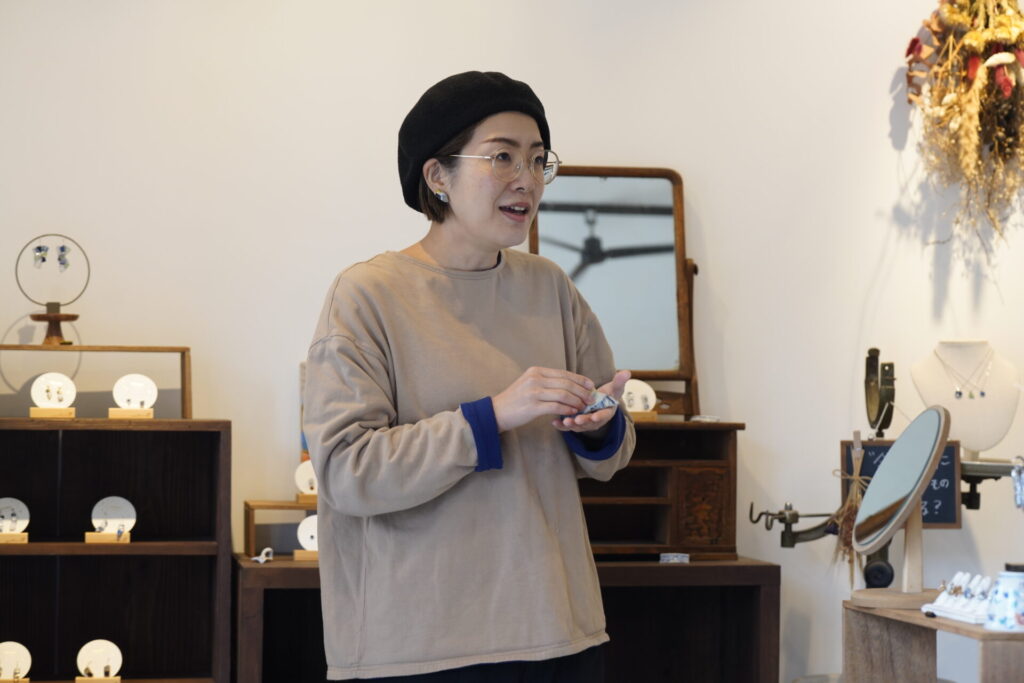
When asked when she hopes people will wear her pieces, Watanabe answers like this:
“I want people to wear them in everyday life. I want them to be like a companion that lifts your spirits when you catch sight of yourself in the mirror.”
Not only on special occasions or at parties, but on ordinary days too—days of T-shirts and jeans. A fragment sways gently by the ear, catches the eye for a moment, and makes someone think, Maybe I look kind of great today.
That is the kind of moment she wants to create.
The materials in her accessories are fragments of vessels that once lived in someone else’s daily life. They may have been pieces of a rice bowl used by someone a hundred years ago. Or perhaps a plate broken because it failed in the kiln. Once their purpose had ended and they were on the verge of returning to the earth, Watanabe’s hands gave them back their radiance. This time, they become part of someone else’s confidence, someone else’s smile.
What Watanabe hopes to pass on to the future is the history of Hongo ware, along with the irresistible charm that lives on in the town and its people.
“It’s fine if you don’t know much about Hongo ware. I just hope people will come casually, visit the kilns, and if they can, talk with the craftspeople.”
As she says this, one senses that just as unexpected treasures can be found by looking at the ground beneath your feet, hidden attractions also begin to appear when you step forward with curiosity. The value of Hongo ware does not live only in the vessels themselves. It lives in the town and in the people as well.
Leaving COBACO and walking through the streets of Hongo, the ground that had looked like ordinary gravel only moments earlier now seemed different. Here was a blue shard. Over there, a fragment of white porcelain. It felt as though the whole town had become a jewelry box—and as though I, too, had somehow become part of it.
What Watanabe discovered was not merely broken pottery. It was the town’s new form of hope itself: the act of shining light on overlooked value and weaving a new story from it.