A Final Piece Found in a Kiln Where Time Has Stopped — The Story of Kaya no Gama, Carried into the Future
鹿目郁子
Ikuko Kanome

Aizu [Fukushima]
Ikuko Kanome
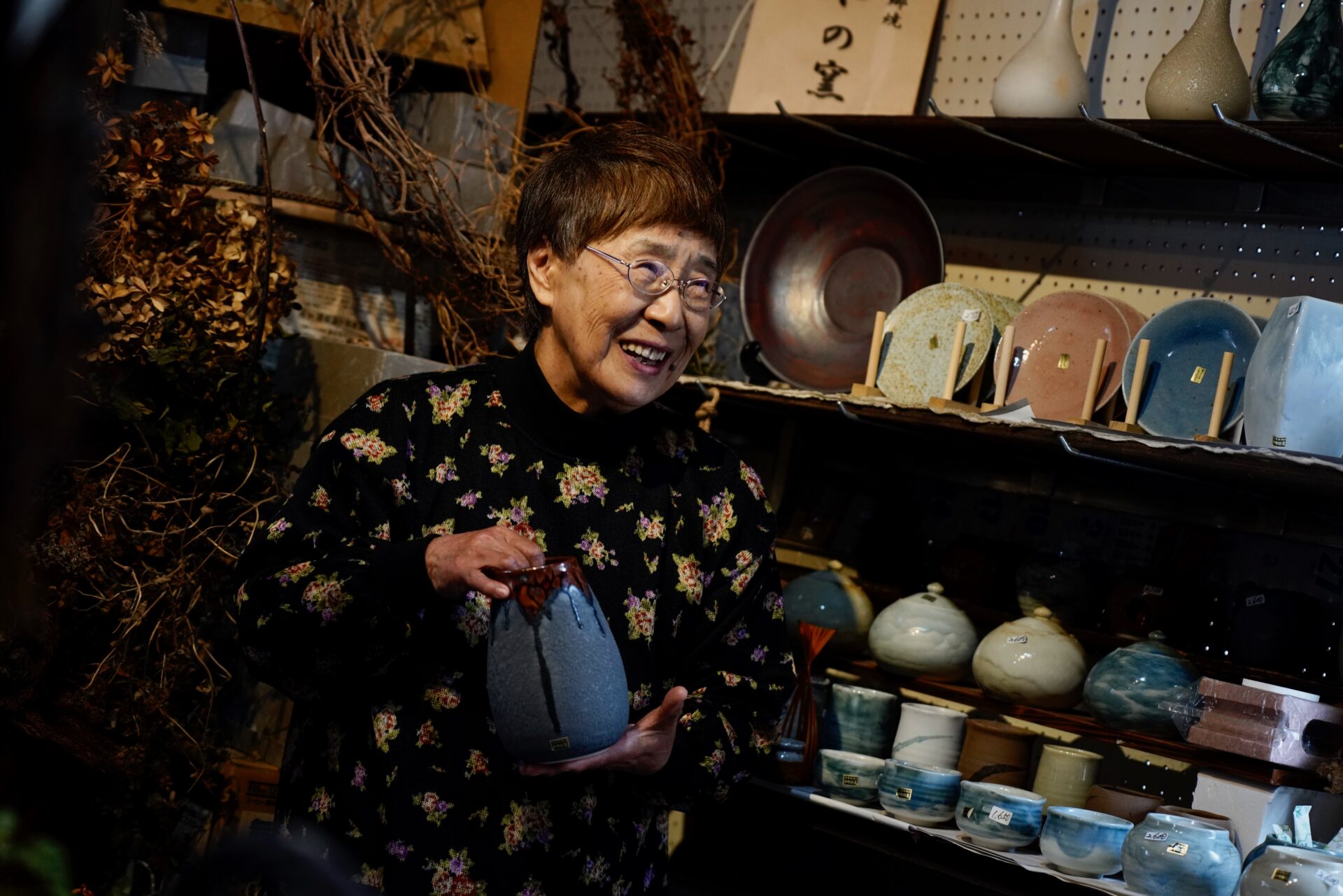
Born in Aizumisato Town, Fukushima Prefecture. At Kaya no Gama, the pottery studio once run by her parents, she sells the works they left behind while sharing the kiln’s history and the techniques behind its ceramics. Her favorite pieces are coffee cups and soba choko cups, which she loves for their comfortable feel on the lips and ease of holding. As the face of Kaya no Gama, she also actively participates in events such as the Aizu-Hongo Ware Seto-Ichi Market and the Mukaihaguroyama Castle Ruins Tea Gathering.
Tucked away in a small lane in Aizu-Hongo stands a charming watermill hut. The history of Kaya no Gama began with grinding stone to make porcelain clay. After the death of her father, who had made pottery as a craftsman, it is his daughter, Ikuko Kanome, who now carries on the kiln’s story and shares its appeal.
The vessels decorated with brush-applied glazes, the changing tastes of customers, and the transformation of local events—all of these speak to the life of the kiln. How does Aizu-Hongo ware appear through the eyes of someone who is not a craftsperson herself? We spoke with Kanome to learn more.
A Kiln Born from a Watermill — The Traces of Her Parents Left in Every Vessel
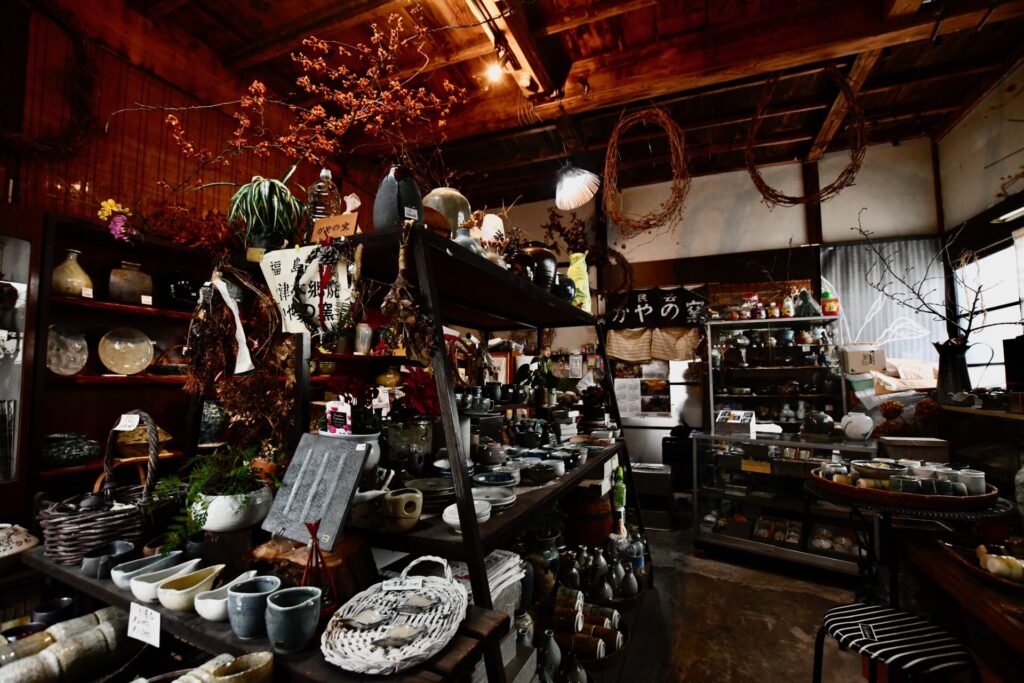
Setomachi Street is the main road of Aizu-Hongo. Just off this street—once lined with pottery stalls and crowded with people—stands Kaya no Gama.
The moment one steps inside, the space seems to hold a distinct atmosphere: quiet, nostalgic, and somehow suspended in time. Lined up on the shelves are powerful vessels in soft intermediate tones and subdued colors. Every one of them was made by the husband-and-wife team who once ran the kiln. No new pieces will ever be made again.
“If my father were still alive, he would be 105 now. He passed away at 83. What you see here are the last works my father and mother made together.”
Ikuko Kanome, who now tends the shop, says this gently. This is a place where, within a stillness untouched by time, one may encounter a final and unrepeatable piece.
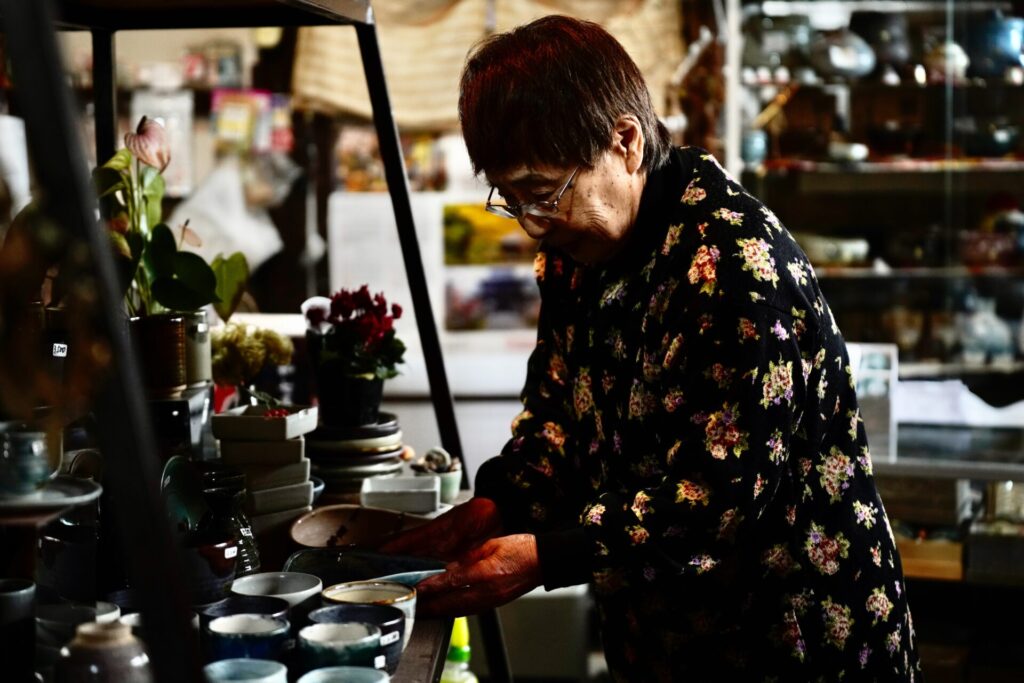
The history of Kaya no Gama is not especially old. It was founded by Kanome’s father sometime after the war. Her family, the Satos, had operated a clay-processing business along the river behind the property, using a waterwheel to crush Okubo pottery stone, the raw material used for Aizu-Hongo ware.
“My father went to war, and after he returned, he started making pottery. My mother worked alongside him—they built it together.”
At the time, it was common for the husband to throw on the wheel while the wife handled decoration and glazing. But Kaya no Gama was a little different.
“My mother made forms too, and my father also did decoration. They made everything together. Looking back, maybe that was unusual.”
Large jars, flower vessels, and bowls for daily use line the shop. In all of them, one senses the confident hands of their makers. Particularly striking are the large pieces made by te-bineri, or hand-building. Instead of using a wheel, coils of clay were stacked and shaped by hand. Their rugged surfaces seem to retain the warmth of a couple who loved clay and lived alongside it.
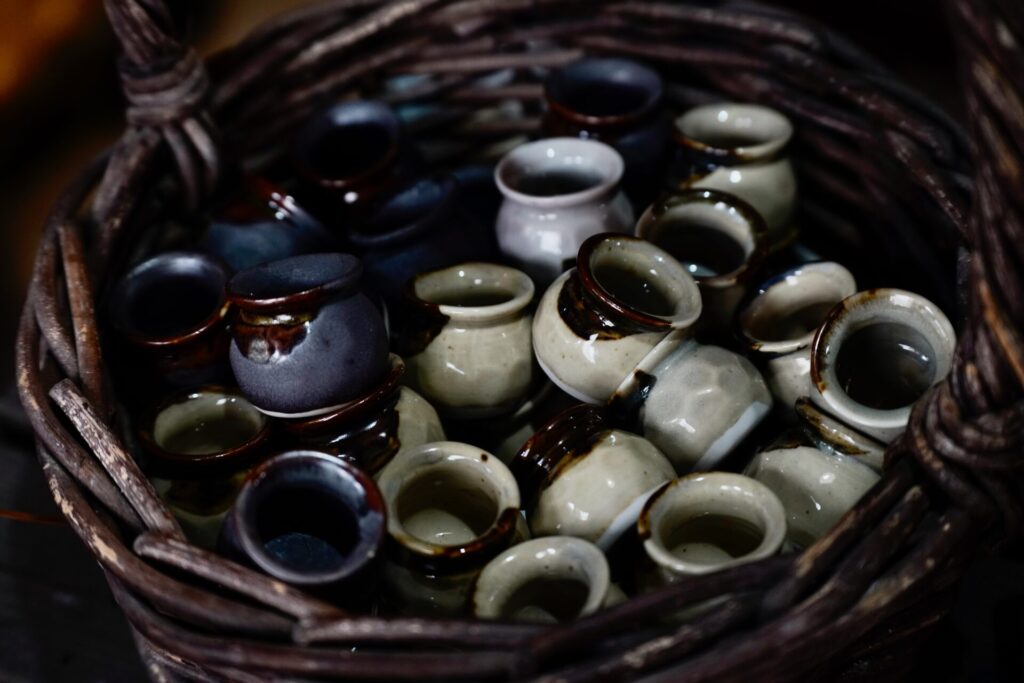
The greatest characteristic of Kaya no Gama lies in its unique color palette. While many kilns immerse vessels in glaze, this kiln made frequent use of a technique called fude-gake, or brush application. A generous amount of mixed glaze was loaded onto a brush and then poured over the vessel in strokes that could be bold or delicate.
“The place where the brush first touches becomes dark, and where the glaze flows becomes lighter. That gradation melts in the kiln and creates a complex landscape. It looks mysterious, doesn’t it? Very different from simply dipping the piece.”
As Kanome points out, even when the same glaze is used, no two pieces have the same expression. The force of the brush, the thickness of the glaze, and the whims of the flame—all of these accidental elements come together to create irregularity, and that irregularity is precisely the charm of Kaya no Gama, something absent from today’s uniform products.
Some pieces also show small speckled patterns caused by iron naturally emerging from the clay itself.
“You can’t really make those patterns happen on purpose, and that’s what makes them so interesting.”
Perhaps the source of the kiln’s expressive power lies in this reverence for nature—something beyond human control.
The Disappearing Table Set of Five
As one talks with Kanome, the conversation naturally turns to the subject of changing times.
At one time, the main products of Kaya no Gama were matching sets of five rice bowls and teacups.
“In the old days, people felt it was embarrassing not to have five matching settings when guests came. Teapot, teacups, saucers—everything came as a full set.”
Today, however, nuclear families have become the norm, and meals are often eaten separately.
“People say, ‘We don’t need five anymore.’ Many customers now buy just one piece in a color they like, or choose different colors for family members so they won’t mix them up. Sometimes I even take them out of the box and display them individually.”
There is something slightly wistful, yet also accepting, in Kanome’s expression as she says this. It is not simply a story of pottery becoming harder to sell. It also sounds like a quiet mourning for a disappearing Japanese scene: a family gathered around the table, eating from bowls of the same pattern.
Even so, devoted repeat customers still visit the shop.
“I bought one at the Seto-Ichi market years ago, but it broke. Do you have the same one?”
To such customers, Kanome replies with both apology and pride:
“There isn’t another one exactly the same. Every piece turned out differently depending on how the kiln fired.”
The Aizu-Hongo Ware Seto-Ichi Market, held on the first Sunday of August each year, is one of the town’s summer traditions. In the past, stalls packed both sides of Setomachi Street, and crowds would gather even before dawn.
“In those days, people spread straw mats right on the street and sold pottery directly on top of them. I was helping out from the time I was in high school.”
In Kanome’s memory, the market is full of dust and lively energy. In recent years, however, the venue has moved to an open plaza, becoming a more orderly event with tents and tables.
“When they do surveys, a lot of people say the plaza is easier to walk around. But people who remember the old days often say, ‘The atmosphere on the street was better.’ I suppose getting permission to put stalls out on the road must be difficult now.”
The flow of time cannot be resisted. Even so, each year Kanome takes the remaining works out of storage and brings them to the new venue.
“Pottery doesn’t have an expiration date,” she says jokingly. “All I can do is keep selling it.”
Behind those lightly spoken words is a deeply felt wish: to place as many of her parents’ works as possible into the hands of others.
The Daughter Who Carries On the Work of Keeping the Shop
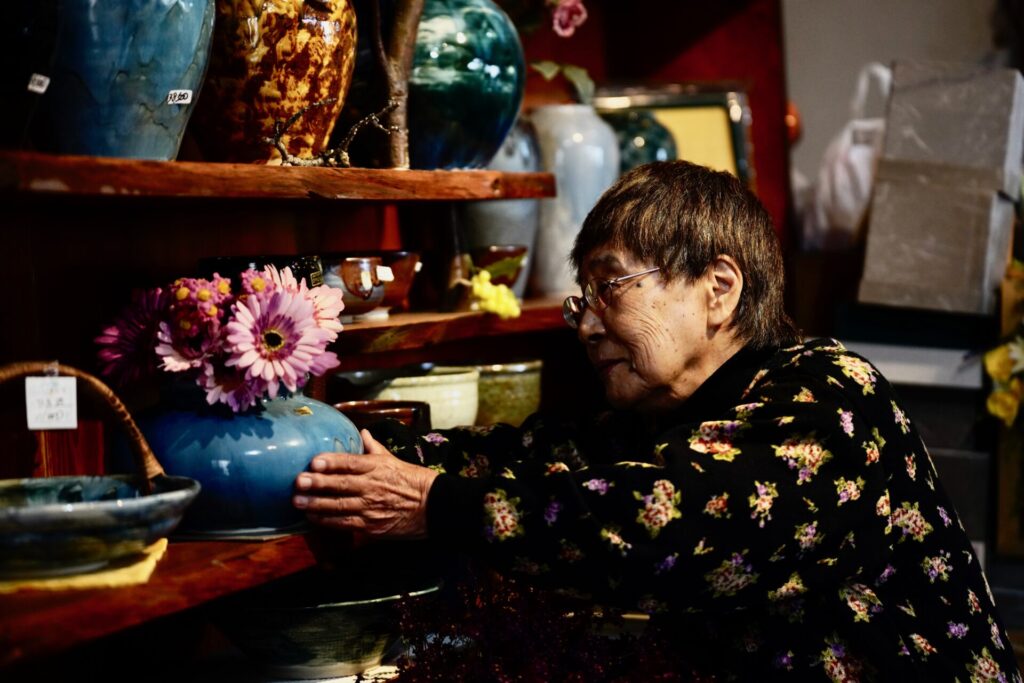
Kanome herself is not a potter.
“There was a time when craftspeople worked here, but now there is no one left. I started looking after the shop when I left my previous job.”
She does not make pottery herself. That means when the remaining vessels in the storehouse are gone, the story of Kaya no Gama will come to an end. At first glance, that may sound like something tragic. Yet Kanome’s face shows no sense of despair.
“This is the only shape of coffee cup we have left now,” she says, showing me a somewhat unusual cup with a wide, flared rim. “It’s easy to drink from. I use it myself all the time.”
She loves the works, uses them, and shares their appeal with those who visit—as the kiln’s greatest fan, that is now her role.
The shop is filled with plates, teacups, large jars, and tea utensils.
“People should feel free to use them however they like. Even this kensui would look lovely with flowers in it, wouldn’t it? And this plate could hold sashimi, or pickles. They’re sturdy.”
The spirit her parents poured into the clay travels onward, through their daughter’s hands, into someone else’s daily life. The inventory may grow smaller, but that is not disappearance. It means the clay of Aizu-Hongo continues living on, transformed into new lives in new places.
What Do You Wish to Pass On to the Future?
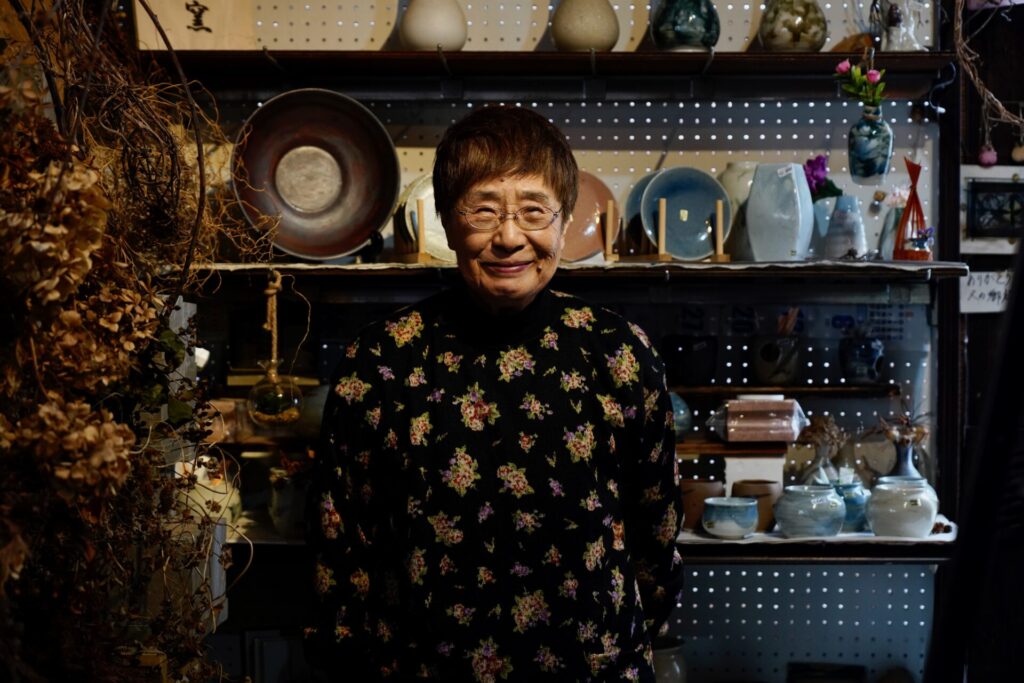
“What about the future of Aizu-Hongo ware? The younger people are working hard, so I’m sure it will be all right.”
Rather than grieving the end of her own family’s kiln, Kanome watches warmly over the future of the production area as a whole.
“This town has beautiful water, and the people are kind. It’s a very good place to live.”
What Kanome hopes to pass on to the future is the town of Aizumisato itself—the place that nurtured the culture of Hongo ware.
Stepping back outside through the noren curtain of Kaya no Gama, Setomachi Street is quiet. And yet, it feels as though a new wind is blowing somewhere through it.
There are long-established kilns standing firmly in place, new kilns being born, independent artists expressing their own individuality, and shops like Kaya no Gama quietly remaining as witnesses to history. All of them are indispensable pieces in the mosaic of Aizu-Hongo ware.
If you visit this place, you may want to do so soon. And if you happen to encounter a vessel that speaks to you, it may be best to take it home without hesitation.
Because what you are holding is not simply a piece of pottery. It is a once-in-a-lifetime moment—something that will never be made again.