Opening Up the Workshop: A Way of Making That Brings Lacquerware Back into Everyday Life
守田 貴仁
Takahito Morita

Ishikawa []
Takahito Morita
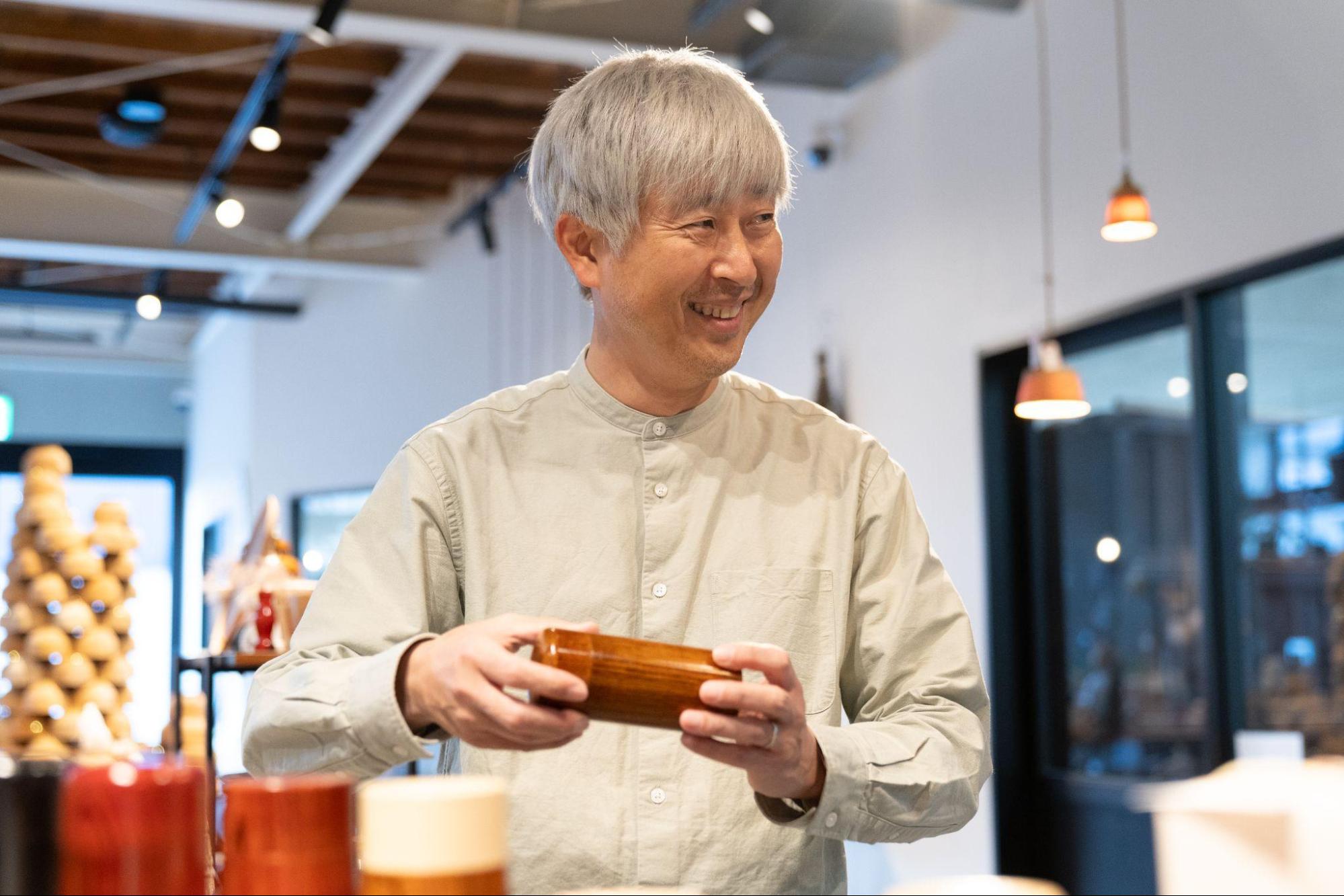
Representative of Morita Shikki. Born in Yamanaka Onsen, Kaga City, Ishikawa Prefecture. He studied electronic engineering at university. While considering his career path after graduation, an encounter with the world of craft production in Kyoto led him into the field of lacquerware, and he joined his family business, Morita Shikki. Today, as the head of the company, he oversees the entire workshop. Grounded in the wood-turning techniques of Yamanaka lacquerware, he develops products such as ultra-thin wooden lighting and lacquer accessories. In 2022, he opened Kōbō Jōkan, an open factory and experiential hub dedicated to sharing the lacquerware-making process, offering wood-turning experiences, and fostering the next generation of craftspeople.
Lacquerware making in Yamanaka Onsen grew alongside the bustle of the hot spring town. Once carried across Japan as souvenirs, it eventually developed into one of the country’s leading lacquerware production areas. At the heart of this growth lies wood turning—the foundational process that determines the quality of a vessel.
In an era when lacquerware culture is becoming harder to pass on to younger generations, Morita Shikki seeks to close the distance between people and lacquerware by inviting them to come and see, touch, and make. The experiential workshop opened in 2022 serves not only as a place of engagement between makers and users, but also as a base for passing the craft and the region itself on to the next hundred years.
Even If Records Are Lost, Technique Remains: Morita Shikki Today
Morita Shikki was founded in 1909. Yet few detailed records from its early days remain. A major fire in Yamanaka during the Taishō period destroyed many of the Morita family’s early products, tools, and documents.
Perhaps because of this, Morita places great importance on sincerity in the work at hand. While he says it was never explicitly taught as a family rule, the foundation of his work is a simple principle: to make things earnestly and carefully.
“When you’re making something to deliver to a customer, you have to think seriously about what the most sincere way of making it is. That’s what we do.”
This attitude is most clearly embodied in Morita Shikki’s ultra-thin turned wooden lighting. The wood is shaved so thin that it allows light to pass through, creating an immediate sense of wonder.
How thin can it be made? How do you know where the limit lies?
Morita’s answer is straightforward.
“By feel. While touching it, using the sense in my hands—deciding whether I can go a little further, or whether I should stop.”
The technique of thin turning itself can be learned in a few years. But producing ten, fifty, or a hundred pieces consistently is another matter entirely—one that requires the experience of a craftsman with a decade of practice.
Behind precision lies steady, patient accumulation.
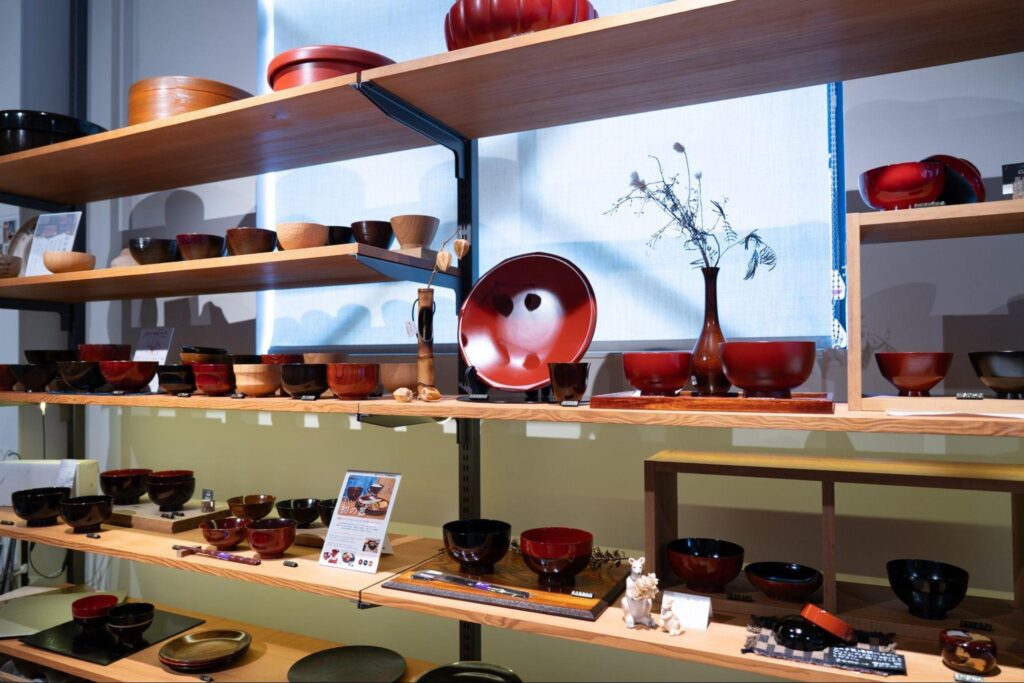
Morita Shikki is also pushing beyond the conventional boundaries of lacquerware, developing accessories and lighting alongside traditional tableware.
The motivation, Morita explains, came from a sense that “things stop being interesting once they become fixed.” Accessories, in particular, are not something people will pick up simply because “they’re lacquered.” They must first be cute, beautiful, or cool—the design has to be appealing in its own right. With this in mind, Morita Shikki has sought places where lacquer can truly shine, drawing on the power of design.
Lacquering glass and metal was pursued in collaboration with public research institutions. With the support of local technical centers and industrial testing facilities, the process took time—but gradually became possible.
“Even when you don’t know the answer, there are people who will search together with you. Having that kind of support made it possible to try something new.”
The strength of a production area lies not only in its craftspeople, but also in the surrounding systems—a land that nurtures technique as a whole.
A Production Area Shaped by Yamanaka Onsen and Its Industries
The character of Yamanaka Onsen is deeply intertwined with changes in its industrial structure.
Morita points to the period of rapid economic growth as a major turning point. The workshop moved from its original location to what is now known as the “lacquerware industrial complex.” In an age of mass production and large-scale distribution, the number of craftspeople increased, and the framework of Yamanaka as a production area took shape.
“I think establishing a system that allowed us to produce in volume and deliver products to society was a huge step.”
Yamanaka’s development alongside tourism also connects here. As a hot spring town with a constant flow of people, it naturally lent itself to linking making with delivering. Morita sees the land itself as having propelled the growth of the production area.
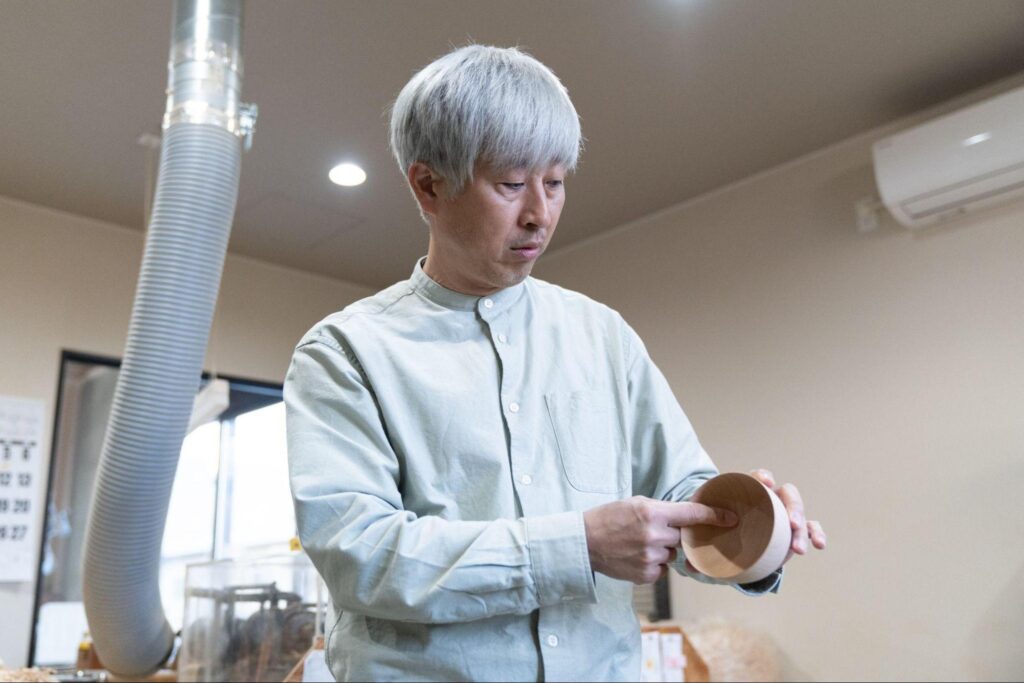
An essential concept when discussing Yamanaka lacquerware is tategidori (vertical wood cutting). Morita explains this method by comparing it to the structure of a house.
Unlike itagidori, where boards are sliced from lumber, tategidori involves cutting logs into rounds. When properly dried, this method results in less warping or distortion over time, allowing for more delicate processing.
“You can’t cut the same way every time. Each piece of wood has its own character. That’s why years of accumulated data and technique become your weapon.”
“Dialoguing with the wood”—Yamanaka’s wooden bases embody this idea perfectly.
Choosing Not to Specialize: Making That Sustains the Production Area
Yamanaka lacquerware is based on a system of divided labor: wood turning, lacquering, and maki-e decoration. Lacquerware exists because each of these roles is fulfilled.
Interestingly, what Morita describes as Morita Shikki’s distinctive strength is not specialization.
“It’s not about specializing only in wood bases, or only in lacquering, or only in maki-e. Lacquerware can’t exist unless all of these craftspeople are there. We want to value an environment where lacquerware can be made as a whole.”
Because of its scale, Morita Shikki can play a particular role—supporting circulation within the production area rather than sharpening a single edge. His words carry a grounded realism about what it takes to sustain an industry.
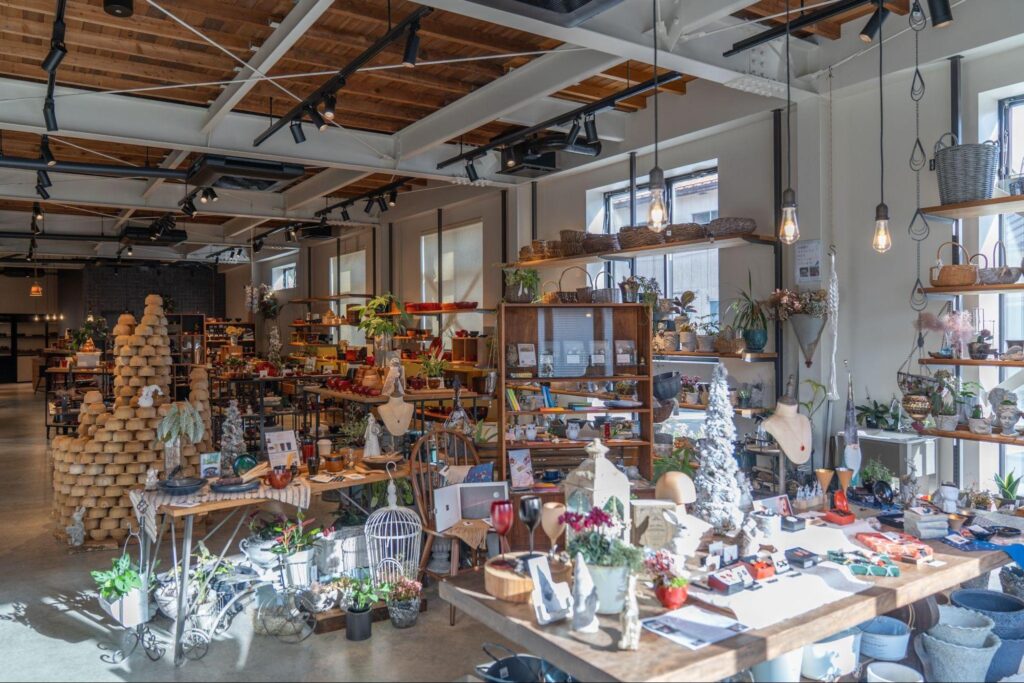
In 2022, Morita Shikki opened Kōbō Jōkan. As an open factory, visitors can observe the entire process—from wood turning to lacquering and maki-e—through glass.
At first, craftspeople felt uneasy about being watched while they worked. But once they began, unexpected reactions emerged.
“They say it’s nice not to feel lonely. Sometimes the gaze is noticeable, but once they’re focused, it doesn’t bother them. Some say they’re happy that people are there.”
Workshops and direct interaction with visitors also provide stimulation.
Showing the process, it turns out, affects the makers’ motivation as well.
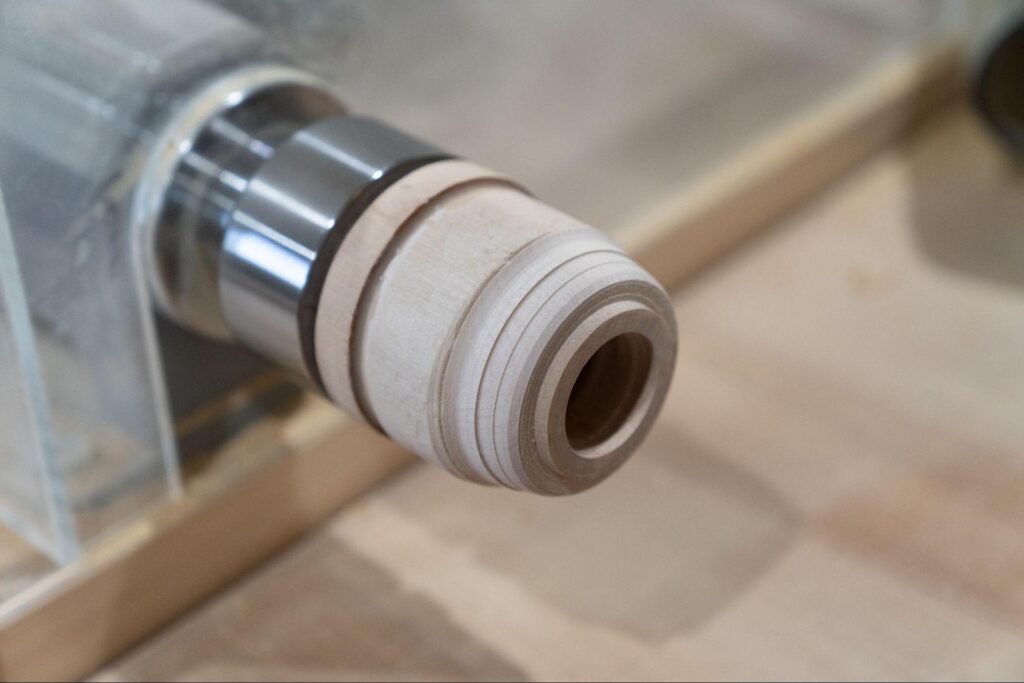
Hands-on experiences are also offered at Jōkan. While painting workshops are common, wood-turning experiences are rare. The reason is simple: there are few workshops that actually do wood turning, the equipment is expensive, and the technique is demanding.
Even so, participants respond enthusiastically.
“They say it’s difficult. But they leave really happy. No one goes home exhausted. Everyone says it was fun.”
Once you shave too much wood away, there’s no going back. That irreversibility creates a balance of tension and deep focus.
Experiencing making something with your own hands becomes an entry point into lacquerware.
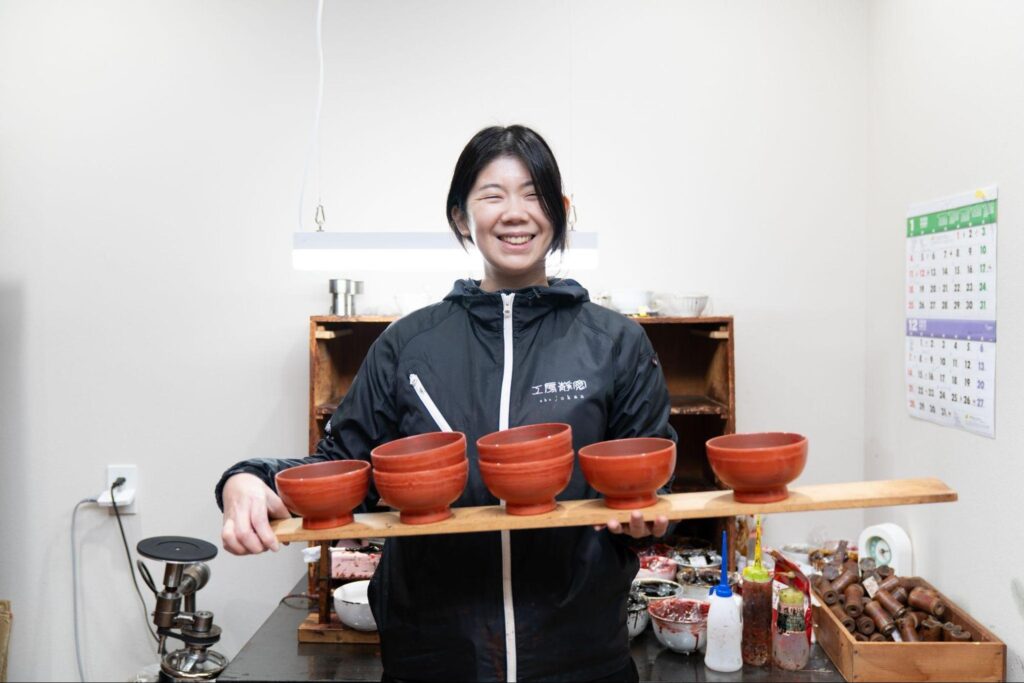
Morita says the most difficult aspect of running the workshop is ensuring that young people can continue.
Making sure that those who jump in with enthusiasm don’t break down halfway through—not because of skill, but because they can’t keep going—means creating a sustainable environment.
What he hopes to pass on to the next generation is an attitude: broadening one’s perspective and never neglecting to refine one’s skills.
A phrase once said to him still remains.
“Try lots of different things.”
Making things carefully and sincerely, while thinking freely and creatively—holding both at once defines where Morita Shikki stands today.
What Do You Want to Carry into the Future?
What Morita wants to pass on is not lacquerware as a product, but Yamanaka itself as a place that can continue making lacquerware.
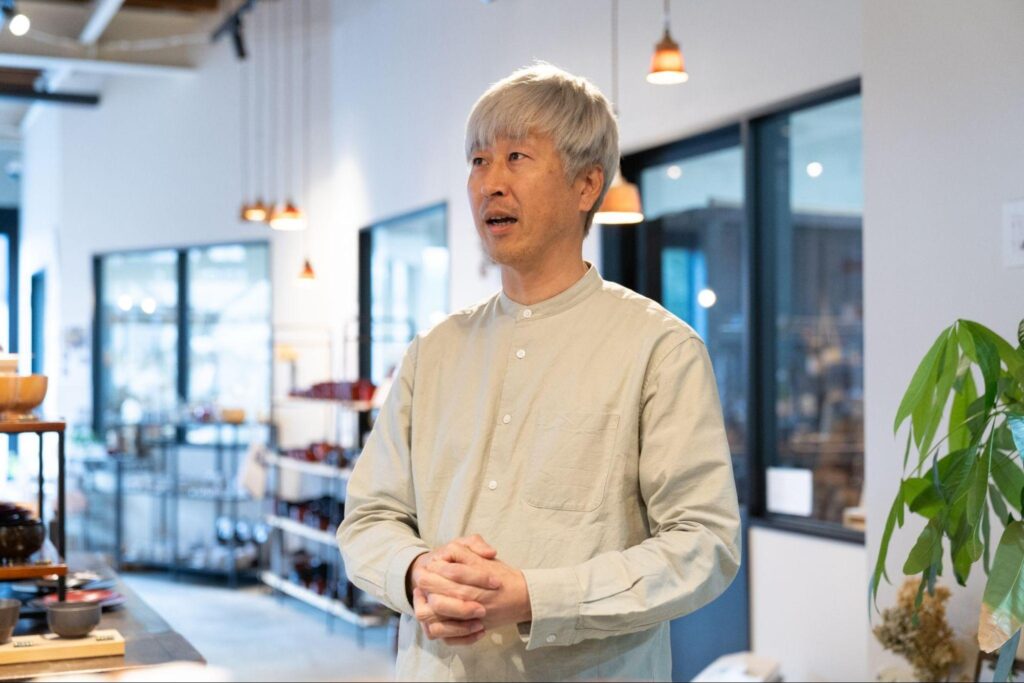
“I want us to be lacquerware makers—and also manufacturers.”
Behind these words lies a wish that the site of making itself does not disappear. By making full use of the workshop’s capacity, increasing the number of craftspeople, and continuing to create new things, the production area remains alive. The moment it stops being a place that can make, culture is severed—this sense of urgency is strong.
“If people can touch, see, use, and even try making things themselves, and through that understand lacquerware culture just a little. If they think, ‘Miso soup tastes better in this bowl,’ at their everyday table—that would make me happy. Once they try it, I think they’ll definitely feel how good it is.”
What Morita Shikki is passing on to the next generation is not knowledge of what is “good,” but an entry point that can be felt through experience.
They continue to open the door—to a life with lacquerware.