Carving Lion Heads Side by Side with the Community:A Workshop’s Commitment to Protect Tradition and Pass It On
知田清雲
Seiun Chida

Hakusan [Ishikawa]
Seiun Chida
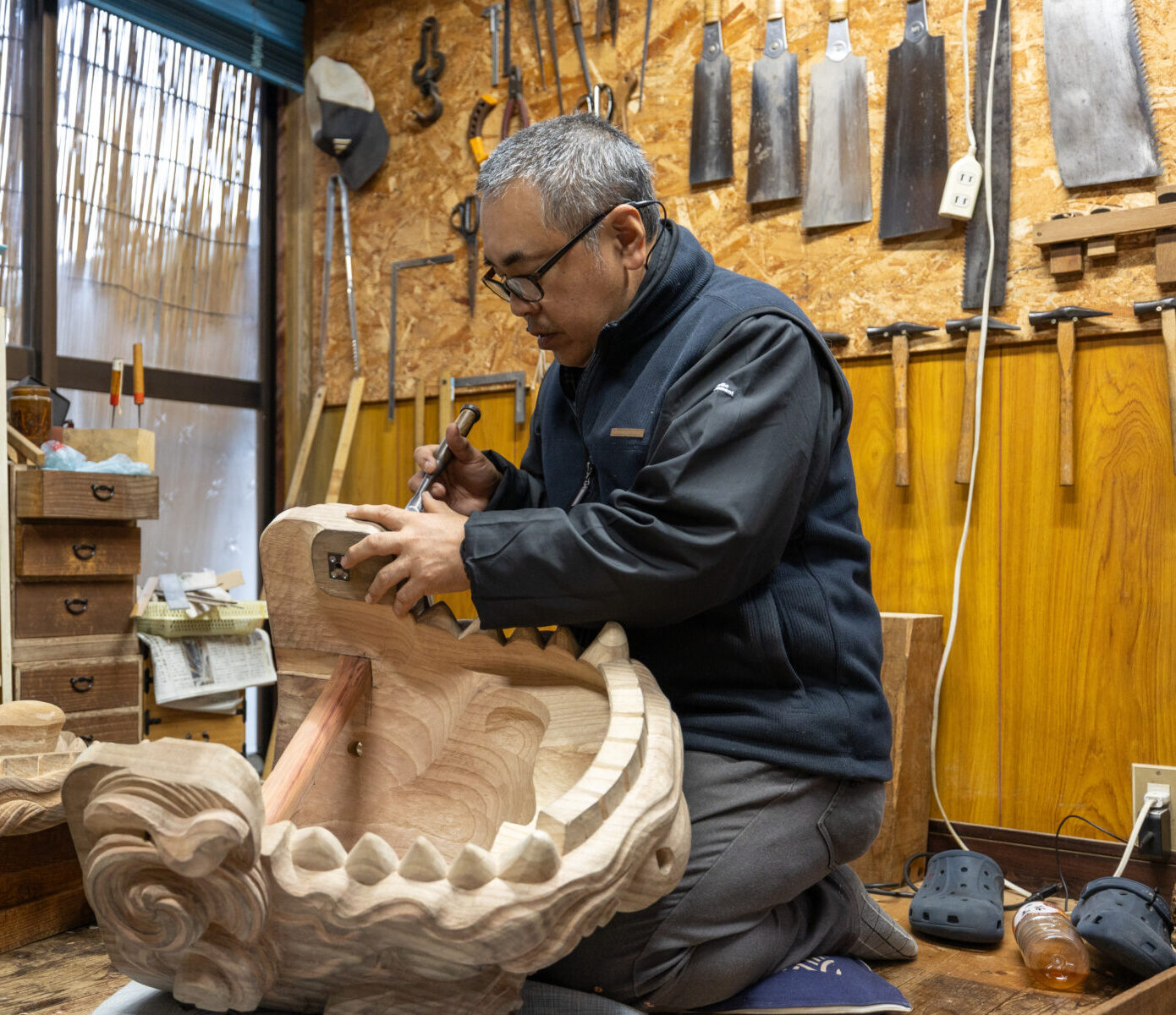
Born in Hakusan City, Ishikawa Prefecture in 1962. As the second-generation artisan of a family-run shishi-gashira (lion head) workshop, he has devoted his life to the craft. After graduating from high school, he trained under a woodcarver in Ishikawa Prefecture, then returned home to take over the family business. For more than 40 years, he has worked as a specialist artisan creating shishi-gashira.
While preserving the traditional method of making lion heads from paulownia wood, he has also introduced improvements such as reducing weight and increasing durability, contributing to the growth and continuity of local culture.
Chida Kobo is located in Hakusan City, Ishikawa Prefecture. Surrounded by magnificent nature, the workshop specializes in the creation and restoration of Kaga-style lion heads—and has protected this tradition for more than 70 years.
We spoke with second-generation artisan Seiun Chida about the pride of supporting festivals through meticulous craftsmanship, and the thoughts and prayers embodied in each lion head.
Kaga Shishi-gashira: A Traditional Craft Passed Down Across Ishikawa
Hakusan City lies in the southern part of Ishikawa Prefecture, about a 30-minute drive from Kanazawa Station. With a population of roughly 110,000—the second largest in the prefecture after Kanazawa—it stretches across a vast area from the Hakusan mountain range (one of Japan’s three sacred peaks) all the way to the Sea of Japan. The Tedori River forms fertile alluvial plains, making the region well suited to agriculture. Manufacturing is also strong here, with industries such as machinery, automobiles, and textiles.
In Ishikawa, shishi-mai (lion dances) have long been a thriving tradition. Their origins are said to trace back to 1583, when the people performed a lion dance to celebrate Maeda Toshiie, the first lord of the Kaga Domain, entering Kanazawa Castle. The tradition was encouraged by successive lords, and Kaga shishi-mai developed into a brilliant and powerful performing art.
Within these festivals, Kaga shishi-gashira have played an important role as protective deities—driving away evil spirits and praying for abundant harvests and household safety. During the Edo period, the craft was refined under the patronage of the Kaga Domain, becoming known for its magnificence and strength.
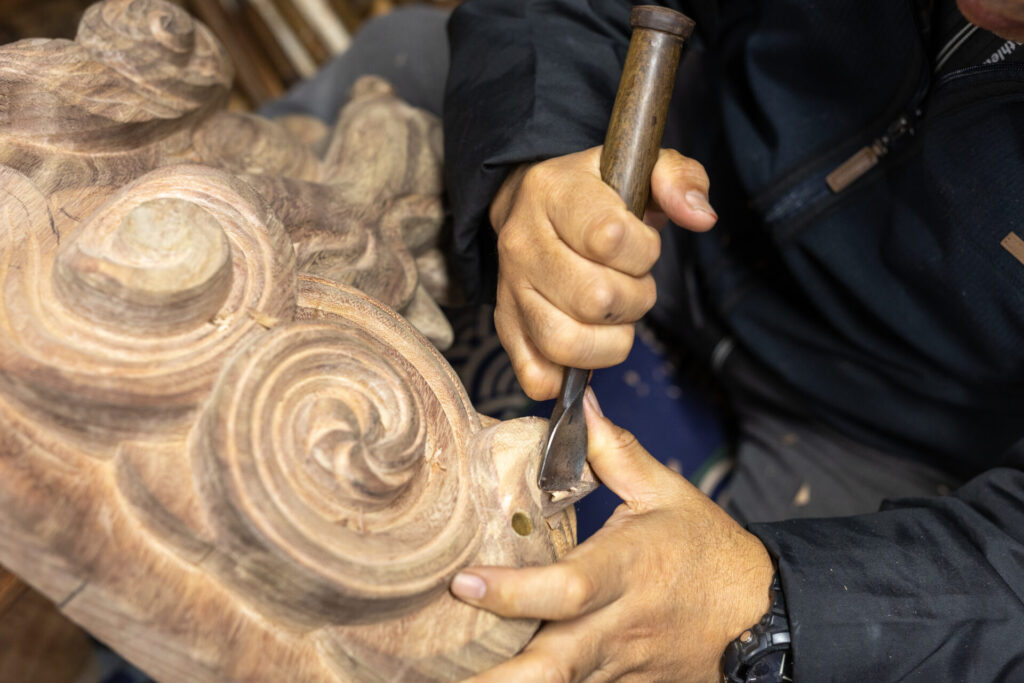
A defining feature of Kaga shishi-gashira is their lavish design: carved from paulownia wood and decorated with gold leaf and lacquer. They also often incorporate a distinctive design known as happo-nirami—“staring in all directions”—in which the eyes appear to glare no matter where you stand. This symbolizes protective power and is an essential element of Kaga lion heads as guardians of the community.
Another notable feature is that Kaga lion heads may have horns—something rarely seen in other regions. Many are made with male and female distinctions: males may have twisted horns, while females sometimes have none.
Chida Kobo was founded in 1954 by the first Seiun Chida. In 2022, Chida inherited the name and became the second Seiun Chida.
“My father originally made paulownia chests and boxes,” he says. “When he received an order to make a box for storing a lion head, he thought, ‘If it’s made from the same paulownia, I’d like to try making the lion head itself.’ That’s how it began.”
For Chida, taking over the family trade felt like a natural path. The turning point came when his father said something at the time he graduated from high school.
“He told me not to stay at home—first, I should go train under another artisan. At my apprenticeship, I learned carving in general and was drilled thoroughly in the fundamentals of woodcarving.”
During those years, he learned techniques not only for traditional carving, but also for Buddhist statues and contemporary art. That breadth of experience later shaped his approach—respecting tradition while incorporating practical, modern improvements.
“What I learned during my training helps me tremendously even now. In this workshop, we always value the attitude of bringing in new ideas and techniques.”
Paulownia Wood, Nurtured at the Foot of Mount Hakusan
A Material Essential to Lion Head Making
At Chida Kobo, paulownia is the primary material. The reason is simple: it is light and easy to work with.
“Lion dancing involves moving the head vigorously,” Chida explains. “If the wood is heavy, it interferes with the festival performance. Paulownia is light—which is the most important thing. It’s not always ideal for carving in general, but weight matters most for a lion head.”
Paulownia can be sourced in the Hakusan foothills, and its lightness and workability make it ideal for shishi-gashira. Historically, many artisans in the region worked with paulownia, making products such as geta sandals and chests, supporting their livelihoods alongside forestry. Today, however, most paulownia craftsmen have disappeared, and even local paulownia has become harder to obtain than it once was.
“In the past there were many artisans—geta makers, paulownia-box makers. Now it’s basically down to one chest maker and us,” Chida says, describing the changes in the community.
Supply has been shrinking year by year, partly because fewer people are involved in felling and processing timber.
“There used to be a tradition where people planted paulownia when a daughter was born, then cut it down around the time she married and made a chest from it. But hardly anyone plants paulownia now. We secure what we can little by little through timber dealers.”
Even finding appropriate wood for lion heads is not easy—material selection is itself a major part of the work.
“Every face is different, so the part you can use from a single log is limited. Even if you find a thick tree, you can’t use all of it. Going into the forest and identifying which trees to cut is hard work.”
Drying the wood also takes time. Proper conditioning requires years of management, yet if paulownia becomes too dry, it can become difficult to carve—so the artisan must also know the right timing.
“If you leave it unused and it dries too much, you can’t even rough-carve it properly. Keeping a supply of good paulownia is truly difficult.”
Even as local access declines, Chida continues to protect the tradition and make the most of the material best suited to the craft. His efforts reflect both the passion of a craftsman and a strong sense of responsibility for keeping lion head making alive.
A Year-Long Process: How One Lion Head Is Made
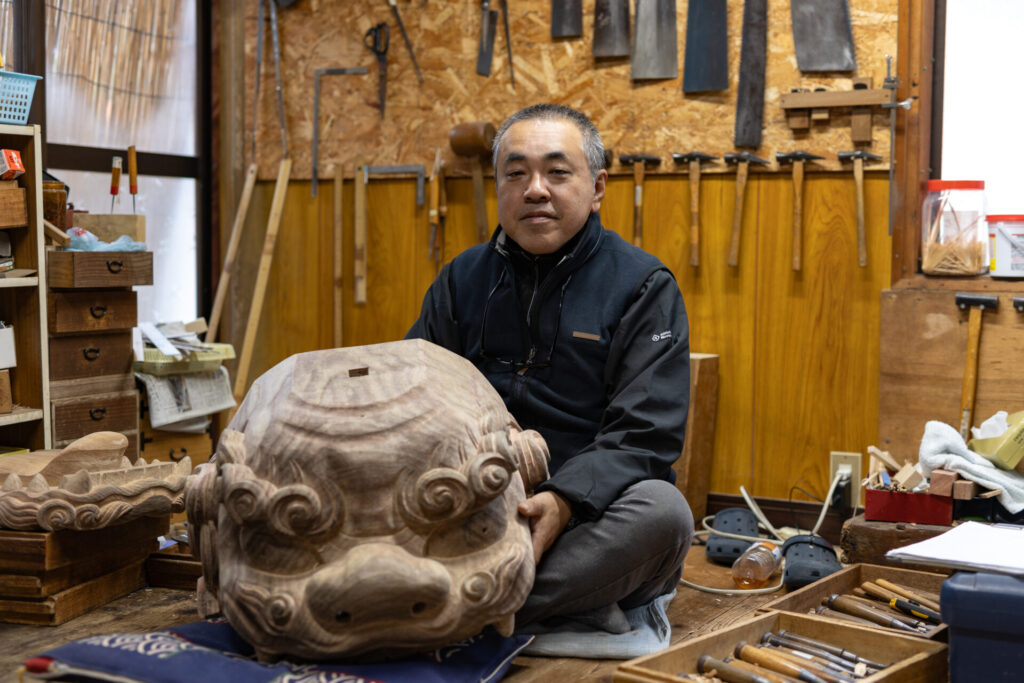
Completing a single lion head takes about a year. This is because the work is carried out through a form of division of labor involving multiple specialist artisans, with the process broken down into very fine steps.
“Once the carving is finished, the piece goes through lacquer coating and metal reinforcement—each handled by different artisans—before it’s completed,” Chida says. “It’s difficult to manage the schedule so we can deliver in time for local festivals.”
After carving, the wood is handed to lacquer artisans, then reinforced with metal parts. Because every stage requires time and high skill, smooth collaboration between artisans is essential.
Among all steps, one of the most difficult is creating the “stare” in the eyes.
“My father taught me that it has to be a face scary enough to make children cry—but that’s the hardest part,” Chida says. The eyes must convey protective power and dignity as a talisman against evil, demanding precise technique and rich expression. Achieving a convincing glare is key to giving the lion head its sense of life.
While faithfully reproducing traditional carving methods, Chida also incorporates newer techniques to ensure a lion head is light enough to move well—and strong enough to endure festival use for decades.
“A lighter head allows smoother movement, but it also has to be durable, or it won’t last for tens of years. I always think about how to balance both.”
He maintains tradition while using modern reinforcement materials and durable coatings to improve practicality. For example, he refines how he carves the paulownia to reduce weight and reinforces vulnerable areas with metal so the finished piece can withstand real performance conditions.
During production, the client checks progress regularly so they can share the vision of the final result.
“Hearing people say, ‘It looks just like the old lion head—but it’s lighter and stronger,’ that makes me happiest,” Chida says, describing what motivates him.
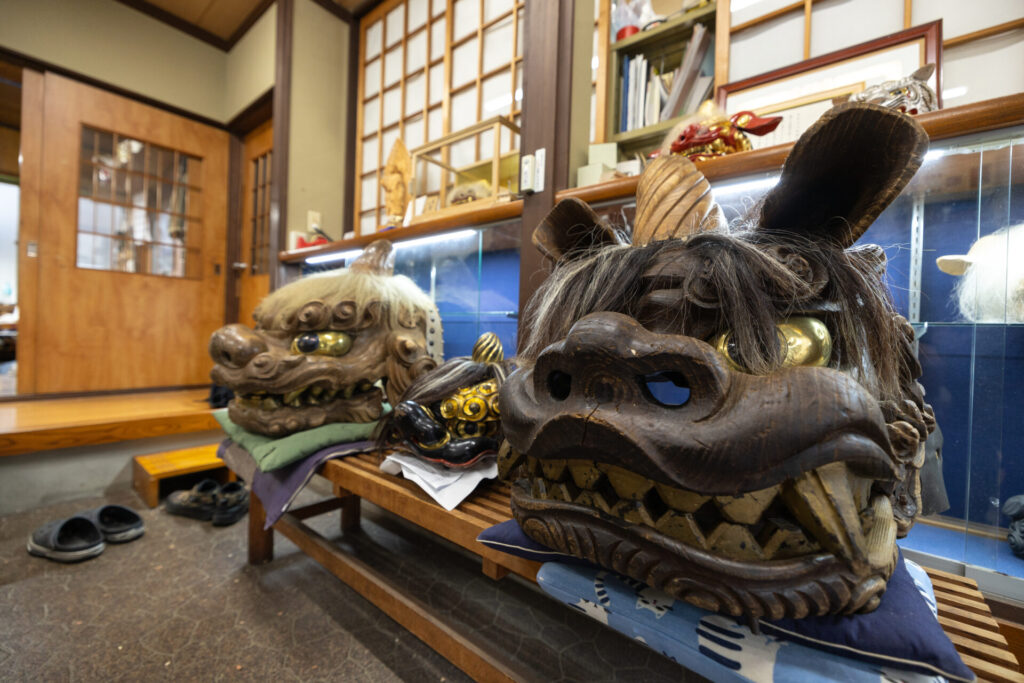
A lion head completed through such careful processes does more than adorn a festival. Even after many years, it remains an object of faith and affection within the community. Embedded in the making process is both a passion for protecting tradition and a sense of mission to connect it to the next generation.
Restoring Lion Heads That Have Been Passed Down for Generations
At Chida Kobo, work is not limited to creating new lion heads. They also restore older pieces—work that carries the responsibility of protecting history.
Many of the lion heads brought in for restoration are said to date back to the Edo period.
“This large lion head here is more than 200 years old, from the Edo period. We restore old ones, and we also take in lion heads from other regions. There aren’t many artisans who specialize in restoring lion heads,” Chida says.
Older lion heads embody local history itself, and after many decades, damage and missing parts are inevitable. Chida consults closely with clients and restores pieces to match their original appearance as closely as possible.
Restoration is not only cosmetic. It also requires adjustments to strength and balance. Because restored lion heads are often used again in festivals, work may include metal reinforcement, re-lacquering, and other measures to improve durability. If the client requests a lighter head, the artisan must also reduce weight while maintaining strength.
“Even lion heads made in the Edo period are still active—used in festivals today. That’s why durability and reinforcement are so important.”
Because designs and decorations vary by region, restoration also requires a deep understanding of local cultures and techniques. Some regions use special materials or methods that can be difficult to reproduce.
“Lion heads differ from place to place. If something like bird feathers is attached, it can be very hard to repair—and in some cases, we have to decline the request.”
Through restoration, Chida connects local faith and tradition—carried for generations—to the future. Seeing a restored lion head shine again at a festival is one of the great joys of his work.
Sharing the Appeal of Tradition with Children
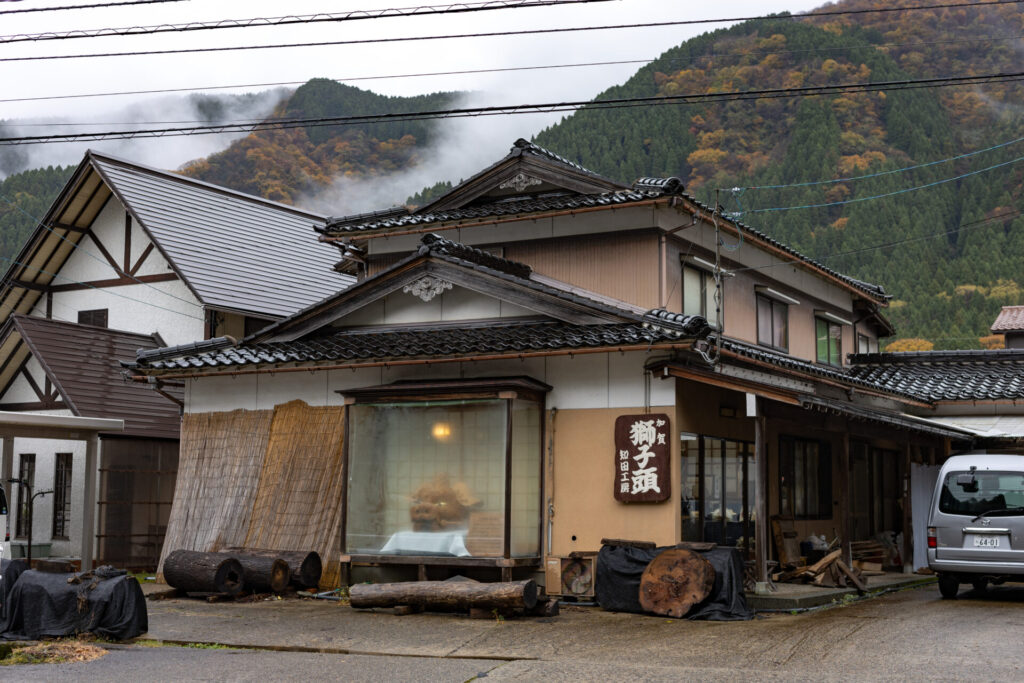
At local elementary schools, students sometimes research lion heads as part of their studies—and they may visit Chida Kobo as well.
“When children can actually hold a lion head and hear how it’s made, they become interested. It’s important that younger generations learn why tradition matters.”
At the workshop, visiting children can try lifting a lion head and closely observe the details, creating a direct encounter with traditional craftsmanship.
“I let them hold it and explain what role it plays. Seeing them surprised or fascinated when they look at a lion head up close for the first time—it makes me very happy,” Chida says with a smile.
“Elementary and middle school students come as part of learning activities. Each time, I tell them how important lion heads are to local festivals and traditions. Especially when middle school students come, I try to help them understand that this is a part of their own cultural heritage.”
Chida Kobo also focuses on nurturing the next generation of makers. In the workshop, Chida’s son and apprentices are already involved, and the craft is being passed down across generations.
“The fact that my son and my apprentices are continuing this work—nothing encourages me more than that.”
Together, they are also exploring more contemporary designs and developing new products. These efforts symbolize an attitude of evolving into the future while protecting tradition.
Through explanations to local children and hands-on encounters in the workshop, Chida continues to feel—day by day—the importance of connecting tradition to the next generation.
What Do You Wish to Pass On to the Future?
Chida values the tradition of lion heads being cherished as protective guardians of the community, while also believing that adding new value is what will carry the craft forward.
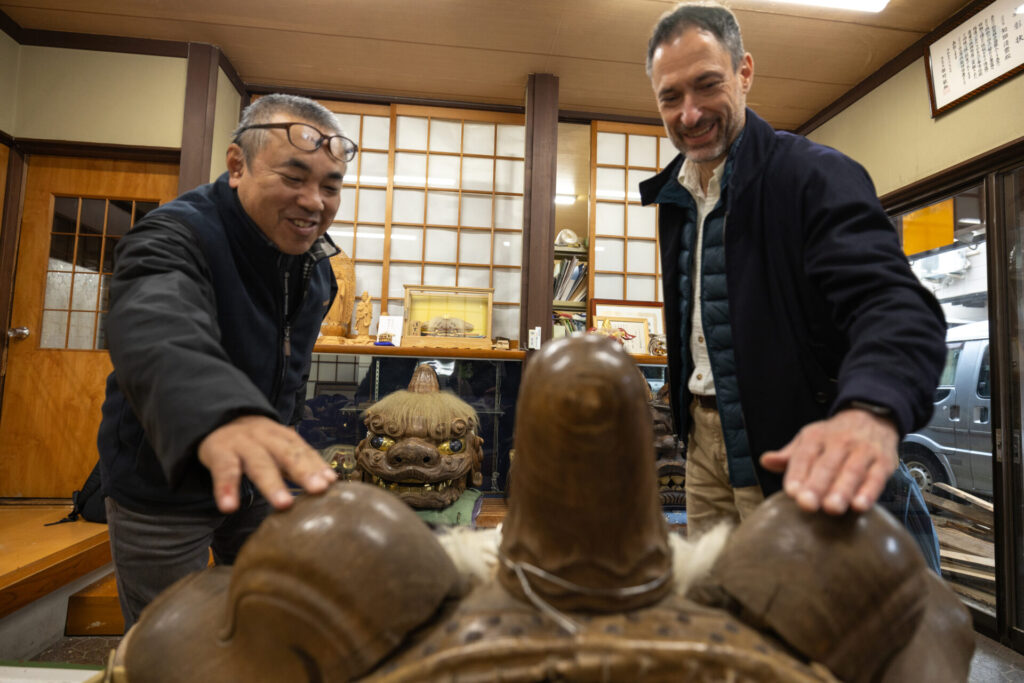
“Festival lion heads will inevitably break after years of use. And recently, there are even communities where the festivals themselves have disappeared. Still, I think it’s important to keep the tradition going without letting it end. That’s why I want to support local festivals while properly teaching skills and knowledge to my son and apprentices,” Chida says.
As some communities lose their festivals and traditions, continuing to support that culture as a lion head maker has become an important mission for him.
Passing the techniques of lion head making to the next generation is also essential.
“When I teach lion dancing to children, I feel even more strongly that we have to leave this 400-year tradition to the next generation. When I was young, I never thought about it. But as I get older, I’ve come to feel that passing this on to my son and apprentices is truly my work,” Chida reflects.To ensure that lion head making—which has gone hand in hand with local culture—is passed on to the next generation, it is vital to protect the techniques and spirit that have been handed down, and to carry on the tradition through steady, sincere effort. Chida’s commitment has become a firm foundation that carries local faith and pride into the future.